Sunday, May 29, 2005

SEPTEMBER 2007/INTERVIEW/KOOL KEITH & KUTMASTA KURT


You’ve been touring Europe this summer and will be in Greece on the 22nd of September, what have been the stand-out moments?

(Keith) They’ve all been good. My fans are basically the same all around the world, I’ve got a cult following of people that make me feel at home no matter where I’m at. I could be in Australia, France, New York or Jersey. It’s just the same Kool Keith fans.


You’ve been back in the studio recently making the new Ultramagnetics album, what was it like getting back into the studio with them after all this time?

(Keith) It was cool but they haven’t been in the studio for a long time so it was cool but hard, we made some pretty good records and we liked it but people wanted us to have made a Critical Beatdown part 2. We didn’t want to do that though, we’ve changed, we’ve matured, we’re not as abrasive, the times have changed our voices have changed. We had fun doing the album and people need to look at it like that.


What for you were the stand-out tracks from the album?

(Keith) Late Nite Rumble’s good, it’s not a singles album though, it’s just all types of songs and people could pick the ones that they like best. We didn’t have a hit in mind when we made it it’s all for people to choose for themselves.


You’ve created a lot of different personas within your music over the years from Black Elvis to Dr Octagon, what was the inspiration for that?

(Keith) It was for the time but I’m getting out of that stuff now and I’m going back to the raw self of rhyming on raw beats, it’s not conceptual. People get caught up in that, but I’m going back to my b-boy essence, and the Bronx culture, a lot of people didn’t get a chance to experience that but I’m going back to that so the focus is on my rhyming not my image. I don’t care so much how I’m dressing now I’m just about the craft. I’m not letting the visual take over, back in the day a group got popular from their sound before you’d ever seen them but now it’s the other way round. I’d rather be heard first.


Who else are you listening to in hip-hop at the moment? Do you like the stuff coming out on Stone’s Throw?

(Keith) That stuff is still around, and will always be around but everybody’s got to find their own niche. I’m not trying to be like any body, everybody gotta take their own line. I gotta have a significant difference. People have a hard time understanding that we can’t all sound the same. I have to have some boundaries. It’s like this is what the media say we’ve gotta listen to, and a lot of places don’t have their own program - it’s like the whole world is synchronised now and I miss the variety. All the DJs own the same records around the world but there are a billion records out there. Everybody doesn’t dress the same so why play the same records all day, or the same video. People need some distinctive programming.


What do you think of the technological innovations in music in the last years?

(Keith) People don’t buy records, they don’t even buy cds, they’ve got a little gadget in their pocket that holds 9000 records in it and it’s taken all the fun out of the industry. I like to buy cds because of the art work, I like reading about the artist. Downloads aren’t even cool – it’s not like you’ve got the album where the artwork looks good in your cd case, the folder of cheap cds written on with magic marker don’t look good, it’s not even cool, you’re not even a total person.


Do you think that’s why a lot of artists and labels are pushing the live thing these days?

(Keith) Well even that’s getting really bad now, people come to shows and record the show on their phones and digital cameras, these little gadgets are taking away from a lot of experiences because they are destroying the global experience of music; after a while people are going to feel like they’ve seen stuff live because they’ve seen it on their computer. It’s obvious why people in the business are having problems.
Down south stuff still sells because down there they buy records, they don’t have computers down there yet they’re in a different time zone, they’re not like these cheap people who’ve downloaded it.


Do you still buy records then?

(Keith) Yeah I buy records, I buy cds, I’ve got everything from the past to the future and the present. I’ve got old stuff, new stuff, r’n’b stuff like Keith Sweat, Jodeci… I’m not like one of these people who’re like ‘Yeah I’ve downloaded Megadeth’s album and it’s in my car’.


Do you like Reggae?

(Keith) Yeah I listen to a lot of reggae, I like Beanie Man, Yellowman, Big Youth I like a lot of Jamaican dancehall, so much stuff is coming out of there.
I like the dancehall chants, and I like the innovation with the beats, they do a lot of futuristic things with the beats there. Jamaicans were also the first rappers, NY might have created the B Boy rappers and hip hop but the people who made the blueprint were the Jamaicans, New York brought the style and the image mainly.


You still live in the Bronx, what’s it like there now?

(Keith) I love the urban living, the south Bronx has come a long way with housing, development, cultural reconstruction; it’s a small city but it has so much stuff, you can buy anything you want, all the styles are here, other cities have the clothing but people don’t know how to wear it. We’ve got the Yankees, the baseball cap all that’s the Bronx – a lot of other cities didn’t know how to wear their baseball cap, copping it to the side is NY originally, our culture.


Did you ever write graffiti (guest question from Quality Not Quantity Productions)?

(Keith) No, I didn’t write graffiti but I used to go to block parties and dance, I was a dancer. I knew all the guys who were dancing.


Did you ever see Bambaataa back in the day?

(Keith) Yeah, I saw him at jams outside in the projects, all over the projects you’d hear the speakers from block to block, people would play in the park, people didn’t even use Technics back then, just old turntables with orange lights on the side. The Jamaicans were the first to jam outside in the park – Kool Herc brought that style to New York.


Can you comment on the word style what does it mean to you (guest question from Quality Not Quantity Productions)?

(Keith) Style means something crass, nobody can ‘be’ style, the rapper image came from New York the jewelry, the chains, the Cangol, the Cazal glasses, the Puma, the Adidas, the swagger of New York city, the cap turned to the side, it’s all New York.


(MOVING OVER TO KURT)
What kind of Hip Hop are you into these days?

(Kurt): There’s people doing new things in a way – Kanye West has his own different style with that sped up soul and his stuff is pretty funky sometimes, I sometimes like Dre’s production, or whoever’s producing for him I think it’s probably someone else. The Neptunes had some pretty funky beats but most of the underground guys are pretty standard, I don’t think there’s anyone doing something better than what I’m doing, no one’s set a new standard. I don’t think anyone’s doing anything like Ced Gee, Bombsquad, Marley Marl, Mantronix and even the 45 King, there’s nobody that came along in the last 15 years that’s done anything at that level.


What about J Dilla and his legacy?

(Kurt) It’s really sad, people are just exploiting the guy’s death, it’s bad enough to exploit someone when they are alive but when they are dead?
(Keith interjects) Yeah play my records when I’m alive, enjoy all my stuff when I’m alive.
(Kurt) Exactly don’t just become a Dilla fan now he’s dead. There’s a sickness in some fans, particular ones that like less commercial stuff who want to keep things for themselves, who stop liking things when they get better known, it’s like a fetish.
I don’t like small minded people and I think the rap audience has a small mind; they only want to hear one thing. I bet you’ve got rappers in Greece and I bet they’re good but I bet you’ve got haters saying people shouldn’t rap in Greek.
(Keith) – It should be like a sport, it should be competitive, like in basketball the players all bump each other hard on the court and elbow each other in the nose but at the end they all pat each other on the back.
(Kurt) – People take it too seriously
(Keith): Conscious rap is like a mutual way of rapping, people say they’re going to buy it but (to me) it lessens the value of rap, people want to hear competitive rappers saying competitive lines, you can’t have twenty groups all talking about being good, ‘hey let’s all go to school, let’s all hold hands’, it’s cool to have that for people that work everyday with a suit and tie on who want to make rap friendly but rap was never friendly from day one. Kool Herc used to go against Furious 5, that’s the bottom line, people have tried to advance rap to another genre that doesn’t exist. They took out the raw element, the competitive part, Rap is like wrestling: people go to arenas to see the Undertaker fight George the Animal. Everybody can’t be a preacher. I know people who ask ‘Is that good rap, is that conscious rap? I wanna know ‘cause I wanna buy good, clean rap’, there’s no such thing. All these kids on the street have got emotions I like that they release their emotions skillfully, everybody still don’t have to rap about ‘I got 18 machine guns and I’m murdering your brother tomorrow’, because that becomes a joke, you’re like a killer in the vocal booth and we don’t need too much of that either, but there’s another part where you can answer someone back cleverly, and they answer you cleverly.
It’s competitive, it’s like tennis, you’ve got Serena Williams and Venus Williams and they play other girls. You can’t play tennis by yourself that would not be tennis.


Who have stood the test of time since no one has grabbed you recently?

(Kurt): I didn’t say I didn’t like anything; I just don’t like small minded people... I think the rap audience has a small mind, they only want to hear one thing, the guy who only wants to hear underground hip hop is the same as the guy who only wants to hear any other single genre. When you get to travel around you see we’re all human beings, someone might like this food, or that, or whatever but it doesn’t make you any better than the next person.
(Keith): I thought the world was set up differently but it’s the same in Boston, it’s the same in Denver, same in LA, same in Amsterdam, same in Germany everywhere has a place where a pop artist performs, everywhere has a place where the underground people hang out, everywhere has a place where the middle artists go and everywhere has a place where Barbara Streisand will play, it’s not like someone can come out and play in the same venue as U2, this synchronization around the world is monotonous. You’ve got the people who go to the 3000 seat stadium to see Michael Jackson... it’s all formatted.
(Kurt): Occasionally you get something else though; we went on tour with the Red Hot Chili Peppers and they’re nothing like us so I was wondering why they wanted us to come on their tour, and it turns out that they’d had the Sex Styles cd and been listening to it on their previous tour and it was their fantasy to get us on their tour even though their fans might not have heard our stuff.


What’s your opinion on D styles? (Guest question from Quality Not Quantity Productions)

(Kurt) – he does his thing. He comes from a crew that nobody paid attention to in the late 80s I mean people like Q-bert, they couldn’t even get a gig, I was at their show the first time in New York and people were like ‘who are these guys?’ but by the end of the show they realised they had heard talent. It takes a while for people to catch on sometimes. There were really no Asian DJs before those guys, now every Asian kid wants to be a DJ.


The shift in music related technology has been significant in the past few years – how has that changed the actual music, is the medium the message in the end, especially in hip hop?

(Kurt) In the early 80s there were only a couple people even able to make tracks because they didn’t have the funding to go into the studio, an SP1200 cost over 2000 dollars in 1985, I think Ced Gee was one of the first people to get an SP12, but now everyone can buy a program or get a cracked program, for just 300 bucks you can buy Reason and make beats so in the 80s everyone was starved to hear something fresh and new, I’m not saying that those guys weren’t the most talented, but they were able to get the equipment first and pioneer a new sound, now it’s so accessible to everyone it would be hard to pioneer a new sound and get it recognized, the market’s flooded in a way, things are almost too accessible.
(Keith) There are about 50, 000 producers now, I’ll be reading a magazine and I’m like I’ve never heard of this guy, I’ve never heard of this guy, turn the page… I’ve never heard of this guy. Maybe someone’s just done a couple of tracks and they’re already getting in a magazine, but people like Marly Marl made thousands of tracks.
(Kurt): The other difference I’ve noticed from the earlier times of production is that producers used to usually be DJs whereas now they’re not always DJs and don’t have that history of DJing, and you can hear when a track hasn’t been produced by a DJ, it’s not so scientific it’s just very detectable especially for rappers. Regarding technology, everybody has got Reason now, everybody has got whatever program that the Neptunes have, the Neptunes are using the same thing as Joey in his basement... but the difference is not just about background in music and knowledge and history in music, but about how creative you can get and how you push the limits of your equipment or your program.
A lot of people would say what do the Neptunes use, they use Reason so I’m going get Reason (I’m not saying they do use Reason necessarily!) because I wanna sound like the Neptune – but that doesn’t necessarily make you like the Neptunes .. ..just because you’re using a program that they use it doesn’t mean you’ll sound like them, you could be using Fruity Loops and be making shit way hotter than they make! In my opinion it’s not the program or equipment that you have its how you use it, how you freak it, how you take advantage of it; when people ask what I use I don’t even tell them because what difference does it make? I choose to advance with technology and try new things I’m not afraid of that. There’s people out there that have good ideas but don’t know what they’re talking about, there’s also a school of thought that says you have to sample from original pressings, but the truth is the first people who were sampling old school records were doing it from Ultimate Breaks and Beats.


Do you go digging? Looking for beats?

(Kurt) Yeah I do, I always laugh when I go to people’s cities and they take me to record stores full of American records – I was in France and the guy said he was gonna take me to the best store and we got there and it was full of records I’ve already got!
(Keith) For me there’s 2 ways, there’s sampling and there’s making original records, rap is separated into two different things, Roger Troutman was a part of Hip Hop, now people are just bumping heads with samples, (you find one) and another group already used it, unless you’re finding your record from Kenya.
(Kurt): back in the 90s Pete Rock, Q Tip, Premier etc, all those guys used to all buy records at the same store- the Roosevelt in NY, and the guys selling the records had all the records marked up with ‘this has a beat on it’, ‘so and so sampled this’ etc... and they were doing this in the early 90s and selling them for like 200 bucks because they knew their clients were going to come and sample it and make serious money off it. It’s taken the sport out of digging as it’s become an exploited thing and the guys in the record shops are the ones trying to tell you what’s hot, so digging is sort of a joke now.
(Keith) You have to go to Jupiter to find a sound that’s different, people go to China and as far as Japan and find records that aren’t even out and hear funk bands in China instead of here... it’s not like if you’re looking for the Ohio Players – I mean who doesn’t have the Ohio players? That’s just part of collecting records. I don’t collect records but I still know the Stax collection, I know Freddie Hubbard, CTI all the common stuff that everybody’s probably got, it had to change you’ve got to go down to Brazil and find a record that no one’s heard.
(Kurt) – Everyone’s already doing that though, people have already gone down there and got all those records and put out compilations with that stuff.
(Keith) – So in this situation then you’ve got to go back to making your own stuff, you don’t lose points for that but in the hip hop world people think you’re cheating if you don’t use enough samples these days but it’s just as qualified. I don’t think anyone said anything when Slave were making original records or when Juice brought out ‘Catch a Groove’.
(Kurt): I’ve often incorporated more live and original music into my production.
(Keith): Yeah.

Tuesday, May 24, 2005

JULY_AUGUST 2007/INTERVIEW/JOE BATAAN


You were born and raised in New York City’s legendary Spanish Harlem, also known as El Barrio; tell us about growing up in this tough environment and the sounds and images that shaped you as an artist and a person?

Well it was quite different to how things are today, back then we didn’t have so much television and mostly you just saw the kids and the grown ups listening to the radio, the radio was a big part of our life and we played that through the windows and out the fire escapes and the music would emanate through the streets when I was growing up as a kid. Most of the things that were exciting to us back then was the music we heard coming out of the apartments and the juke box that played across the street in the candy store; on hot summer days the music would be playing loud and we’d open up the water pump so we could cool off and we’d play in the streets.

What sort of music were you listening to when you were growing up, what were your parents listening to?

I started off listening to pop music, they used to have the top 40 on the radio every Saturday morning and of course we were listening to Nat King Cole, Peggy Lee, Tony Bennett, Johnny Ray and most of the movies that came out that had music, it was a different world because we didn’t have much black radio back then and not a lot of Latin radio. Of course later on came Alan Freed with Moon Doggy and he introduced rock and roll and that was our music as kids when we were growing up as it felt rebellious in contrast to the sounds we’d been exposed to ‘til then. Of course people had bad things to say about Rock’n’Roll, but they had bad things to say about the twist, they had bad things to say about the boogaloo... of course in the end rap music survived and that’s pretty much what we went through. After the Rock’n’Roll era there was some Latin played by Tito Puente, Randy Carlos and guys like that and eventually when it got to the 60s people like me and Peter Rodriguez were able to incorporate the R’n’B and Latin sounds together and that was the birth of the boogaloo and Latin soul.

It’s been well documented that you became a musician while serving time in prison. Tell us a bit about this experience, was it what motivated you to succeed in the music world?

Growing up as a kid I was no different to any other kid, I had my share of troubles, having too much time on my hands and I got into some trouble with a stolen vehicle and they sent me away. I decided right then when I was away that I was not going to waste my life, I was going to study and read everything I could get my hands on and so I started to learn music while I was in West Coxsackie Reformatory. After I was released I was determined that I was going to start something, so I came home and I talked with the guys that had been singing in the hallways and they said that they were organizing a Latin band, so I went to someone’s rehearsal but they didn’t want me there because I was supposedly the neighbourhood tough guy and the neighbourhood had changed while I was away so they didn’t want me involved, and that got me so angry that it motivated me to do something with my life, so I started my own band. As a result I had the youngest band in Latin music - some of them were like 12 years old! I was about 19 and made myself the leader and the rest was history. We were together for about 6 months and then we started making records – of course now we were the neighbourhood sweet hearts because the kids were so young so a lot of the younger generation could follow us and could identify with our music because no one else was really doing Latin with English lyrics, which went on to become so popular and still is today in fact.

It's been alleged that you were part of the Dragons gang in New York. If true, how dangerous was this world and do you feel that this experience was what gave your music its distinct "street" sensibility?

Yes I was a member of the Dragons for a time and that experience of being able to see life from the street level definitely influenced my street sensibility to my fans as well as to my self.

You released a number of records for the legendary Latin music label Fania – how did that come about?

We were starting to play around the neighbourhood and had started to get noticed and a lot of people wanted to put their hands on us and control us at that time, and the only thing I really had going for me was my aggressiveness, as I didn’t know about the business, about publishing, about royalties, I was just a novice. Anyway, we had a whole host of guys that wanted to sign us at that particular time, so what happened was I signed with all of them in an attempt to get the best deal because none of them were really giving us good contracts and didn’t have our interests at heart. The only way I thought I could protect myself was that Joe Bataan isn’t my real name, Bataan is actually my first name so I was signing everything as Joe Bataan, and then finally one guy caught me and pretty much threw me out the door and said to me “We’re going to teach you a lesson young man, you do things our way or you’re not going to do anything for anybody”. So there I was out on the streets, thinking I had nowhere to go and that I’d ruined things again, but nonetheless, Jerry Masucci was just starting Fania at the time and he said he would take a chance on me, and so we started to record and the rest is history. Fania went on to become one of the most legendary labels in Latin music and even bought up the catalogue of some of the smaller labels I’d had negotiations with that hadn’t got their musicians interests at heart. One record came after another for us and we started getting airplay on American stations, then the crossover effect started to take place and we built a new audience, not only the Latinos but the black community, the Jewish kids were big fans of Latin musicians and then the white audiences caught on and we had everybody. Now Latin music is one of the biggest influences in the world.

One of the ways that you managed to cross over was by singing in English. Did that cause you any problems at the time, did people consider it a risk?

It was new, but I came at the right time. I wasn’t even the singer originally, there was another guy by the name of Joe Pagan and when he started to realize that the boogaloo was getting popular in the dancehalls he wanted to try doing a song in English, but he had such heavy diction, so the guys at the label asked me to try and sing it instead, so I tried and I’ve been singing ever since. He never went on to sing his songs in English but I did, and I guess my technique was a little different to the standard boogaloo because a lot of my songs have lasted throughout the years. I’m a lyricist and a lot of my songs have stories, as opposed to ‘dance to the beat’, ’get up and shout’ kind of fillers, I had actual stories which has helped them last – this is now my 40th year in the music business.

Your biggest hit for Fania was ‘Gypsy Woman’ in 1968, which was a Latin interpretation of the Impressions hit from 1961, how did that come about?

Well, it was going to be another song and I was trying to teach the guy how to sing, so I picked up some of the words to Gypsy Woman and was showing him how they fit in to my melody – I was trying to show him how words can fit into any melody if you know how to control the pattern, so that’s how it came about. It went top 16 on New York Black Radio and was a big breakthrough for us as we started getting played on both the Black and the Latin stations.

Did you experience racism within Latin music circles due to your ethnic background?

Oh yes, you get that all over, even today but at that time it was more prevalent because I’m not really Latino. I grew up in Spanish Harlem but my father is Filipino and my mother is black but all my friends were Puerto Ricans, so growing up in a Puerto Rican neighbourhood I had to learn to speak Spanish, but I never really identified with anyone else, I was just myself, that’s how I described myself in one of my songs “Ordinary Guy’ – and I never thought it would make a difference but apparently it did down the road. What had happened was that as long as I was making Latin music the Latino community were endeared to me and loved my music, loved the slow songs, but when I ventured out into other types of music and started making some Latin jazz and some straight R’n’B the black community took hold of me as well and started to consider me one of theirs, and the competition in the streets became ‘what is he? Is he black or is he Puerto Rican?’ and that went on for years, even to this day. It doesn’t matter to me, I’m just a universal person but at that time it mattered to people, don’t ask me why. It also mattered when I went to Europe and they wanted me to change the album covers, putting certain people on the cover to appeal to the people buying records. They had a lot of things going on in the industry then, there was one radio station where they wouldn’t play my records because if you weren’t Latin you didn’t get played and then some of the stations decided they wouldn’t play artists that weren’t black and I got caught in the middle for many years. Maybe that’s why ‘Joe Bataan’ never evolved into an ‘Elton John’. Only now in my twilight years am I getting recognized in the way I thought I should have been recognized. I guess it’s a different generation and they really appreciate a lot of things I did in the past, to them it’s new even though some of that stuff goes back 30 years! I’ve actually discovered I have a lot of young fans these days and when I question them about how they know my music they tell me their mothers and grandparents passed it on to them.

The riot LP came out in 1968 and addressed important social issues; what is the story behind this album?

When The Riot was released it was awarded a Gold album. During this span The Riot actually out sold every Latin and Latin soul artist by a margin of 3 to 1. This album was musically documenting something like an outbreak of freedom for young Latinos and blacks in New York and the surrounding tri-state area. Of course what was exceptional was that this album was performed by the youngest group of musicians during that time. All the members were young teenagers the youngest being just 12 as I mentioned before.


What was your involvement with Ghetto Records?

With Ghetto Records I was basically the originator and the founder of the label. The same was true of Salsoul Records and then the disco explosion happened.

Speaking of Salsoul you are one of the people credited with coining the term as well as being part of the foundation of the label – how did you envisage the label working at the time?

Actually when I left Fania Records, (after negotiating for a long time I wasn’t really happy anymore) I was looking for a new label and I didn’t really know where to go. So there was this little label dealing with Chicano-Mexican music called Mericana Records, so I went up there and sold the idea of me recording for them to a Joe Cayre and he gave me a very small amount of money to record and I went out a made an album, got it done way under budget and then got it played on the radio. He was amazed that we sold 15,000 records in a week and of course he was excited, so we talked about a deal and then he said we could start a label together, so I agreed to name the label. The name I picked was Salsoul which just joins the words Salsa and Soul so it’s no different from Latin Soul or Boogaloo Latin but I called it Salsoul and it immediately caught on. I had the hit ‘The Bottle’ and then ‘Rap-O-Clap-O’ and things just went on from there. Of course I didn’t really get a fair deal because eventually I sold my rights to the Cayre brothers thinking I could just do it again. I remember having the dream that Salsoul would become a household name years later, but you know, I don’t have regrets, I started the label and I’m proud of that and I was one of the innovators of Latin music within the disco scene so overall I’m happy.

So you mentioned your big hit with Gil Scott Heron’s ‘The Bottle’, how did that come about?

Well he was having a big hit in New York with that record and I was always one of those people who could tell when a record was going to be big and that there was a possibility you could cover it and also have a success off the record - actually Gil Scott and his partner were really happy that I covered it as they had run out of money and couldn’t produce the record or manufacture it anymore - so I decided to do the instrumental and I got a guy to play the saxophone who’s now famous called Dave Sanborn and the rest is history, I think we sold 80,000 records in a week when it came out it, it went Top 100 in Billboard magazine which was huge for that time and we were at the threshold of disco music.

And of course you also mention Rap-O-Clap O – that’s considered quite a ground breaking track, can you tell us about your inspiration for that?

Yeah that was a real strange story, there were some kids at the community centre in the neighbourhood that I used to run, and I just couldn’t understand why the place was packed every night and what these kids were all doing just stomping their feet while a couple of youngsters at the decks were just spinning records. So one day I asked these kids to record, their names were Jekyll and Hyde back then and of course they went on to be producers for Motown, but in the end they didn’t show up to the studio, I’d arranged everything but I guess they didn’t think I knew what I was doing, so I was stuck there with the bill and everything so decided to do the song myself. I went to Salsoul with it when it was done and they told me that they wanted me to go to Holland, they said the record was a hit and I couldn’t understand how they could know a record was a hit when it hasn’t been played yet, and they told me ‘they know these things’! At that time Holland was the focal point of Europe for music, so I went there and I didn’t get back to the states for 6 months, that’s how big that record was for me, one of the biggest of my life.

Your name appears on the production credits of the Lasso LP from 1977, what other work had you been involved in as a producer?

I produced many records for all the labels that I worked with - Ghetto, Fania, Salsoul; I produced for LaSo, New Jersey Turnpike, David Sanborn (from The Bottle), Paul Ortiz’s ‘Tender Love’, a track I did with Jocelyn Brown called ‘Sadie’.. the list goes on!

More recently Italy’s Irma records released a house version of "Ordinary Guy" in 2003 - Were you personally involved in that?

Yeah I was - Irma Records flew me out to Italy to sing my song on their recorded track – there’s also going to be a vocal and a rap version soon coming out on a label in LA.

In 2005 you made a new album on Vampisoul Records entitled ‘Call My Name’ tell us how that came about?

That did really well - you know I never in my whole life got interviewed as much as I did when that record came out; it was like the resurgence of my life. I met this young kid called Danny Collas, he was about 24 years old and he came to see me play, and he had a suggestion. He said “do you want to record something with me in my basement?” and I said “yeah sure, why not?”, so I went down to his basement and we did these songs – cause you never know – Europe is a funny market, it’s not like America, there’s a lot of songs that come out there that might not do anything in the states, so I just figured you might get blessed or lucky or whatever, so I did these songs with him but he didn’t have anywhere to take the music, and I happened to notice that there was this little label in Spain that was re-releasing old Fania stuff, so I told him to call, but I had no idea he’d made a deal with them and they were releasing the record. The reviews were fantastic all over the world.

When we first heard the lead track from that release we actually thought it was an old Joe Bataan track that we just hadn’t come across before.

Yeah you have to give Danny credit, he wrote and produced these songs but he tailored them for me and my style, so he must have been one of those fans that had studied me for years, and he knew that these songs would suit me. He sought me out, he could have got anybody to sing but he wanted me and the results were like magic, because people all over the world had that same impression you had.

That track has always been a big dance floor hit for us whenever we play it.

That’s really good to hear! You know back in the day apparently I had a bit of a hit in Greece but I think your government rules made it really hard to get any money out of the country, but I saw some sales figures at least and they were good, so I always wanted to get out to Greece.

Monday, May 23, 2005

News


13/10/08

In conjunction with Black History Month 2008

Unlimited Free Image and File Hosting at MediaFire


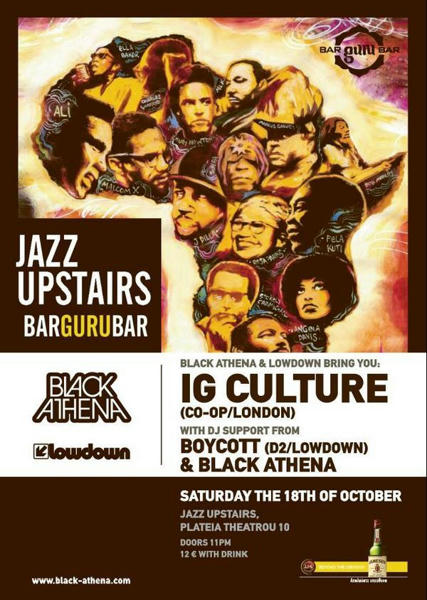
The producer's producer who has released for everyone from Big Dada, 4th & Broadway, 2000 Black, Talkin' Loud and Goya and whose 2008 Japan only album 'Zen Badizm' has had music freaks from all walks of life going crazy for its geniusly conceived deep-afro-broken-funk; IG (also recording as New Sector Movements amongst myriad monikers) is not only West London's foremost broken beat pioneer but a cross-discipline multi-genre experimentalist dedicating his whole life to bass heavy productions and whose formation and participation in London's now legendary Co-Op club has made him one of the most sought after DJs around. It will be his first time out in Greece and he'll be delivering an across the board set of all the most essential broken, hip-hop, afro, dub, soul and more. The event takes place at Jazz Upstairs (Guru) and support on the night comes from Black Athena and Boycott (d2/Lowdown).



Listen to Black Athena live every Saturday & Sunday, 1-3pm on Athens International Radio 104.4FM or via: www.air1044fm.gr & www.athina984fm.gr.

12/09/08

Once again it’s been a couple of months since we’ve updated you with our comings and goings so we've got a lot to pack in to our irregular bulletin but first we must kick off by giving some love back to all of you who’ve supported us over the summer! From those of you who came to the festivals, to the random summer parties, who got in touch during the show and who made guest appearances for us – thank you one and all!

And of course thank you to everyone who showed their face at the opening bash of the season for the Outro ladies down at Yoga Bala on Friday – it was an excellent start to the ‘winter’ period for us so we hoped you all enjoyed the music and the party as much as we did.

We’ve also got some upcoming dates for your diary – 3 events for now (and something secret and special coming up in November!), each on a very different tip starting with next Wednesday’s inaugural ’100 bpm @ K44’ in which we’re taking things down an alternative pathway for a midweeker typified by off kilter Wonky sounds alongside crunked up synthy hype, leftfield (with a small ’L’) noises and steppy clutter the whole night long - think Bristol, think Glasgow, think "Los Angeles" and you’re thinking on the right lines... Free to get in as ever and a 10 O’clock-ish start; following that on Friday the 3rd of October we're extremely excited to be co-hosting PPP (AKA Platinum Pied Pipers), playing live for the first time in Athens on a night that also features handpicked DJs from the soul-jazz-hip hop cognoscenti of Athens across two floors for a party set to go on all night long, with the band playing live upstairs at the night’s climax. That takes place at Soul Stereo, is free to get in and kicks off at around 11.

Finally on the 18th of October, something we’ve been trying to arrange for a long time – the Godlike IG Culture will be gracing these shores for an appearance at the lovely Jazz Upstairs, hosted by us and the Lowdown boys and with DJ support from the two collectives (Black Athena on a mellow warm up tip and Boycott bringing the house sounds after the guest). We’re very excited to be doing this particular event at the fabulous Jazz Upstairs and on their heavy sound system so want to give you all a bit of a long range heads up on this so you can be ready from now – anyone who’s seen IG do his thing at the legendary Co-Op over the years will know this is not to be missed.

As always you can catch Black Athena's twice-weekly radio broadcasts on Athens International Radio 104.4 FM, every Saturday and Sunday afternoon 1pm-3pm (Greek time: GMT +2); the show can also be heard worldwide by going to www.athina984fm.gr or www.air1044fm.gr then clicking on the streaming logo in the top right hand corner of the page. The show is not currently archived (coming soon though!) so for now be sure to catch it live.

Regular listeners know the show is dedicated to the best underground music around, be it brand new beats or rare grooves dug from the crates and also functions as a stage to hear what's being produced on the Athens' underground. On that note we are producing a particular segment of the show called Platform in which we want to showcase the music being made and played around Athens or further a field and are keen to hear your mixes and demos. As ever anyone who'd like to be considered for Platform can email us to find out more: (black-athena@hotmail.com).

Recent Platform features have included some excellent guest mixes from the likes of AFTA-1, Thomey Bors, Fabrice Lig, J Melik and Boycott (d2/Lowdown) - a mixture of international guests and local heroes who’ve all bought their own unique flavours to the show.

Black Athena also broadcast monthly from Italy's Radio Pellenera and Singapore's Dance & Soul. The newest installment of Black Athena's show, Black Athena FM, will be available on demand in the next few days at both (www.danceandsoul.com) & (www.radiopellenera.com) and will feature beautiful music from Nas, Black Spade, Finale and Yaw amongst others and also includes part of an interview we conducted with rising star Afta-1.

06/05/08

It's a little earlier this year than usual due to the dates for Synch, but either way it's that time once again for a birthday party – Black Athena's to be precise – we are 3 this summer and to celebrate are bringing one of the hottest up and coming producers that the UK has spat out in the last year – Manchester based Trus'me (Prime Numbers) who with his debut 12” for the cooler than thou Stilove4music label out of Chicago, garnered the rapturous praise of house heavy weights from across the pond including the godlike Kenny Dixon Jnr. as well as Europe's own pantheon of underground music aficionados (Jazzanova, Mad Mats, Ashley Beedle, Gilles Peterson etc…).


As you can guess we are super-excited about this so hope as many of you as possible can come out in support on the night, as well as to hear the fine sounds of Manchester's most precocious production talent, and Europe's own answer to the Detroit massive.


We'll be there in musical support too so expect a night end to end with deep and heavy black musical flavours – future soul, hip hop, disco, Detroit... it’ll all be there. The party takes place on Saturday the 17th of May at Yoga Bala in Psirri and as ever is hosted by Outro.


There will also be some special little extras on the night but more news of that to come...


Extra info at: www.thecityvibe.com and in Greek at www.avopolis.gr/live/dates_events.asp


...and a big thank you to the Greece is for Lovers crew for the beautiful flyer!


www.myspace.com/trusme

www.black-athena.com

www.myspace.com/outro_


Saturday the 17th of April
Yoga Bala, 5-7 Riga Palamidou, Psirri, Athens
Doors: 11pm Entrance: FREE

01/04/08

Black Athena Present Benji B & Thomey Bors

The collective who've been bringing the vibes at parties around the capital for the last years are very proud to announce a special evening taking place at One Happy Cloud dedicated to the best in underground black music with two very special guests at the controls: BBC1Xtra's Benji B, and up and coming Greek producer Thomey Bors who together will be taking the crowd on a journey through hip hop, future soul, broken beats, nu jazz, deep house and Detroit techno. You cannot miss this.

DJs:
Benji B (BBC 1Xtra / Deviation, UK)
For those who attended last year's road blocked event at Black Athena's birthday bash where Benji B made his debut on Greek shores you'll know what this man is all about: future music woven together seamlessly with a head nodding beat and an ever present ear for melody. Benji's name is synonymous in music circles as a tastemaker, a DJs DJ, one of the best radio producer's in the UK and most recently a promoter of one of London's best club nights, his own monthly Deviation session which has featured guests as diverse as Flying Lotus, Eric Lau, Dego (4 Hero), Waajeed (PPP) and more. Benji has also shared bills with Theo Parrish, Steve Spacek, Skream and Madlib, and is currently winging his way round the Miami Music Conference with guest appearances lined up alongside Kevin Saunderson, Ron Trent, Benga, DJ Spinna and Daz I Kue to name just a few, before making a stop here in Athens. He has also travelled the world guesting at the biggest music events you care to name, from the Big Chill and Southport in the UK, to Barcelona’s Sonar festival, and to all of the world's biggest musical capitals, be it to hang with the Rush Hour crew in Amsterdam, to hold it down with the Stones Throw massive in California or to go deep with Tokyo's Jazzy Sport heads.

http://www.bbc.co.uk/1xtra/benjib/
http://www.myspace.com/djbenjib

Thomey Bors:
A true home grown talent, Thomey Bors is a superlatively gifted producer of Greece's very own; having honed his DJing skills experimenting with sounds as diverse as drum'n'bass, Detroit techno, experimental electronica, hip hop, soul and more he turned his talents to producing his own beats and the results have had heads turning and ears pricking up in Greece's underground scene. Having received a full playback of his debut EP on Black Athena's FM radio show, and contributing a highly praised set at the STFU festival Thomey now opens proceedings for one of the mentors of his art.

http://www.myspace.com/thomeybors


Saturday the 5th of April
One Happy Cloud, 12 Aristofanous St, Psirri, Athens
Doors: 11pm
Entrance: 5 Euros

Contact:
Black Athena
E: black-athena@hotmail.com
W: www.black-athena.com

24/03/08

We want to announce a very special event that we're hosting this coming Friday night at Soul Stereo in Psirri; the night is called the True Soul Sessions and we'll be giving you soul from the past, the present and the future, from the sweet soul music of Marvin & Barry to the sample steeped soul of Dilla and Madlib, the psyched out stylings of Spacek or Badu, the refried soul that Moodymann and Theo do so well and the best of the rest of this deep and classic axis.

Check out the beautiful eflyer designed exclusively for us by Greece Is For Lovers at:
http://www.greeceisforlovers.blogspot.com/


Music is Everything... and there’s no music without Soul.


Black Athena presents the True Soul Sessions:

Friday the 28th of March

Soul Stereo, Evripidou 65, Psirri, Athens

Doors: 11.30pm

Free Entrance

19/02/08

March the 1st sees a very special happening taking place as part of the monthly Black Athena night as US DJ, re-mixer and re-editor Prince Language will be joining us on the decks. As ever Black Athena will provide blissful beats and melodies from across the board including Future Soul, Hip-Hop, Deep Funk, Disco, Reggae, Detroit Techno & Jazz, while Prince Language will be bringing his eclectic take on anything and everything as showcased in his highly respected No Comprendo mixes (check out www.thenocomprendo.com for more info).

Be sure to arrive early as it's set to be a roadblock!


Yoga Bala, 5-7 Riga Palamidou, Psirri, Athens .

Doors 11pm; Free Entrance

10/02/08

J Dilla Tribute on AIR FM 104,4
--------------------------------

1st Hour

(Slum Village Dilla Memorial)
01. Carlos Nino & Miguel Atwood Ferguson (2008)
02. J Dilla ft Dwele – Dime Piece (The Shining, 2006)
03. Slum Village – Look Of Love (Remix) (Fantastic, ‘96/2005)
04. Steve Spacek – the Dollar (Space Shift, 2005)
05. J Dilla – The $ (Money) (Ruff Draft, 2003)
06. J Dilla – Nothing Like This (Ruff Draft, 2003)
07. Bullion – Caroline No (download, 2007)
08. Slum Village – Fantastic (reprise) (Fantastic Volume 2, 2000)
09. Bullion – I Know There Is An Answer (download, 2007)

10. Minnie Ripperton – Inside My Love (For ‘Look of Love’)
11. Dionne Warwick – You’re Gonna Need Me (For ‘Stop)
12. J Dilla - Stop (Donuts, 2006)
13. Platinum Pied Pipers – Shotgun (Triple P, 2005)
14. J Davey – Red Light (Jay Love Japan)
15. Phat Kat – Nasty (Carte Blanche, 2007)
16. Frank & Dank – One Time For The (EP, 2007)
17. Dabrye ft Dilla & Phat Kat – Game Over (Two/Three, 2004)
18. Busta Rhymes & DJ Spinna – Dillagence (2007)
19. Jaylib – LA To Detroit (Champion Sound, 2003)
20. The Impressions – We Must Be In Love (For ‘Love’)

2nd Hour

(Ruff Draft Tribute documentary)
21. J Dilla – Walkin On It (Donuts, 2006)
22. Slum Village – Raise It Up (Fantastic Volume 2, 2000)
23. Jaylib – The Red (Champion Sound, 2003)
24. J Dilla – Crushin’ (Ruff Draft, 2003)
25. J Dilla ft Pharaoh Monch – Love (The Shining, 2006)
26. Madlib – Take It Back (Chrome Children, 2006)
27. J Dilla – Light Works (Donuts, 2006)

28. DJ Cam ft J Dilla & Cameo – Love Junkee (Love Junkee EP, 2002)
29. Common – Thelonius (Like Water For Chocolate, 2000)
30. Black Milk – Look At Us Now (Popular Demand, 2007)
31. Phat Kat – Don’t Nobody Care About Us (Dedication to the Suckers EP, 1999)
32. Jay Dee - Ritmo Suave Bossa Nova (White Label, 2003)
33. J Dilla - So Far To Go (The Shining, 2006)

James 'Dilla' Yancey, 1974-2006, R.I.P.

22/01/08

Black Athena start the New Year in the way they mean to go on by kicking off 2008’s party proceedings this Saturday (January the 26th), representing the length and breadth of black music. Expect Future Soul, Hip-Hop, Deep Funk, Disco, Reggae, Detroit Techno & a little bit of Jazz.

Saturday the 26th of January

Yoga Bala, 5-7 Riga Palamidou St, Psirri, Athens

Doors: 11pm Free Entrance

28/11/07

First up we need to tell you about our monthly party taking place in our usual venue, Yoga Bala in Psirri, this Saturday night (December the 1st) hosted as always by Outro. As ever expect a blend of blissful beats and melodies from across the board including Future Soul, Hip-Hop, Deep Funk, Disco, Reggae, Detroit Techno & Jazz.

Be sure to arrive early as it's set to be a roadblock and Black Athena will be packing in the musical treats from beginning to end.

Yoga Bala, 5-7 Riga Palamidou, Psirri, Athens.

Doors 11pm; Free Entrance

It's not going to be the last Black Athena event of 2007, however, so keep your ears to the ground for news of something special coming up before the year closes…

09/10/07

Black Athena Weekender: Fri 26th & Sat 27th Oct. 2007

The regular Black Athena party will take place on Friday the 26th of October at Yoga Bala in Psirri and as always is not to be missed! Expect the usual mix of: Future Soul, Hip-Hop, Deep Funk, Disco, Reggae, Detroit Techno & Jazz.
Listing At Destination Out

Then on Saturday the 27th of October Black Athena present the highly anticipated double act of re-edits master Lee Douglas (Rong Music, NYC) & Andrew Lovefingers (Black Disco, L.A.) who will be winging their way to Athens to grace the decks of the newly revamped One Happy Cloud in Psirri. Expect soulful and psychedelic sounds spanning the entirety of disco, Balearic, funk, cosmic, re-edits, bootlegs and more.
Entrance is free and the warm up comes courtesy of DJ Alexees (Boogie Dub Social Club/Urban Disco).

25/09/07

Saturday the 8th of September saw Black Athena playing the opening weekend of the new season with a deep and soulful session at Yoga Bala in Psiri, hosted as ever by Outro. The night was huge fun as always and the resident DJs showcased all the gems they'd picked up over the summer to an appreciative crowd.

The next Black Athena party will take place on Friday the 26th of October at Yoga Bala in Psiri and as always is not to be missed! The October date also coincides with Breast Cancer Awareness Day so Black Athena will be turning Pink for the occasion in an effort to raise money for the worthy cause.

Yoga Bala, 5-7 Riga Palamidou St , Psiri, Athens .

Doors: 11pm

Free Entrance

The 22nd of September saw the long awaited live appearance in Athens by legendary rapper Kool Keith alongside his longtime collaborator and producer KutMasta Kurt and the renowned MC Motion Man. The event was a roadblock and everyone who made it down on the night seemed more than happy with the show that greeted them; highlights included the back to back versions of Blue Flowers, and Kurt's incredible skills on the decks.

The Athens International Film Festival has also opened its doors for another year and promises to keep audiences at the cutting edge of contemporary cinema. Black Athena were lucky enough to attend the Mel Cheren tribute documentary 'The Godfather of Disco' last Friday and can't recommend it highly enough. Coming up this week a documentary about Arthur Lee, the Blaxploitation classic Coffy and Michael Moore's new documentary 'Sicko' all promise to enthrall audiences.

10/08/07

Saturday the 30th of June was an extremely special night for Black Athena: Benji B (BBC 1 Xtra/Deviation) graced the decks of Yoga Bala to help us celebrate Black Athena’s second birthday. Benji was totally on the ball as always and totally rocked the place from start to finish! We would like to thank all of you who came down on the night and everyone for your support these two years; we promise to continue working hard to bring you all the best in aural pleasure! Keep On.

The highlight of July came in the form of the Synch festival; the annual event, which has in the past hosted astonishing artists such as Theo Parrish and Underground Resistance. This year’s line up was equally mouthwatering and included Mark Ernestus and Tiki Man from Rhythm & Sound, Beppe Loda, Chateau Flight, Moxie, and Bill Laswell’s Methods of Defiance. Keep your eyes peeled for the fruits of some of Black Athena’s conversations with the leading lights of the weekend.

19/06/07

Saturday the 30th of June sees one of Black Athena’s most anticipated events of the year in the form of our second birthday party, which coincides with Outro’s closing party in an event that is set to outshine all others with the inclusion of a very special guest from the UK - Benji B (BBC 1 Xtra/Deviation).

Yoga Bala
5-7 Riga Palamidou St.
Psiri
Athens
Doors: 11pm
Free Entrance

A few days before on the 27th of June Peanut Butter Wolf will be making a unique one off appearance in An Club accompanied by Baron Zen. This week on Thursday the 21st of June and as part of the European Music Day 2007, Nostalgia 77 will be appearing live in Technopolis in Gazi, Athens.

17/05/07

The first weekend in May went off with a bang when Mr. Daniel Wang graced Athens with his presence to take to the decks at Yoga Bala in Psiri. Daniel brought the party to Greece and provided us with one of the most blissful sets heard in this little corner of Europe, keeping a lively crowd on their toes until daybreak.

Friday the 20th of April also saw an exclusive visit by Detroit legend Eddie "Flashin" Fowlkes who played a super-deep mix of Detroit gems past, present and future to the El Barrio punters before popping in to the Black Athena session the following night.

The next Black Athena party will take place on Saturday the 26th of May at Yoga Bala in Psiri and as always is not to be missed! The May date will see resident DJs on a classic tip before the exclusive June Birthday party, which Black Athena can now confirm will take place on Saturday June the 30th and feature very special guest Benji B (BBC 1Xtra) playing exclusively for the first time in Greece.

Yoga Bala
5-7 Riga Palamidou St.
Psiri
Athens
Doors: 11pm
Free Entrance

06/05/07

Saturday May the 5th also saw Black Athena’s introduction onto the Greek airwaves. You can catch the brand new radio show hosted by Athens International Radio 104.4 FM and produced by Black Athena every Saturday afternoon 1pm-3pm. The show is dedicated to the best underground music around, be it brand new beats or rare grooves dug from the crates and will also function as a platform to hear what’s being produced on the Athens’ underground with a particular focus on giving a voice to the non-Greek community.

20/04/07

Black Athena will be representing once again at Yoga Bala in Psiri on Saturday night (April 21st). Those that can make it down should expect sounds and rhythms from the spectrum of black music - now and then. On the night the DJs play from 11 and of course there's no tariff on the door. Look forward to seeing you there.

13/03/07

We would like to thank everyone that came down and showed support at our last Black Athena night at Yoga Bala. It was really exciting to see all of you down there having a good time! If you're still left wondering about some of the tracks aired on the night, check this month's Black Athena FM for some insight. The next Black Athena night at Yoga Bala is on Saturday the 31st of March and as always, it's going to be a roadblock!

Yoga Bala
5-7 Riga Palamidou St.
Psiri
Athens
Doors: 11pm
Free Entrance

The beginning of March has been an interesting time in Athens as Friday the 9th and Saturday the 10th saw two amazing guest DJs in town. On Friday night Barrio played host to Slam Mode's Michael Cole who thrilled the crowds with a deep and atmospheric set, while on Saturday one of the most instrumental personas in Broken Beat, Dominic Stanton, AKA Domu made a special guest appearance at Yoga Bala, playing music from every conceivable genre of modern and classic dance music.


In other news as well as our regular monthly shows at Dance & Soul, Black Athena are now also broadcasting from Italy's Radio Pellenera. The March installment of Black Athena's show, Black Athena FM, is now online at both (www.danceandsoul.com) & (www.radiopellenera.com) and features the blissful sounds of: Smokey Robinson - 'Quiet Storm', Temptations - '1990', Peven Everett - 'All My Life', Doris Norton - 'Norton Apple Software' and many more.

22/02/07

Following Black Athena's exhilarating January session at Yoga Bala, highlight's of which included the Salsoul Orchestra's 'You're Just The Right Size' and Lesette Wilson's 'Caveman Boogie', the next Black Athena night at Yoga Bala will be held on Saturday the 24th of February with residents playing soulful underground sounds all night long.

Yoga Bala
5-7 Riga Palamidou St.
Psiri
Athens
Doors: 11pm
Free Entrance

01/02/07

El Barrio, the newest addition to the underground Athens music scene, has another excellent Sunday session booked for this week, supported once again by Black Athena. The night has been newly named 'Workshop - The Collective Sound of Athens' and this week features scene stalwarts Dr.Vodkatini live, as well as DJ sets by Bomba/Energia.

El Barrio
53 Keramikou St.
Metaxourgeio
Athens
Doors: 8pm
Live Band: 10pm

03/02/07

El Barrio is Athens' newest underground music venue and although only recently opened the club has already hosted one of the hottest producers and DJs of the moment, Karizma, and is now embarking on a regular Sunday session whose debut this Sunday will feature two of Black Athena's own collective of DJs, Tassos Apokremiotis and Petros AKA Just Landed Cosmic Kid, who play together on the night as Deep Jazz Experience. Jazznovation will also be playing live and will be on stage at 10pm.

El Barrio
53 Keramikou St.
Metaxourgeio
Athens
Doors: 8pm

15/01/07

Saturday the 27th of January will see the Black Athena collective taking charge of the decks at the ground floor bar of Yoga Bala in Psirri once again. Expect soul, disco, reggae, hip-hop, jazz and beats.

www.black-athena.com

Yoga Bala
5-7 Riga Palamidou St.
Psiri
Athens
Doors: 11pm
Free Entrance

30/12/06

Black Athena celebrated the festive period by delivering a crowd-pleasing session at Yoga Bala, as ever hosted by Outro. Black Athena residents played all night long, into the small hours of Christmas Day. It was good to see you all down there and we certainly hope you enjoyed it as much as we did. Highlights of the night included: Arthur Verocai - 'No Boca Do Sol', Jaylib - 'The Red', Capricorn - 'I Need Love', a classic flashback in the form of FSOL – 'Papua New Guinea' and many more.

16/12/06

Christmas Eve will see Black Athena delivering a festive Yoga Bala session in collaboration with Outro with Black Athena residents playing all night long, into the small hours of Christmas Day. Black Athena hope you'll come and kick off a merry Christmas with us from 11 onwards.

10/11/06

October has been a busy month for the Black Athena collective, the 22nd saw us taking charge of the controls at the newly opened Lab 22 in Exarchia, while on the 28th we returned to Yoga Bala for another packed out Saturday night session, which was a stormer! On Sunday the 29th we were back at Lab 22 for a 'Day After' Session and because Sunday just wasn’t enough we did a session the following Thursday to round it all up!

The next Black Athena dates for your calendar are:

Thursday 16th of November, Black Athena Sound System Live @ Lab 22, plus Black Athena DJs

Lab 22
Zoodochou Pigis & Academias Str. (Kiafas Str.)
Exarchia
Athens
Doors: 10pm

Friday 24th Of November, a Yoga Bala session in Collaboration with Outro, Black Athena residents all night long, we advise getting there early!

Yoga Bala
5-7 Riga Palamidou Str.
Psiri
Athens
Doors: 11pm
Free Entrance

Black Athena will also be playing at the PLATFORMA VIDEO film festival in early December. PLATFORMA is an international film festival held annually in Athens, aimed at promoting contemporary cinema and films created using video and new media.

Now in its sixth year PLATFORMA VIDEO will be held from the 2nd to the 7th of December, 2006 at the Nixon Bar Cinema and Bios in Gazi.
More info on Black Athena’s participation will follow.

05/09/06
Thursday the 7th of September will see the Black Athena collective taking charge of the decks at the ground floor bar of Yoga Bala in Psiri, for the first of a series of parties to kick off the new season after the calm of August. Black Athena hope to see our usual crowd down there and will be bringing the sweet music from 11pm onwards on the night. Entrance is free.

Yoga Bala
Riga Palamidou 5-7,
Psirri
Athens

04/08/06
This month English Deejay Carlos Slazenger (while currently holed up in Athens) posts a one hour set of 1950s and 60s horror rock'n'roll. These novelty songs are from the era of crazy exploitation rockabilly made by mostly one off groups to cash in on the teenage horror movie craze that began with television broadcasts of 1930s horror films.
Carlos Slazenger has produced programs for Resonance FM in London and regularly plays live as part of DJ team Non-Stop Hits, and solo.
Disillusioned by bland mainstream pop and supposedly alternative indie groups he trawls the junk shops and markets for unusual music to add to his collection of outsider and incredibly strange rock'n'roll.
Carlos will next be plying his unique wears on Resonance FM on the 15th of August 2006 at 1900 BST.

Listen online at href="http://www.resonancefm.com"_blank">www.resonancefm.com
You can also visit Carlos at his myspace page:
www.myspace.com/carlosslazenger

15/07/06
The July installment of Black Athena's monthly radio show, Black Athena FM will be online until August 15th, courtesy of the Dance & Soul crew (www.danceandsoul.com), if you haven't checked it out, here's your chance.
Highlights of this July's show included: Mary Lou Williams - 'One', Aloe Blacc - 'Liquid Love', Roy Hargrove - 'Crazy Race' and Alton Miller - 'Clouds are Gone'.
The next installment will be with you mid-month so don't forget to check back.

15/07/06
The 14th of July saw the Black Athena collective taking charge of the decks at bar Open, for a follow up to their first birthday party back in June. Again we would like to thank everybody that came down and helped make it another night to remember. Aside from the Black Athena regulars, our special guest for the night was DJ Vags who impressed once more with his synthetic disco beats and his trademark cosmic influences.

1/07/06
The main musical event of note this coming month is of course Greece's answer to Sonar, the Synch festival, which is held in Lavrio on 8th and 9th July. This year looks to be a first-rate celebration of underground dance with Black Athena particularly looking forward to Galaxy 2 Galaxy and remixer of the moment, Henrik Schwarz.

24/06/06
Aside from all the Black Athena fun June also saw a visit to Athens by man of the moment Dixon from Sonar Kollektiv. His June 23rd appearance at Psirri's One Happy Cloud was seminal and definitely counts as one of the events of the year.

22/06/06
June 21st was another big day in Black Athena's summer calendar as Black Athena Sound System took to the stage at the European Music Day Festival, in Thissio. Black Athena played an incendiary set fusing Black Musical tradition past and present to a curious gathering of onlookers, with live spoken word additions from Black Athena's resident words man Steve.

10/06/06
A big thank you to everyone who made our first birthday party go off with a bang! The night was a huge success and individual contributions from all the DJs, musicians, visual and culinary experts combined to create a fabulous night.

01/06/06
June the 21st sees the Black Athena Sound System taking to the stage at the European Music Day Festival, which takes place at various locations around the city. Black Athena will be fusing Black Musical tradition past and present with Urban/Ancient Athenian surroundings. Expect music, movies and more.
For more Info please check: www.musicday.gr and our site at: www.black-athena.com.

01/06/06
Black Athena is One!
June is turning into a busy month for all of us here at Black Athena. The first date for your diaries will be our one-year anniversary birthday party, to be held on June 9th in a brand new bar, situated right in the center of town in Syntagma, which has the rather unusual name: ‘Open Sky with a Bird and a Parrot by the Square’!
The usual Black Athena residents Costis, Jo, Petros and Tasos will be joined on the night by Athenian persona DJ Idolos for a special CDJ – live Trumpet session, which should make it an unmissable occasion. Culinary experimentalists Funky Gourmet will also join forces with us on a mission of warming up your palette, with their ultra modern creations. You’re all welcome!

Black Athena / One Year:
Friday 9th of June/ Open Sky with a Bird and a Parrot by the Square /10, Othonos Str./ Metro - Syntagma.
Kick off – 10pm

17/05/06
The May/June installment of Black Athena's monthly radio show, Black Athena FM is currently online courtesy of the Dance & Soul crew (www.danceandsoul.com).
In the latest show we give listeners the chance to sample the so far unreleased project by The Concorde Loop Band entitled 'Feelosophy'.
Other highlights of this month’s show include: Gil Scot Heron 'Peace go with you brother', Dudley Perkins 'Come Here My Dear', Hugh Masekela 'The Boy is Doin' it (Carl Craig Remix) ' as well as Greek 80’s electro rarity Jazzburger 'Set On Fire', Per cussion 'Don't Stop' and 94 East 'One Man Jam'.

13/05/06
May’s musical highlights included an appearance by Bronx born DJ Antonio Ocasio for a one off session, in Black Athena's prior home 'One Happy Cloud’, whilst Friday the 12th of May also saw the appearance of Jurgen von Knoblauch, of Jazzanova at Moshi Moshi, Athens.

05/05/06
May 4th brought a very special visitor to Athens - legendary New York jazz drummer Steve Reid along with the 'ensemble' that helped produce last year's 'Spiritwalker' album (Kieran Hebden AKA Fourtet), a work of mastery which combines electronic synthesis with straight ahead free jazz.
Steve Reid cut his teeth drumming in a number of cult outfits including Sun Ra's Arkestra, and for Motown records and as such brings a rich heritage to this contemporary pairing which made the night one to remember.
Black Athena had the chance to speak with the legendary drummer and the results of those conversations will be available on www.black-athena.com in the near future.

20/04/06
The Years of Defiance: The Art of the 70's in Greece is the title, of the latest offering from the Greek Museum of Modern Art. The exhibition offers an insight into Greek modern art from '69 to '81. The period is particularly interesting since it coincides with the years of political unrest and the military dictatorship in Greece.
Many works are heavily fuelled by the political dead end of the time, while others explore issues of the body, sexuality, mass culture and art itself.
The exhibition is being held in the Athens Concert Hall (new wing) and ends on the 7th of May 06.
For more info visit: www.emst.gr

Also check: http://www.theodoros.net/ergo/xeirismoi/xeirismoi.htm
http://www.theodoros.net/ergo/performances/performances.htm

15/04/06
The April installment of Black Athena's monthly radio show, Black Athena FM is currently online courtesy of the Dance & Soul crew (www.danceandsoul.com).
The latest show introduces a brand new section entitled 'spiritually speaking'. Black Athena cohort Petros Malevris aka Just Landed Cosmic Kid, dives deep into his record box and reveals some excellent and hard to find spiritual jazz gems, for your ears only! Highlights include Horace Tapscott's 'Desert Fairy Princess', Jaman Quartet's 'Free Will', Nate Morgan's 'Mrafu' and many more.

14/04/06
Thursday the 13th of April saw the re-appearance of Osunlade for an unpublicized, full moon special, in Black Athena's prior home 'One Happy Cloud'. It was good to see him in a more urban setting again, away from his newly adopted volcanic surroundings of Santorini!

03/04/06
The March installment of Black Athena's monthly radio show, Black Athena FM is currently online courtesy of the Dance & Soul crew (www.danceandsoul.com). For those tuning in for the first time, the show mirrors the work Black Athena have been doing during the past few years through the Black Athena website and club nights and spans decades and genres of quality music.
The latest show is crammed end to end with luscious sounds such as Audley Rollen's 'Be Wise', Bilal's 'Hollywood' and RB Hudmon's boogie classic 'Searching For Your Love'. It also features Tasos Apokremiotis' Black Athena Mix for March (we liked it so much that we had to include it on the show!)
Check back mid April for the next installment.

02/04/06
The first day of April saw Black Athena out and about at the annual Record Fair, which has just taken up residency at Technopolis in Gazi, Athens. Black Athena were in an anticipated minority against a barrage of rock behemoths but still managed to meet plenty of like-minded souls and a good day was had by all.

30/03/06
Black Athena are in the process of forging some interesting collaborations with local fanzines and radio stations, more details of which will be announced as plans are finalized.

06/03/06
The first of Black Athena’s new monthly radio show’s aired in February courtesy of the Dance & Soul crew (www.danceandsoul.com) and by all accounts went down a storm. The show mirrors the work Black Athena have been doing during the past few years through the Black Athena website and club nights and spans decades and genres of quality music. The February show is still online for those yet to catch it; while the show for March will have been recorded by the time you read these lines. So log on and enjoy!

06/03/06
February also saw the return of the Black Athena Discotheque, with a guest set at 'Loop' on Saturday, February the 11th. The gathered throng were treated to classics including Cerrone’s Look For Love, Voyage’s Point Zero and Marta Acuna’s Dance, Dance, Dance as well as some Detroit rarities and other assorted gems. Thanks to those of you that came down and showed your support, keep checking the website for news of our next date.

06/03/06
The saddest news of the last month came with the tragic death of Hip-Hop luminary J-Dilla who sadly passed away due to complications arising from the chronic autoimmune disorder Lupus.
J-Dilla, born James Yancey, was just 32 years old however his life’s work already more than surpassed not only his contemporaries but also the legends of the Hip Hop scene. He was a founder member of Slum Village and worked with almost every other Hip-Hop artist of note including Kanye West, Madlib, A Tribe Called Quest and Common.
Such was his commitment to music that J Dilla recorded the foundation for the current 45-minute instrumental album Donuts while hospitalized last year due to his condition.

Tributes have poured in from his contemporaries, his idols, and his fans alike, and radio shows from the likes of Benji B have acknowledged the great man’s untimely passing with shows dedicated to his life’s works. Black-Athena would like to add our voice to the many in the global music community to say that he will be sadly missed but never forgotten.


07/02/06
Black Athena are pleased to announce the commencing of a monthly radio show entitled 'Black Athena FM' courtesy of the Dance & Soul crew at www.danceandsoul.com. The show will reflect the work Black Athena have been doing during the past few years through the Black Athena website and club nights. So log on everybody and enjoy!

07/02/06
February sees the return of the Black Athena Discotheque, with a guest set at 'Loop' on Saturday, February the 11th. Entrance is free and on the night Black Athena’s deep soul, disco and dubbed out sounds will be on the menu.

15/01/06
Mikro Mousiko Theatro in Koukaki, Athens are hosting a cinematic tribute to Sun Ra comprising two nights over two weeks. Part I will be held on monday the 16th of January with the projection of John Coney's "Space Is The Place" (1974), while part II will be held the week after and features Phill Niblock's "The Magic Sun" (1968)and Robert Mugge's "A Joyful Noise" (1980). Projections commence at 21:30.

05/12/05
Black Athena the club is relocating! We are currently in talks with several interesting venues and in the New Year will be revealing our new home for the next few months. There will also be a charity fund-raiser at the start of 2006, which everyone on the mailing list will be invited to attend.

15/11/05
There have been an increasing amount of enquiries regarding the films projected during our last two Black Athena club nights. For those that were interested we projected:

'Shadows' (1959) Dir. by John Cassavetes

'Two or Three Things I Know About Her' (1967) Dir. by J.L. Godard

24/10/05
Black Athena (Discotheque)at "One Happy Cloud", 12 Aristofanous Str. Psiri, Athens.
Another sunday session with guests DJ Tassos Apokremiotios and DJ Vags in the mix, doing it Black Athena stylee."Space is the Place" on the screen was tripping out everyone at The Cloud. Highlights of the night included Directions "Busted Trees" Carl Craig's mix, Yam Who's "Wrap You Up" and Osunlade's "5th Dimention".

02/10/05
Black Athena (Discotheque)at "One Happy Cloud", 12 Aristofanous Str. Psiri, Athens.
Another Sunday session with a few faces which we haven't seen for a while coming down to join us. Highlights included Roy Ayer's "Holiday" (DJ Spinna Mix), Fonda Rae's "Touch", Airto's "Celebration Suite" and Bobby Mcferrin's "Turtle Shoes".

25/09/05
Black Athena (Discotheque)at "One Happy Cloud", 12 Aristofanous Str. Psiri, Athens.

10/09/05
Black Athena (Discotheque)at "One Happy Cloud", 12 Aristofanous Str. Psiri, Athens.

09/09/05
Black Athena (Discotheque) at Caffeina, 6 Kiafas Str. Exarheia, Athens.

03/09/05
Black Athena (Electronics) at Loop, 3 Plateia Agion Asomaton, Thiseio, Athens.

21/08/05
Forthcoming residency in "One Happy Cloud" in Athens Psiri district soon t.b.c.

19/08/05
Black Athena (Electronics) at Loop in Thiseio, Athens.
Highlights included Steve Martin's "Smoking" as well as Ian Ardley's "Santorini" from the Greek Variations LP recently re-issued by Soul Brother.

30/07/05
Black Athena (Discotheque) at Caffeina in Exarheia, Athens.

26/07/05
Black Athena (Electronics) at Loop in Thiseio, Athens.

Friday, May 20, 2005

MAY 2007/INTERVIEW/BENJI B


Your radio career began when you worked as the producer of Gilles Peterson's World Wide show. What impact did this have on your development and how was it working with Gilles?

This had a huge impact on my development as it was my first gig in radio and was like jumping straight in at the deep end. I taught myself nearly everything – I learnt on the job while the red “on the air” light was on every week. At this time I was headhunted to produce for an independent radio production company too, so I must have been doing something right. It was a crazy time and definitely gave me a confidence in the broadcast environment that you can’t learn anywhere else. I was only 16, I’ve been involved in radio for over a decade now.


Regular listeners of your show will know that you were a huge fan of the late J Dilla and continue to give his and his associates' work a great deal of support in the UK. What do you think it was that made his music so unique?

God made him unique. I don’t really know what to say beyond that – he was a musician with his chosen tool, beyond the realms of just a beat maker or producer. He had a sound that inspired a generation, but that was impossible to copy. Only he could get the feeling he achieved in his music, because there was, and is, and will always only ever be one J Dilla. May he rest peacefully.


The independent hip-hop scene seems to have undergone a renaissance in the past few years, resulting in an abundance of brilliant records. Can you pin-point what was integral to this happening?

I’m not sure I agree about the abundance of brilliant records, but there have definitely been a handful of very special ones. What was integral? The homogeneity of “mainstream hip-hop and R&B” or in more direct terminology, pop music, the dominance of MTV culture and the further globalisation and merger of major recording companies. There’s definitely been a surge in wonderful beat making talents over the last few years, but there is only a handful of MCs at “independent” level who can consistently kill it. In some ways the counter-culture movement is stronger than it ever has been – in other ways the independent hip-hop scene is dead compared to even 5 or 6 years ago when entire record stores could dedicate themselves to that music. Those stores are gone and no-one is buying the records. If the internet nearly killed hip-hop beyond the mainstream, let’s hope it’s the thing that eventually saves it. I think that this will be the case - I hope so.


Do you have a point of personal reference musically that's been essential in giving you your direction and individual style?

Jazz and my background as a musician; those are the foundations for me. I played sax for 14 years.


Considering the sheer amount of music you must receive and get to hear each week, how difficult is it for you to edit yourself, for the purposes of a two-hour show?

It’s not hard at all to be strict about editing the music. In fact the hard thing is actually finding music that lives up to the extremely high standards I set myself. Often the hard bit is not getting depressed by the mountains of rubbish music that it’s necessary to listen to in order to find the jewels, however when you find the gem it is always worth it. This is basically my job with the radio; to arrive at the station with a box full of music that has been filtered down into just the essentials; the good stuff. Music is like food to me – and I never ever lose my appetite.


You are known for having helped to break some of the best artists and acts of the past few years including Amerie, Sa-Ra Creative Partners, Aloe Blacc, Tawiah and others. What are the stories behind their discovery?

It’s simple really – I’m in the privileged position of receiving music direct from labels, studios, A&Rs and the artists themselves, often before it is signed, pressed, or in some cases even finished. If the music fits the show, offers something new, inspires me, or may be of interest to the audience, it gets played. It is not based whatsoever on a notion of what is ‘cool’ or might go on to be ‘big’. Of course if I can break artists that I care about, that feels great to me; if they go on to be huge that’s fantastic, but I don’t seek credit for any of the above. My job is to be early on these things, and although I’m in a position to give the music a platform, ultimately the music will speak for itself.


For a number of years the cult of DJing (where DJing was an art in and of itself) had been relegated in many cases to simply being a promotional/money making tool for producers. How difficult is it to be a good DJ? Can producers be good DJs, and do you think we're returning to a time where the distinction between the two is again relevant?

No – I don’t think the distinction is relevant, often being a producer means that you can bring a different perspective to the decks that a gigging DJ wouldn’t. Likewise, someone who has spent a long time in clubs honing the art of selection and mixing for the right moment and the right crowd might be able to offer experience in the field that someone else couldn’t. It’s pretty simple – either you are a good DJ or not! Asking the question can producers be good DJs is almost a rhetorical question; of course they can! Often they can be more amazing than those who are not musicians or producers; look at some of the biggest DJ names in the world: Louie Vega, Francois Kevorkian, Theo Parrish, etc. All heavyweight selectors, all heavyweight DJs, all heavyweight producers. I hope this answers the question.


What happened to Broken Beat? Did it suddenly go a bit quiet? Why do you think that was?

Broken Beat hasn’t gone quiet, only the hype has. Journalists and fashionistas were on it for a minute and now they are on something else. It might be fair to say that broken beat hasn’t exploded into something bigger than it was – but it would be inaccurate to suggest it had disappeared anywhere. Co-Op in London is still rocking, and the key producers in that scene have just as busy DJ diaries and studio schedules as they ever had. The problem with broken beat is that people (i.e. the media) want to generalise and pin point a “genre” when it’s really just about an approach to syncopated polyrhythmic music and not at all about a uniform sound or beat.


What is your view on the dubstep craze that's taking over the UK underground, is it all hype or do you think some of those artists will be able to evolve outside of the scene?

I don’t really think it’s a craze, again I think the media is just in a craze about it. Next week the craze will be Nu-Rave. Dubstep is another native music of the UK which has been healthy and alive and kicking for well over 5 years. It still will be long-after the ‘craze’ has shifted. Hopefully the new found focus of the media and the unity of the key players in the scene will allow it to grow into something quite powerful though. Forward (the flagship dubstep night in London) has been running for about as long as Co-Op has. People like Skream and Benga and Coki make incredible music. The sonics they achieve in the bottom end are so sophisticated they could test any sound system worldwide and some of these guys are only 20, 21... that’s what makes their music and their development within music so exciting. Personally I love it and I know that the most prolific and talented artists in that sphere already have the skill to evolve into anything they want to.


You've DJed at parties and festivals all over the world from Detroit to the UK, to Holland and Japan, and in June you're coming over to Athens to play at the Black Athena second birthday party. What has been your favourite DJ gig that you can recall?

Favourite DJ gig ever? That’s a hard one. Of recent times, I must say Mercati General in Sicily wins for environment; it’s set in an orange grove in an old wine making building with the volcano Mount Etna bubbling behind. In terms of fun, the Stones Throw party in Miami was a lot of fun, DJing with Madlib and co. was very messy – too many mojitos! Also in Miami I got to do a party with my good friends Geology and Waajeed – we’re calling it the Rocketscience collective. I have to say Japan is always extra special too, last year playing at Unit in Tokyo was a big gig for me, and a highlight of the last 12 months would have to be playing in Brazil for about 5 hours till 8 in the morning with the best dancers I have ever spun for. Amazing.

FEBRUARY 2008/INTERVIEW/MICHEL BAUMANN FROM MANMADE SCIENCE

You’ve been producing under various guises including Jackmate and SoulPhiction for the best part of 12 years, what first lead you into production? Who inspired you within the world of music at the time?

I was playing around with instruments, turntables and tape-decks since a very early age, but my initial decision to actually finish a track and send it to a label was in 1996 when C-Rock of the Stir 15 label heard some tracks in my studio and asked me for a demo; that led to my first two 12"s as Jackmate back in 1996/97. My influence to make house tracks was, and still is, the early Chicago and Detroit sound. Artists like Lil Louis, Larry Heard, Derrick May, Ron Hardy and Electrifying Mojo tapes from our American friends had a great influence, as well as Hip-Hop and also EBM, which was heavy in the 80s here in Stuttgart.


After working as a type of solo producer for all these years what made you want to work in collaboration with Benjamin and Nik under the Manmade Science banner? Is it easier to produce as a collective ensemble?

We have all been friends for years and all have our certain ways of DJing and producing, so to begin with we just started to jam... I’m not really a band person, so I was kind of surprised at how smoothly it went and so we continued from there. After quite a short time and our first releases on Philpot we got our first gig at the Stuttgart Jazz Open 2005; that was the moment when we started to become serious about it.


As you’ll no doubt be aware your output in many of your guises including the Manmade Science album is compared to that of Kenny Dixon Jnr. – whilst this is obviously a compliment do you ever find it frustrating to have the sum of your efforts diluted in such a way?

I see it as a compliment as well as a burden, ‘cause really the most we’ve got in common is that we both make House Music! It shouldn’t bother me, that people don´t really seem to know about the culture of House Music, its history, the roots, whatever… Kenny Dixon as well as Theo Parrish or us are just continuing in that tradition....there´s not so many people doing that, so if that means we must be compared to each other so it be...I don´t care, I love ‘em both! It should be noted though that House Music isn´t slowed down "Minimal" with strings!


How necessary are the often bandied about terms such as "click" and "minimal" within dance music to describe something that is essentially techno in your opinion?

Nowadays the term "minimal" describes, for me at least, the total absence of soul or sexiness...so I better know that before I listen to the record! I guess those terms are necessary for marketing people, but it is all techno...if it´s not really different, name it different, so maybe people will recognize it. Minimal for me (originally) was Rob Hood, DBX, that kinda stuff. For me it’s more interesting nowadays to examine the use of the term ‘House Music’ (see above!).


Having experienced the music industry from many angles including a period working in a record shop, producing your own music, DJing and being a fan and a buyer of records have the changes brought about by the digitalization of music made you feel more or less positive about the future of the industry?

We (as Philpot-Records) don’t care so much about the industry! Really to think today that you can make big money from vinyl is absurd... vinyl will always be there, as long as there are pressing plants, but it isn’t a real part of the industry anymore. What I really dislike about the digi-formats is that people don’t really care about real quality! Some people play recorded 96 Kbps MP3s from MySpace at a club! Others share my album on soulseek at 128 Kbps… I don´t care about the sharing all that much, as long it’s not for commercial use or in a forum, but I hate to produce on proper equipment to get a proper sound and then have people lame it down to 10% of what it was... just respect the art !! Personally I use digital and analog equally in the studio, but I use vinyl to play in the clubs.


Do you consume music in the same way as you used to? Do you still buy physical product?

For sure!!!! I’ll support vinyl to my or its death and beyond, it’s the media of my lifetime! (But I also buy CDs sometimes).


Arguably your work and that of a handful of other European producers such as Simbad and Red Nose Distrikt attempts to bridge the distance between Detroit hip hop and Detroit techno, yet in the US the scenes and sounds are still often quite disparate, why do you think that is?

As SoulPhiction I try to merge all my influences from hip-hop and dub to electronic music to jazz....Detroit is just a part of that...but I feel the music has got the same roots, and basically I like drums and bass ...! I don’t know if the two scenes are always disparate, I mean Amp Fiddler introduced Jay Dee to using an MPC...and he also worked with Kenny Dixon and others. Hip Hop is also using a lot of synthetic sounds today, so sometimes a, for example, Dilla track can also have a kinda Rave quality.


Do you think the semi-imagined, almost romantic otherness that Europeans feel about Detroit and Americans feel about Europe creates part of the musical myth?

Detroit ain´t no romantic myth for me and I guess that changes for everyone who´s ever traveled there, but I do feel Europeans relate to Detroit-artists with a kinda imagined ghetto-style, so the artist and the music seems more authentic to them… inner-city Detroit is partly horrible though, for sure, but to my knowledge, there´s not so many Detroit-artists actually living in downtown Detroit today. Anyway, maybe because of all this I love white labels, because I just want to care for the music, and not where an artist comes from.


The album ‘One’ works as a story from beginning to end yet has disparate pieces that appeal to the dancefloor; was this simultaneous appeal deliberate? How did you go about creating it?

The reason for the variety of styles is that we mostly jam with each other, and each of us has got his own prior styles...while Nik is mostly into the more acoustic and vocal stuff, Phlegmatic and I love the early House era... and we all share a heavy addiction to quality Disco and danceable R&B, so the mixture of that made it onto the album, while the 12"s are more club-related.


Which is your favourite cut from the album?

Definitely "Chicago Sidewalks", ‘cause it’s got that sonic tension and atmosphere that is very sexy to me and the sax from John Thrower perfectly blends with the track.


Who do you tip to break through in 2008?

It’s got to be one of our Philpot Artists! His name is Tim Toh and that youngster is a miracle to me, so raw, so tense… I also hope Patrice Scott and Reggie Dokes Records will find their way into every DJ’s bag!

Thursday, May 19, 2005

AUGUST 2006/INTERVIEW/KARL BARTOS


Karl Bartos is best known to most as an ex member of the Godfathers of techno, Kraftwerk, and co author on such pioneering tracks as 'The Robots', 'The Model', 'Pocket Calculator' or 'Tour de France'. The Techno Nation never ceases to stress the importance of Kraftwerk's influence on their creative work and as such he enjoys something of a cult status amongst this new generation of electronic trailblazers.
Bartos’s authenticity as one of the founders of a particularly German genre has also meant that he has remained a la mode with his peers and contemporaries which has lead to fruitful relationships with myriad musicians including Depeche Mode, Electronic, The Human League, and contemporary electro producers such as Anthony Rother.
Black Athena got the rare, and incredibly propitious opportunity to speak with Karl whilst on a promotional tour of the UK to coincide with his solo album 'Electric Music', available on Soundjam, the result of our encounter however, has until now been hiding in the dusty archives. Now for the first time the interview finally sees the light of day. Here you will find the first of our two-part interview with the great man:

So what was the idea behind Kraftwerk? What was the mindset of you and the other members at the time?

Karl Bartos – Well we’re looking way back in the sixties and seventies now, and at the time Germany was occupied by English and American music, and if you wanted to make a statement about your background and culture, you had to come up with something else. Something completely different, otherwise we would have sounded like skiffle, or Lonnie Donegan or The Beatles, so we wanted to represent what the Bundesrepublik would sound like, the music landscape of our culture, which was destroyed within WWII.


How did all these different elements, the computers, the futuristic sounds, robots, new technology, and new society how did it all fuse together for you and become what we know as ‘Kraftwerk’?

It was really a case of the right people at the right time, in the right place. We took what existed around us and ran with it.


What were you listening to at the time?

James Brown! If you listen to him you’ll find it actually very synthetic, no melodies, but loops, cut ups and samples. Very repetitive. At that time we were also very into minimalist stuff like Steve Reich, people who use a very tiny piece of melody and then repeat it. Basically it is very annoying to do these things yourselves, so why not do it with machines? They do it for you and you get to take a back seat and listen.


So how do you feel about music now that you can see comes from a tradition of Kraftwerk? Do they inspire you or do you feel that you’ve already done that and people should be breaking their own boundaries and pioneering new ideas?

If I’m in a club and I hear Detroit sounds I really like it.


Do you relate it to what you did, because all these DJs say ‘Kraftwerk, Kraftwerk, Kraftwerk’ but maybe you don’t think they are doing what you thought they’d do?

No I hear it, I hear it in Afrika Bambatta for example. But to be honest I don’t care too much whether it is from us or not. I’m actually tired of these sounds for me personally, which is why I did my last record very organically. It was rehab to me to use different musical colours to keep me excited.


Your new record is very pop compared to the dark, synthetic sounds we are used to from you, apart from the aforementioned escapism what was the influence behind that?

I spent two years in Manchester hanging out with Johnny Marr, trying things. I’d helped him out with his previous album ‘Raise The Pressure’ and it had bought all the guitar culture back to me, and reminded me that I can play the guitar; it was the instrument that I started off with. In 1968 I was 16 and I was listening to Radio Luxembourg and I was listening to The Beatles and The Kinks. I started my first band playing all those sort of songs. So really I’ve done all this before, and Johnny bought it back to me. I couldn’t hear a 909 and more I couldn’t hear techno anymore – I was so tired after doing it for 20 years.


Electronic were borne out of New Order, who themselves claimed to be inspired by Kraftwerk; so it’s something of a circle isn’t it?

Yeah I know and it does make me feel claustrophobic, so I really had to work to do something different. To keep myself interested.


So was Johnny Marr the person who inspired you, or did your desire to try something different lead you to Johnny Marr?

Both I think, I was tired of dumtsch, dumtsch, dumtsch, as although some of it is good, a lot of it is not! Meeting Johnny took me back to my childhood, so it helped me break out!


When did you start playing with Kraftwerk?

When I was 21.


Was there anything about at that time that sounded anything like Kraftwerk?

No, we were completely fresh and new. I was playing opera at the time as I studied music, and they picked me up during their Autobahn America tour. It was my professor that got me the job. I met them; 2 weeks later I was performing Autobahn on Broadway. It reminded me of classical music more than pop, in the sixties and seventies we had a lot of classical electronic sounds coming from people like Stockhausen, John Cage and Steve Reich, so it reminded me of these very serious performers. We also considered ourselves part of the German culture above being part of the rock and roll culture. Although we knew about it, so in some ways we attempted to put both worlds together.


Around the end of the seventies there was another band close to your sound called Telex..

Yes, they were French, no actually Belgian, which is worse!


They were also very influential and have been remixed and re-edited by the likes of Carl Craig. Were you connected with them at all?

Not really, if you play similar instruments you sound similar that’s all. If you play a guitar you sound like The Beatles, if you play very fast people call you heavy metal, so certain sounds are simply similar.


What do you think of the current musical scene in Germany?

Well there’s a lot of techno, a lot of machine music. There’re some clever guys in front of a computer getting a black female singer to sing over the top and in some cases that’s it.


Do you think there is an inherent German ness about Kraftwerk that would have meant that no three or four other people from another country could have done what you did? Is there basically something about your country and it’s societal culture at the time that led to this as a natural progression?

Definitely, we were a post war generation, there was no German music anymore, and we had to do something about it. Have you heard of the Comedian Harmonists? There was a male vocal group in the thirties and forties, and apparently a few of them were Jews so they had to ‘leave’ Germany during the war, and basically they were considered to be the last German group, everything got cut off during the war and all the good musicians of the twenties, the Berlin scene, the classical scene was all destroyed by a small Austrian man.


He was very fond of music though reportedly.

Yes but Wagner, he got it all wrong.


Did you ever feel that you were part of the Krautrock scene?

No, we don’t belong to that, there was never any connection between Kraftwerk and Tangerine Dream, or Kraftwerk and Can – especially Can – they didn’t even play electronic music. The only link is that we were all from Germany! In this country you can come from Liverpool like The Beatles, or Manchester like Herman’s Hermits and you are considered to be worlds apart – we came from simply the same country, and suddenly we were all the same!


So how did you expect people to react to Kraftwerk when you first played it? Did you expect them to dance, or sit around listening?

I really have forgotten, I’ve not had to answer this question before and now I really can’t remember. Don’t ask me! You’re really so immersed in it when you are doing it that you don’t even really think about it.


What was the reaction to start with, expected or otherwise?

Well when I first entered America some guy said to me ‘Heil Hitler’ and I just thought, where do I come from? What do I represent for these people? And when we first came to England we had a centre fold in the NME and it featured a swastika, then over the top it said ‘Kraftwerk, the final solution of pop music’ so obviously they also considered us to be Nazis, because we were German and because we were using machines. David Bowie also did a song ‘V2 Schneider’ about Florien. So there were all these comments, some jokes, some not. People were afraid. Ralf joked that we were the sons of Marlene Dietrich and Eva Braun, but eventually people did get to understand that yes we were German, but no we were not part of that.


Do you think your generation suffered any war guilt then, or this a myth?

I don’t feel it, but it’s like a suit, you can choose to put it on or not, and I don’t. I was born in ’55, the war was over, and I grew up in the British occupied zone. My brother in law is from Yorkshire too!


Is there a resentment on the part of the German people that there was a direct Americanisation of their culture after WWII? Did this lead to the taking back of the German identity by members of the arts community such as yourselves? Did people want to regain a German ness do you think?

No, only idiots were talking about these things, right wing movements, which unfortunately are still going on everywhere. These people think for some reason that being a nation is important. I think it’s important to try and keep your identity but we always considered ourselves Europeans. Hopefully pretty soon everybody will become modernised with shared language and currency.


Is that why you sung in English a lot. Did you like the idea of it being a universal language then as well?

Exactly, and although I’m now back after this last really organic record, to making electronic music again – using cut ups and big beats - before I was making pop songs, and for me these things only work in English. After spending two whole years in Manchester, I started thinking in English anyway, and coming up with lyrics in English and they sound better. I mean ‘Together we can do it all’, ‘Zusammen wir konnen es schafen’ it just doesn’t sound as good!


What do you think about experimental bands like Atari Teenage Riot that are somewhat obsessed with the concept of German ness?

I like them a lot but I can’t abide this obsession. Germany is such a weird country, if I wasn’t a German I wouldn’t want to live there. It has good history, and good artistry, but now that the wall has come down you see that there are strangers to us from our own land. There is a language barrier between us the way there is between the English and the Americans! They are good people there, but I can’t understand them, they are really slow. It will take at least two generations to put us together!

Wednesday, May 18, 2005

MAY 2008/INTERVIEW/TRUS'ME

You’ve been working on a follow up to Working Nights recently; do you feel under a lot of pressure to better it considering your debut received such a rapturous reception?

Pressure is good - it helps you to keep the bar high in your production and thought process. It's nice that the first LP was received so well by everyone but you're always putting a little of yourself out there for criticism - I'm prepared for whatever happens.


Your 2nd album includes collaborations with Detroit heavyweights such as Amp Fiddler, Paul Randolph, & Piranhahead. How has it been working with them and what should we expect from the album?

The next LP is to highlight a deeper level of my production in collaborating with the artists that you mention. It's a more enjoyable experience to work with fellow musicians - it's how music should be made; it's a communal experience, the more minds the better. It's also a way to grow, learn and develop as a producer. You've got to push yourself as far as possible on each project otherwise you become stagnant.


You’ve been commissioned to do a series of remixes for artists that include LCD Soundsystem and Quasimode amongst others as well as a release for Third Ear. Which has been your favourite to work on?

The remix is a whole new ball game; you can only take the track so far as the base is already there so it's kinda like working around a sample of music and giving your own take on it. It's a longer process and less natural to me right now, but at the same time it's enjoyable to see how fellow producers develop their tracks - it's an educational experience. I have to say, the LCD remix was the most fun as there was much more to work with.


How did you hook up with the Linkwood Family and Reggie Dokes for the first Prime Numbers release?

Linkwood & the Firecracker label have the same mentality as everyone at Prime Numbers - my own imprint - so the collaboration was inevitable. We have a forthcoming LP with Linkwood in 2008 that we are very excited about. I have been a fan of Reggie Dokes from day one, It's just great how minimal he can be whilst still having this full sound, he also has a forthcoming LP on Prime Numbers in 2008 - so watch out, we've got some killer stuff ready for your DJ box!


Manchester’s love affair with Detroit has been well documented over the years and in another interview when asked yourself you’ve put it purely down to the good taste of the locals, but do you think other parallels exist – for example the uniquely similar impact on the music scene the two places have had in their respective countries, or the concept of dance music as a background to work (Theo Parrish has spoken of using factory sound samples for example) or even the simple case of being exposed to a lot of good music from a very young age?

I'm not sure it's anything but the choice of good music; Manchester's youth are exposed to club nights such as Eyes Down and Electric Chair - there's a great music scene. You know, not everyone in Manchester is into what I call good music; it's a city that seems to have a wide taste though, my friends are into music scenes I just don't even know about but they highlight the best bits to me, whether it be dub step or some folk track - that's why you will hear eclectic tastes in my mixes. You only have to come and take a walk down Oldham Street in Manchester and see the 11 record shops all in a row selling old and new vinyl from all genres to understand why music is so important to the city.


You launched your debut album at the tail end of last year with an extremely intimate party that featured yourself and Moodymann on the decks – what was it like playing alongside Kenny Dixon in such an up close and personal setting?

We had fun and the guests had a great time, you literally could just go up and shake hands with Kenny, it was like Kenny down the pub, ha ha. It felt right; Kenny was in town and wanted to play. He's a fan of my work and it just seemed natural to have him there on the day.


How much do you think independent labels, producers and promoters rely on there being a scene to attach themselves to? Or is the notion of a scene just a practical tag for journalists and marketing people to use?

I don't really feel there is any scene for what I'm about right now; people want to put me into this pigeon hole of Theo and Kenny. My taste is much wider than this, I have a love of all music and when I'm asked to play a freestyle gig this is where I feel most comfortable - the reason I'm really looking forward to playing in Athens!


You’ve mentioned in the past that you’re first and foremost a DJ, what’s the approach you take on your DJ sets? How difficult is it playing alongside heavyweight names, do you ever catch yourself thinking what to put on next?

I approach a set with the attitude that I have to throw in as many styles and genres as possible in the time I have! It's not important who is before or who is after, you have to be yourself and do your thing. When I say I'm a DJ first, it's to highlight that I love music foremost. My own style of production is to help me bridge the gaps between the many styles and tempos that I love. Essentially, I produce DJ tools but I try to make them pieces of music in their own right.


On the 17th of May you’ll be playing here in Athens for Black Athena's 3rd Birthday party, what should people expect? Where else have you played out over the last year that you’ve particularly enjoyed?

Wow - I have enjoyed everywhere this year - a warm welcome at each and every venue. I'm told Athens' party crowd is open and expecting which is just the way I like it. Expect Reggae, Soul, Disco, 4x4, Techno, Afro, Hip Hop, Latin and of course Soul music...


You’ve mentioned that you don’t buy new records that much, what are the latest old records you’ve been into?

It's not that I'm not into new records, it's just I wait for a track to sink in - to ensure it's a winner and something that I want to listen to in ten years time. I don't see the point in playing upfront stuff unless it's my own.
On the digging tip, really feeling J.D Hall - I wanna get into you 12", Eddy Grant - Nobody got time 7'' and Midnight Express- Danger zone 7"


And something obvious but we have to ask – first record you ever bought? And first one you chopped up?

My first ever record was My Girl Lollipop and the first track I messed with was a Gypsy Kings track ha ha. I love the Gypsy Kings - reminds me of growing up and chilling with my girlfriend!

NOVEMBER_DECEMBER 2007/INTERVIEW/LUKE UNABOMBER


You (Luke) and Justin started the now legendary Electric Chair club night 12 years ago, what prompted you to start your own night? What other stuff was going on in Manchester at the time?

Manchester had obviously had a real revolution in music from the mid 80s to the early 90s with acid house and underground music had just exploded and Manchester became a real capital of music in the UK; me and Justin had both gone there as students in the 80s, but by about ’94 a mixture of gangster-ism and commercialism had come in and kind of killed the city’s original vibe so it became really insipid, flat, lifeless, and commercial and it really changed a lot, so me and Justin decided to start our own party, and decided to do it in the most horrible and dirty underground basement we could find so that the only people that came there were there for the music, which is a bit of a strange psychology really! That’s how it all started anyway in June 1995, in an old rock club.


December 29th will see your penultimate Electric Chair party which will feature a number of your friends from the music world playing five records each. Tell us a bit about that.

Well the club has been on every month for the last twelve years and a lot of people have played there from Francois Kevorkian and Danny Krivit to local DJs like Chris Duckenfield and James Holroyd, so a real mixture of music from quite big DJs to total unknowns and local heroes, so we just felt that the penultimate Electric Chair should kind of be a celebration of everybody that’s played there because the club has never been about one sound, or one dimensional bpms for 6 hours, it’s always been a real mixture of music that we love and appreciate so we wanted to reflect that in one of the penultimate nights before we lay the club to rest really. The list is mad, I can’t even remember all the names, there’s Mr. Scruff, Gilles Peterson, Winston Hazel, Chris Duckenfield, there’s so many people all playing 5 records each, I think there’s about 20-odd DJs playing. It’s a bit of fun and a celebration of all those years and a celebration of the fact that we want people to listen to everything from hip-hop to disco to soul to house; there were no real boundaries to the music that we played although Billy Joel would be pushing it obviously!


How do you feel the music has changed at your night over the years? How does a playlist from the first year of the club compare to a playlist from now?

They are probably remarkably similar if you compare them actually. I think at the first Electric Chair that we did in June ’95 we were badly mixing records we all knew, so it was a lot more naïve, and there’s probably a few less hits now than there were back then but the philosophy is still very similar. I think it’s like anything if you were a chef, you develop and mature and you refine your style or your sound and it’s at a better level than it was then but I think the same philosophy was there because we really do play music across a real eclectic foundation and sometimes it’s funny because it raises eyebrows, because a Blondie track or a Talking Heads track or even a Beyonce track – outsider pop music – is something that we love and we didn’t have any snobbery against that, so when we first did the club we did that and we still do it now. It’s changed and become more refined but the philosophy and the vibe are exactly the same.


Do you ever get people coming up to you in the club asking you to play their music – giving you CDR demos etc..?
Yeah and funnily enough it can be quite difficult because I’ll only discover them three weeks later at the bottom of my bag with a random phone number on them! But yeah, there’s a lot of music that comes out from the underground and that’s one of the ways that we break new stuff at the club, and we also do radio so people are constantly dropping off CDRs for us to hear; there was a guy in Manchester called Trusme who’s stuff we’ve been playing. Sometimes the standard varies but we get some interesting stuff.


So what do you think of the Trusme stuff? His debut album has just come out to quite a lot of acclaim hasn’t it?

Yeah, I love it, he came up to us at the club and that’s how we got to know his stuff and we’ve been playing it out. He’s been getting a lot of attention obviously on places like Benji B and a whole host of underground radio shows and in the clubs. It’s good, it’s got a quintessentially Detroit vibe about it but it’s very much a Manchester thing in terms of the influences he’s taken. It’s quite strange because people like Moodymann and Theo Parrish are a big influence in Manchester and the musical development of the city particularly over the past 15 years so there’s lots of people coming through now who were heavily influenced by that stripped down Detroit sound and in London it’s probably a bit different; bizarrely that sound is really big here despite Manchester being a much, much smaller city so people like Trusme have that heritage and are now making their own little take on that which is really good.


Do you think an artist like that has the potential to develop his own sound from that as well?

I think he has to because otherwise you end up just being a derivative or influenced sound if you don’t take it further yourself, but he’s young and he’s got the time to do that. When you’re young you should be militant and you should be into one sound and then as you get older you can branch out and combine your influences with your own philosophy and your own art form, whatever that is.


When you came down to Greece and played what struck us was that it was a real party, about you guys having a nice time as much as the people at the club having a nice time and the music being based around that, which should be one of the most basic things when you have a party but sometimes it’s not:

It’s funny you should say that because me and Justin have always firmly believed that an underground club night doesn’t need to equate with loads of men, with beards and green jackets, discussing dub plates in a small salubrious pub in East London. The idea that that’s underground is a funny one because an underground movement should be all about a celebration of what you love, and music is to move to ultimately, dance music is a very dirty word, but that’s what it is and me and Justin have always felt that’s the core of what we do. I think if you’re very self conscious about what you do the music ends up being the least important part of what you do, but for us its central; it sound a bit obvious and crass but the best clubs have always had the party element as the central theme yet some people see that as selling out like: ‘ooh you’ve got women dancing in your club, you can’t have that!’, but for us the best clubs in the world always had a gay element, a female element, were multi-racial and brought together a real mixture of people, the music should obviously then be very honest and the moment you get self-conscious and too conscious of what an underground is then you lose that very basic thing – a party is a carnival it’s about enjoyment and fun.


It’s interesting that you use the word carnival, we like that:

Well, that’s the thing, we’re very influenced by the British sound from the Wild Bunch and Massive Attack to Soul II Soul who started off in the African Centre in London, and Warp records – all of those things came out of underground parties and basements in the UK where there was a real melting pot of music. There’s always been a real influence of black American music in the UK, as well as Jamaican music and European electronica that somehow merge and what results is a very strange mutation. All the best things in the UK in my opinion came from that philosophy where they were influenced by all the musical styles from all over the world, but then gave it their own quintessentially British take on that, the sound systems of the Wild Bunch made Massive Attack and the same with Soul II Soul and that’s what we’ve always been influenced by and why the carnival element is so important. The moment there’s too many men at your party who are all just stood there with notebooks discussing jazz then you lose the fundamental guts of the party and that should be at the heart of any underground movement.


You are also responsible for the groundbreaking Electric Souls compilations; was the concept of those to document the music you were playing at the club night at the time?

Yeah they were just a reflection of the music we were playing, there’d be some stuff that was more vocal and then some stuff that was more heavy and stripped down and instrumental that didn’t necessarily do a lot, so they were a really honest reflection of what we were doing not just at Electric Chair but at our underground party Electric Souls, which was our sort of illegal, hush-hush thing that we held in various strange places around Manchester, and the compilations reflect that time for us. We’ll also be doing another one in January to commemorate the end of Electric Chair.


Why did you decide to end the Electric Chair parties after more than a decade and what's next for the Unabombers?

We never set about starting the club to make money and we believe that everything’s got a shelf life and you have to be very honest with yourself, and me and Justin have always said that the moment the club became like a pair of ‘velvet handcuffs’ (we always use that strange expression!) that was the moment that we’d stop, and what we meant by that was once it became comfortable and a form of income and we just did it every month, like on autopilot and the moment the passion left from ourselves was the moment to move on, and we felt this year that the time was right. It could sound a little bit pompous but it isn’t meant to be we just felt you have to move forward and have change, without that you just become stagnant and relying on what you’ve done in the past and we’ve never been interested in that – it all ends up a bit Spinal Tap in a way so we knew that the moment that felt right to kill it, we would. Electric Chair is only part of what we do anyway so we will still be doing parties; we just want to take it forward and take more risks and not become reliant on the past.


Even though you've decided to wind down the regular Electric Chair event will you still be doing one off specials?

Yeah, I think in many ways if you get too comfortable with a regular event it stops you doing new things and taking risks, so we’ve already planned to do parties in Manchester, in London, and there’s an amazing party in Croatia that’s just incredible, it’s like people across Europe all congregate there in the summer so we’re going to be doing about 7 or 8 parties throughout the year as well as some stuff in Manchester, so it’s definitely not the end, it’s just the end of that chapter and that club. It’s a bit like moving house really, we’ve been in the same house for 13 years nearly and it’s time to move out! We’re also doing live stuff now with The Electrons so it’s probably going to get busier if anything.


Any plans to come back out to Athens, maybe even for a live event?
I think so yeah, I’ve spoken to Kostas (B Bluz promoter) who’s been such a great support over the years and so we’re definitely coming out there again, we even spoke about trying to do something before Christmas although that’s probably not possible now! Playing abroad is usually the most exciting thing really, traveling from Manchester and three hours later being in a different city, different culture, a whole other country and then you meet like-minded people, which is exciting, the best bit of the job really. That’s when it really feels worth it, especially when you are playing at some random bar on a Sunday night in the middle of nowhere, it’s great! Athens is definitely on the agenda.


At the end of the summer you released your debut album as the Electrons, how did that come about? At what point did you decide to move from DJing as a duo into working on production together?

In the UK in the music industry people use a word all the time – ‘fast tracking’ – you know, to get on in the business you have to do certain things, but me and Justin have always been more about the slow process really and slowly evolving so the Electrons album was almost like a compilation, it was just like the next step, we weren’t trying to be the next brand, the next ‘Ikea’ or the next Fat Boy Slim, that’s not our outlook, this was just a continuation of what we were doing so all the tracks on the album are just vibes, tunes, influences that we’ve taken up over the last 10-15 years and road tested in various underground clubs across Europe, and just put it into an album format and the same with the live really. We wanted to make something that reflected our musical tastes, from the house sound of ‘Joy’ to the more vocal tracks on there; we weren’t trying to be clever it was really just a reflection of what we love. It probably took about a year and a half writing, producing it and mixing down but obviously it was longer than that in a sense as there are lots of ideas there that have been hanging around for a longtime before that. It’s just the result of grafting in underground basements for the last decade and more. The influence we took from that British vibe of sound systems like Soul II Soul and Massive Attack, all those things came from basement parties and then got out onto the pavements and spread the word, so Electrons is in that tradition of taking the thing live, getting a drummer, a keyboardist.. Pete Simpson who’s the singer had already been doing stuff with me and Justin anyway and me, him and Justin had been doing a sound system across the UK so this really was just another mutation of what we’d been doing.


You mentioned ‘Joy’ before, which is one of our favourite tracks from the album along with ‘Be With You’ and ‘Don't Give Up’; what are your particular favourites?

If it was something I was going to take into a time capsule or be on a dessert island with then I think yeah ‘Joy’ and probably ‘Be With You’ as well! They’ve probably got more musicality and a bit of a deeper musical vibe (I hate using that word deeper!). ‘Joy’ is quite a precious track because when we wrote it, it involved people who had passed away and remembering them so a lot of love and soul went into making that. It depends on my mood though, we took a decision that we didn’t want the album to be idiosyncratic just made for 500 people with one sound, we wanted to put all our influences in there so there’s tracks on there that have a completely different vibe like ‘Classic Cliché’, which has got much more of a pop edge to it, although the word pop has become something of a bad word, but we don’t take it like that, then there’s tracks like ‘Joy’ which are deeper, not as much happens, and they’re a bit more sublime and late night and subtle. If I had to put my finger on one track, yeah it’d be 'Joy’ I think.


Be With You has something of Sun Palace about it on the beat

Yeah, it definitely had that influence, me and Justin had written the basis of that track probably about 2 or 3 years ago and it’s just mutated into that. It’s done well actually Benji and Gilles Peterson and some of the jazz and world side of underground radio in Europe have picked up on that one.


Over the years you’ve managed to invite some of the music world's best DJs and producers to join you at your events; who has been you favourite guest?

We get asked this and if I was being honest and talking about the craziest and maddest the club has ever gone it’d probably be Laurent Garnier in terms of the most unbelievable atmosphere where it became completely unhooked. It was during the Gulf war and obviously there was a lot of opposition to the war and there was a real sense in music at that time that the world was horrible and brutal but there was a sense of passion and pride again in music and Laurent Garnier played ‘War’ by Edwin Starr and he combined it with this crazy speech from an army guy out in the Gulf who was condemning the war as atrocious and then he brought the track in underneath it and the whole place just erupted. There’s nobody that’s played at the club though that’s not added something to it, sometimes the more subtle people who’ve not necessarily had the biggest response have still been absolutely awesome, Karizma played for us recently and he was absolutely awesome. It’s a difficult question because it’s been nearly 13 years and every guest has provided a very different sound. I think from the UK it’d probably be Chris Duckenfield who’s normally known for SWAG and his house and techno influenced productions but when he plays in Manchester he really mixes it up dropping in ragga, disco, boogie, everything, he’s incredible and I’ve got a lot of respect for him. Harvey as well, he was originally part of the TONKA sound system in the UK back in the 80s, unfortunately he’s now living in California, but he was incredible at the club too, a completely bizarre, Balearic, weird and sort of cosmic sound when not many other people were doing that, and in Manchester Harvey’s got a huge following, so yeah difficult to say but they are amongst my favourites, as well as Danny Krivit who’s one of my favourite DJs, when he gets it right and he’s on it he’s phenomenal.

Tuesday, May 17, 2005

DJ Sets

Image Hosted by ImageShack.us

Download_BlackAthena Playlist 22/11/08 - Paul Bennett
Full
Download_BlackAthena Playlist 10/09/08 - Fabrice Lig AKA Soul Designer @ Ten Days Off Festival 2008
Part 1 Part 2

Download_BlackAthena Playlist 09/09/08 - Black Athena @ Synch Festival 15_06_2008
Part 1 Part 2
Part 3

Download_BlackAthena Playlist 13/07/08 - Afta1 Mix For Black Athena on Air FM 104.4
Part 1 Part 2

Download_BlackAthena Playlist 06/05/08 - Thomey Bors
Part 1 Part 2

Download_BlackAthena Playlist 18/04/08 - Carlos Slazenger Salutes Ron Johnson
Part 1 Part 2

Download_BlackAthena Playlist 18/02/08 - Petit Bear
Part 1 Part 2

Download_BlackAthena Playlist 29/11/07 - DJ Espeekay of Listen Up!
Part 1 Part 2

Download_BlackAthena Playlist 25/09/07 - Black Athena Vs. Petros
Part 1 Part 2

Download_BlackAthena Playlist 06/08/07 - Alexees: Synch Festival Tribute Mix
Part 1 Part 2
View Playlist

Download_BlackAthena Playlist 20/06/07 - Tasos Apokremiotis

Download_BlackAthena Playlist 15/05/07 - Phoibos

Download_BlackAthena Playlist 10/04/07 - Disco Junkies AKA Crooner: Discomixes of Discomixes
Part 1 Part 2 Part 3 Part 4
View Playlist

Download_BlackAthena Playlist 13/03/07 - DJ Frankie Baldoni Secret Desire Mix

Download_BlackAthena Playlist 07/02/07 - Obscure Greek Disco Project by Just Landed Cosmic Kid

Download_BlackAthena Playlist 13/01/07 - Paul

Download_BlackAthena Playlist 16/12/06 - Jo
View Playlist

Download_BlackAthena Playlist 10/11/06 - Poison Boyfriend: Pink&Grey Athena

Download_BlackAthena Playlist 30/09/06 - Supernature: A Retrospective 2000-2003
View Playlist

Click to Stream_BlackAthena Playlist 06/08/06 - Carlos Slazenger's Real Horror Show
Download
View Playlist

Click to Stream_BlackAthena Live @
The European Music Day 21/06/06

Download

Click to Stream_BlackAthena Playlist 01/06/06 - Start The Dancer
Download
View Playlist

Click to Stream_BlackAthena Playlist 06/05/06 - Beat Sud Americano
Download
View Playlist

Click to Stream_BlackAthena Playlist 06/04/06 - Jo
Download
View Playlist

Click to Stream_BlackAthena Playlist 06/03/06 - Tasos Apokremiotis
Download
View Playlist

Click to Stream_BlackAthena Playlist 03/02/06 - Crooner
Download
View Playlist

Click to Stream_BlackAthena Playlist 24/12/05 - Christmas Special
Download
View Playlist

Click to Stream_BlackAthena Playlist 05/12/05 - Jo
Download
View Playlist

Click to Stream_BlackAthena Playlist 01/11/05 - Just Landed Cosmic Kid
Download
View Playlist

Click to Stream_BlackAthena Playlist 03/10/05 - DJ Vags
Download
View Playlist

Click to Stream_BlackAthena Playlist 04/09/05 - Tassos Apokremiotis
Download
View Playlist

Click to Download_BlackAthena Playlist 17/06/05 - Costis
Download
View Playlist


*Low bandwidth users may currently be experiencing some problems with streaming the sets, we hope to resolve this problem soon.

Payment & Postage


Payment

Send an
email with the records you require (subject to availability), as well as your postal address. We will reply with the total cost including postage.

Send Payment via paypal at: kopsaville@yahoo.com, and your records will be shipped to you immediately!


Postage

We will post anywhere in the world, Paypal or cash in registered letter are the accepted methods of payment.Postage is € 5.50 worldwide for one CD, or € 10 for one lp or 12".

Postage for Greece is € 3 for one LP, € 4.50 for two, € 3.50 for one CD.

How To Use

The home page always displays the newest items in.

In order to view older items click on the month you wish to view on the archives menu, situated at the bottom of the menu's column.

In order to search for a specific item or genre, try using the blogger search box on the top of the page. Type "disco" and you should come up with the disco records we currently have in stock. Type "Tantra" and you should come up with all the records we stock by this group.

APRIL 2007/INTERVIEW/KEVIN SAUNDERSON


What was the atmosphere like in Detroit back in the 80s when you first started making music?

It was a very progressive city as far as the people because we were all young, I wasn’t quite there at the very start but Juan was already making this music. I guess you could describe it as a bunch of black kids from Detroit, who thought they were pretty cool, even though a lot were just teenagers in high school during the first couple of years of the trend! Then it became more popular by the time me and Derrick fell into it in but from about ’81 Juan was doing his thing, and that was the beginning of that kind of Detroit music. I wasn’t that close with Juan originally, we were at school together and hung out, but I was closer with Derrick so when I went off to college he went to Chicago, where he heard a lot of new stuff due to the radio out there which was really good. He got to check out the different clubs and see Frankie Knuckles, Ron Hardy, people like that. Derrick started networking out there and getting an experience of the house music scene, getting to know the people in the record stores there, while Juan was getting his records out here in Detroit. At that point Derrick moved back to Detroit, and started getting real serious about what he was doing. He was influenced because of Juan, while I was getting really excited with the technology available - I couldn’t believe you could use this stuff and make your own record! So around that time we all really started bonding through the music, where we’d previously bonded through football ‘cause we’d played it together in school. When Derrick moved back he immediately started doing this radio show but nobody knew it was him, he’d just quietly set it up and he called it ‘Street Beat'. He was using it to play Juan’s stuff as well as some European stuff and that really inspired me. I started looking at the equipment available, at some 909s and 808s, and I started reading books and really trying to learn more about the process - it was like a virus, I just had to do everything to help me make tracks and become a proper DJ.


What were your influences when you were starting out? What sound were you trying to achieve in those early productions?

I just wanted to make a drum beat, so I started out experimenting with the drum machine, and through DJing I had started to realise how that was done, so it was quite straight forward to start making patterns, drum rhythms, etc.. After a while though I got kind of bored – I’d listened to a lot of beats by then, so the next step was the bassline. My real inspiration was when I’d go home during the summer time and I’d go to the Paradise Garage with my brothers, which for me was the most amazing experience. You got to see a DJ playing music where the beat never stopped, which was amazing to start with for me, but then as well as that there was this incredible sound system, the people who were creating a crazy atmosphere and on top of that the great music. I got to hear unbelievable stuff - extended Chaka Khan edits, Cerrone, early house stuff, Larry Levan was playing all that kind of stuff and it was so unique to me that it was a real influence. Detroit had its own sound though, so I had two lots of influences; when I first started DJing in Detroit I was playing things like Michael Jackson and Madonna, then bringing in a bit of New Order and Kraftwerk. There was also this incredible radio show with this guy 'The Electrifying MoJo’, which was a Detroit show, and there was this section called the Midnight Funk Association where he would play albums, whole albums, and then talk about the album, so if Prince had an album out he’d play every single track, and really talk it up. He really nurtured artists and helped you learn a lot, he was really influential for all of us back then.


What other clubs did you frequent at the time and who were the DJs that inspired you?

As well as the Garage, I saw Ron Hardy at the Music Box a few times which was also amazing, Paradise Garage was more of a gay scene, with a real positive vibe but the Box was raw, underground, it was like being in someone’s basement with this real energy level. He still played lots of disco but there were a lot of hi-hats and kick drums being brought in, as well as the European stuff. At the same time I’d be getting out to Chicago every few weeks and you’d get to hear these great shows like Hot Mix 5 on the radio out there. The shows would start at 8pm and go on till 3am, and the cool thing was the DJs were playing Detroit stuff too. At one point I had 3 tracks on a record and every track on the ep was being played on the shows because obviously the scene wasn’t that big yet so all the DJs were playing the same stuff! You can imagine how it felt to be young and hear your stuff getting attention like that, it was such an honour. Not long after that I was approached by some people making techno compilations in England which was really exciting. Before I knew it I had had a couple of massive tracks in the underground and I’d broken through.


Techno and House went on to become separate genres in their own merit. Was there any difference between what you were doing in Detroit with what for example, Marshall Jefferson was doing in Chicago in the early days?

Yeah, there was a difference, Juan was the one making the sound and he started back in 1980, I hadn't heard house then, only European stuff and disco, so he sounded so unique. Cybotron was just completely futuristic compared to albums we’d heard – he’d made his own genre. The house cats came not far after, and were using the same technology that Juan was playing with, 808s etc.. so I think the equipment helped to shape the music and give both scenes a certain sound but Juan was different, he definitely had his own sound. I was influenced by both though, I had some House and some Techno in there when I started I’d had a dose of each from the Garage and from Juan, while Derrick had his own thing because of the Chicago period, that’s why he liked the strings so much.


What sets Detroit techno apart from the other sub-genres of techno that have since been produced - do you think that the melody plays an important part?

Yeah, we’ve got melody and our own sounds. We could feel the melody and the music because we were making music for DJs.


Juan Atkins' early works were influenced by the European electronic sounds of the late 70s/early 80s, which in themselves were a response to the underground disco sound coming out of the states. How important an influence do you think that original disco sound was on your work?

It was definitely an influence, a big influence. When you hear those amazing records with vocals, proper songs... you can’t help but be inspired. It was also big, danceable music and that had to be an influence.


You were part of the infamous 'Belleville 3' are you all still in touch these days?

I just talked to Derrick today, and I saw Juan yesterday! Sometimes one of us is out of town or on the road, but we always check in, we’ve known each other since high school, junior high even, well over half our lives in fact!


Any plans for a supergroup? Or putting stuff out on each other’s labels?

We've talked about doing something all together musically, but it hasn’t happened yet, we’re all always so busy. I did put one track on Derrick's label back in the day, but if I make stuff now it goes on KMS, we’ve all always had that autonomy.


It’s been widely documented that you did your earliest recordings on a basic set up at home, how do you think the advancement of technology has changed how people produce and how easy it is to get into production?

It's easier for editing purposes and trying to simply create but you do need to be more conscious about the sound - the sound isn't as warm as with the analogue equipment, but it does make a lot of things easier, things like final scratch for the DJs etc.., I like to go with the flow personally, I like technology cause that was what got me where I am, but I don’t worry about it, if I wanna use something from the past I do, I mean back in the day if you wanted to edit you had to edit tapes and use razor blades, that was a real process - if you lost a piece you could be in real trouble!
I’ve been doing some shows with Ableton actually, live stuff mixed with video images, I like the program, the way it works, I've been getting really into that!


During the two decades that you've been involved in music you seem to have had more success in Europe, particularly, the UK - why do you think that is?

Detroit is a small market compared to New York and a lot of these other places, we had a situation where black kids were making music that nobody at home really believed in, but somehow it still managed to have a major influence in Europe, especially in the UK. Hip Hop was so big then but people couldn't connect it with what the Detroit kids were doing or they just wouldn’t accept it, that it was urban kids, just black kids doing something new, so what happened was Hip Hop just got bigger and bigger, then European techno came back over and started to distort the way techno was perceived in general, so Detroit wasn’t an easy place to work, nobody really knew how to view our stuff or where to place it and with Hip Hop crowding things it made a small market even smaller.


What do you think of the contemporary music scene in Detroit?

The black kids are mainly into Hip Hop, and there’s really not a lot of space to do anything else. My kids love that sound but they’re influenced by their peers, from the TV, it’s everywhere! They don't have the same outlets and influences that we had though, like the good pirate stations, and good media. That had a bigger impact then, now there are different pockets, with the west coast, the south, the east coast etc. Everyone’s doing it in their own way. Hip Hop has definite influences from techno though, Juan style stuff particularly and some of the younger producers are acknowledging that sound and using technology to bring that sound into it. One of my goals is to get a Hip Hop artist and create a bridge between Hip Hop and Techno, to try to do something like I did with Good Life and bring the two sounds together into something big, influence a whole movement maybe. Hip Hop is getting more diverse and less formatted, different sounds are being brought in so there’s room within it for experimentation. When Missy Elliott sampled Cybotron, I had to explain to my kids that that was Juan, ‘cause of course they know Juan, and they were freaking out! It’s the same with a lot of samples from Hip Hop like the good old soul stuff, my kids are always asking me how I already know the new songs, but I tell them I knew the originals – they don’t even know they ain’t originals!


You've released under a lot of different aliases (E-dancer, Reese, Esser’ay, Inner City, Tronikhouse), was it your purpose to create a different sound with each project?

I always wanted to put out a lot of records on my labels, partly to show my different moods, but also just to get stuff out there. I started out making some quite dark deep sounds and was just banging out tracks, but later I wanted to try some breaks, I’d heard some of that sound coming out of the UK so thought I’d experiment a bit, then with Inner City there was that collaboration between me and Paris so that had a different identity as well, while Reese Project was for the deeper, soulful New York sound. I suppose they all had different angles but mainly I just like working and want to put out a lot of good stuff.


Which contemporary DJs do you like on the scene now?

Now? Oh man, I don’t listen to other DJs any more! I used to hangout at parties and check out all the DJs but these days when I play out it’s rare that I hang around after my set to hear the other guys play! Over the years people like Laurent Garnier always impressed me, I liked Carl Cox for his energy, he gets on a techno vibe and bangs it out - it makes for a good dancefloor. Of course I always liked Derrick for his unique style, and his real musicality, and you know he’s heavily influenced by Ron Hardy too so it’s good to hear a bit of that in there.


And producers?

Carl Craig is the best producer in the world, the whole wide world. He’s got it going on, he makes so many good records and just has totality. He's a close friend of mine too so I'm very, very proud of him.


What did you make of the so called ‘next generation’ of Detroit spearheaded by people like Jeff Mills?

Jeff gets called next generation, but you know he was around when we were. We had DJ battles with him and he played Hip Hop, but also some very commercial stuff that people wanted to hear, to start with we really struggled to get him play our records in fact! We’d be like ‘come on man, please play our stuff’! After a while he was influenced by us though, and started making Techno. Of course he was creating music that was more sonically raw, definitely more abstract and very, very minimal but very interesting at the same time. He’s got his own signature.
You’ve also got to mention Underground Resistance and Mike Banks, they were really making things harder in techno, taking the dancefloor to a new world - something like Germany meets Detroit. It was a slightly different time so they wanted to take a different route and it worked for them. The sound was harder but still had a real groove, was interesting, and they had that militant attitude which was how they marketed themselves, and coming from Detroit that made a lot of sense, Mike is a truly great man too, but he’s not as mad as people think he is! He’s not mad at all in fact, just one of the nicest guys you can ever meet, you gotta really push him to make him mad, I ain't never seen him mad, I've only seen Nice Mike! He had a vision of how he wanted to do things though, the aesthetic, look, feel, philosophy; Mike was strict but made a lot of valid points, he didn't want people jumping on their bandwagon, he'd seen us helping people out and people not appreciating things so he took his own approach.


What does the future hold for you?

Well I’ve got a remix album coming out, the concept of that was that I hooked up with a few of my favourite friends, people like Kenny Larkin, Carl Craig, Carl Cox etc. and we’re making versions of all my classic tracks under all my different aliases.. Then after that I’ve got a new Kevin Saunderson album, under my real name for a change!

Monday, May 16, 2005

BlackAthena Playlist 30/09/06

Friday, May 13, 2005

FEBRUARY 2007/INTERVIEW/OSUNLADE


Osunlade is one of the most creative individuals in contemporary dance music having worked with such diverse artists as 4Hero, Musiq Soulchild and Patti LaBelle. Originally from the states and having also sampled life in Puerto Rico, the maverick producer decided to re-locate to the beautiful Greek island of Santorini where he is now based. Black Athena caught up with him to find out more.


We understand that you are currently based out in Santorini - what inspired that move? Did the volcanic landscape influence your decision?

Nothing specifically inspired the move. It was natural, I’m not moved only by the landscape, the energy itself of the island is what mainly captured me, however it wasn’t one thing or anything in particular that inspired the move; just the moment in my life and the universe allowing it to happen.


How difficult is it nowadays for a producer to remain informed and have a feel for things, while based in a remote location such as a Greek island?

Things are the same everywhere now with technology so I’m just as informed as I ever was, nothing has changed in that sense. On the other hand personally I like to stay out of what’s going on with the rest of the world. It keeps my own world clean and within itself.


Your long standing love affair with Prince's productions is well documented, if you were given an opportunity to collaborate with him would you jump at the chance?

Under mutual and honest terms, yes. I was a fan of his music, and have worked for him in the past, however the demise of his reign is due to his ego and lack of truth surrounding him. His music has definitely suffered because of this. I’d have to come eye to eye, man to man and leave all things non productive at the door before I could join him in any creative aspect. Nonetheless, it would be a great honour to see the outcome given the chance.


You're credited with producing a number of R&B records in your time. What is your view on the renaissance of the neo-soul movement and some of the more recent talents to appear on the scene such as Georgia Anne Muldrow and Aloe Blacc?

I love what they do, but I don’t think the focus musically is on what they do. R&B is simply hip-hop now and a lot of that music is very bad these days, totally commercial and bastardised. I’m not sure if the types of artists mentioned will ever see the acknowledgment they truly deserve.


You’ve said in the past that you favour an organic dynamic in your music, however recently there seems to be a return to the trend favouring a more synthetic approach in underground electronica and dance. What are your thoughts on this?

It’s a natural evolution. House music itself has taken a turn to the past. The days of sweet afro or soulful, dreamy songs are quite boring, at least for me, our vibrations are moving faster due to all the technological things going on, so we all think differently. Our brains react differently, and the more synthetic gear is just a much more interesting palette. I still take the same approach to my music though, it’s all organic as it comes from within, no matter the sound or outcome.


‘Sokin Sikartep' is one of the standout tracks from your latest LP 'Aquarian Moon', coming across as an expansive workout reminiscent of Carl Craig with a splash of Vangelis. Can you tell us a little bit about this track?

There’s not much to say about it except it was the only true house song on the album. I just had that late 80s early 90s era in mind, nothing more.


The late 90s saw a turn in your life and your musical direction. From an in-house producer for major labels you decided to follow your own path by setting up your own label. Is music as purely a commercial commodity a factor that smothers and inhibits musical growth?

Definitely!


It has been widely documented that you are an ordained priest of the African religion Ifa. How does this ancestral culture inform the essence of your music?

It is one with my life. People ask this question because the thought of religion for most is an act. You live your life, then you pray to God when you need to repent or feel bad for some action you’ve done. Ifa is not a religion (at least to me) it is a culture. How your life is lived, it is one and the same. So musically it’s not a separate entity it all comes from my life’s experiences. Music is meant to document one’s life. This is what I’m doing, nothing more. My faith and/or religion aren’t something outside of my existence.


Which new producers and artists do you rate at the moment? Is there anyone coming through that you predict really big things for?

I don’t predict anything. There are many artists doing great things now. I only hope to see more producers and artists push the boundaries of growth.


Thursday, May 12, 2005

DECEMBER 2006/INTERVIEW/DAVE LEE


It’s been well documented that artists such as Masters At Work and yourself have managed to maintain a double identity regarding your musical output, making records that have both commercial and/or specialised appeal. Is this conscious and if it is, how is this possible on a purely practical level?

I have fairly broad taste in dance music. I love the DJ Spinna, Osunlade type soulful house, broken beat, etc but also I like the odd more techy deeper track and even some more commercial big room or electro records – there is good, bad and average in all genres of music – the snobbishness in the dance scene annoys me. I also sometimes appreciate records for the production, even if I wouldn’t play them, so something like Bodyrox is just as good as Bar a Thyme for me.
In the studio I like to vary what I’m making. Right now, most of my time is spent on producing a new Sunburst Band album but I’m also making some more commercial tunes in between. I have even done a track on Robbie Williams’ new album. It’s about a balance that keeps things interesting for me - as well as making ends meet financially.


Judging by the tracks you compile, you seem to be primarily an American Disco enthusiast. What is your view on the European sound of the 70s and what do you make of the recent resurgence of interest in the 80s Italo sound?

I think the Disco Spectrum LPs have a fair amount of Euro tracks on them, but in my opinion much of the best disco music was from the US – well, at least the more soul and R’n’B flavoured type.
I do like a lot of UK disco/jazz funk – things like Hudson People, Funkmasters, Freeez, Hi Tension, Atmosphere etc. I may be doing a compilation of this for BBE soon.
My favourite European producers by a mile are the Change guys - Malavasi and Petrus – though they worked with American vocalists, which made a big difference. I have collected many early 80s Italo boogie tracks (Selection, Rainbow Team etc) and even did an article on this sound for Keep On magazine, but a lot of that sort of stuff has nice music but is let down by the quality of the singers they had available.
There is also some nice French disco - Space, Cerrone, Voyage etc – I recently included a track by Apradys (Voyage’s bass player) on a compilation called The Trip that I put together. There had their own spacey vibe in France – I guess today it would be called “cosmic” (yawn!)
Regarding Italo Disco, well there is some good stuff, but I find much of it far too cheesy and Hi-NRG for my taste. For example I recently heard a 12” by Phil and Friends, which is very sought after – but it just sounded like your bog standard Euro fodder to me, so I don’t understand why anyone would pay $400 for a copy? I often think this with the expensive Italo stuff, though there is a 12” I got the other day by LEB Harmony called ‘Feelin Love’ which is good. However, as a genre its more miss than hit for me!


Which is your favourite disco band and who is your favourite disco producer?

There are so many that I love - Patrick Adams for his chords and strings, Narada Michael Walden for his bass lines and energy, Randy Muller for the raw funk element, Quincy Jones and Maurice White for their enormous productions, Chic for great grooves and songs that have stayed with the following generations.

Act wise…Earth, Wind and Fire probably – if you can call them disco? Disco is littered with great one off 12” and acts who maybe weren’t strictly disco but made a couple of records that fall into that category. Norman Connors, George Duke and Lonnie Liston Smith are all acts I have lots of albums by from that period.


You are a big fan of Jupiter Beyond’s “The Riverdrive”. What is so special to you about this record? Could you tell us a little bit about the background of the record?

It was an early 12” I bought back in the day – it was pretty popular in the UK clubs at the time and I had heard it on Radio Luxemburg’s disco chart. I guess that and Tamiko Jones both had spacey elements with lots of effects and delays but aren’t cheesy musically – well maybe the intro of River Drive is a little corny – but it’s not horrible! What I like about River Drive is the way it completely changes half way through - the first part is quite happy, even a little Boney M-ish (!) then it switches into a wicked jazz funk groove with great solos and echoing percussion. Without that second half I wouldn’t be that keen on it.
Records like “ River Drive ” make you want to listen to it right till the end. It’s that old tension and release thing. I’m not into a lot of the nu-disco re-edits that remove the slightly cheesy section and just repeat the cooler bits, as often with out the change the tracks sound flat, for example Roy Ayers “Get on Up Get on Down”, wouldn’t work so well without the “I Wanna Dance with you all night” bridge, even though its pretty corny by today’s standards.
Regarding the origins of River Drive – It’s a bit of a mysterious record. I heard a rumour that it was the work of James Mason (of Sweet Embrace fame) but he didn’t like it (or disco music generally) so didn’t use his own name…maybe that isn’t true though? He certainly made a disco record under an alias, and this would fit the bill. Whatever, it is strange that writer producer P. Lightfoot only made this one record.


You worked with Linda Clifford and Norma Jean from Chic on the Sunburst Band album. How was it being in the studio with such dexterous and legendary vocalists?

Great, it’s always cool to be in the studio with artists you have owned records by for years. Thelma Houston and the Blackbyrds were also a nice buzz for me. If I lived in the USA I’d search out more of my favourite singers and record with them but flying people over to the UK, paying hotels etc.. is just too expensive. Having said that, I've worked with some fantastic singers who didn’t get the same breaks but are just as talented as the big names.


You put out some of the first Blaze records on your Republic imprint. Did you get to meet the guys from Blaze at the time? What do you think of their approach to music?

Yes, many times. I worked with them in the studio in the US and watched them remix over in the UK – we brought them over to do a little tour in ‘88 and hooked up some remixes – Coldcut, Mica Paris, Womack and Womack. I don’t know about now but they were doing things very quickly and spontaneously back then. Josh is a great keyboard player with a fantastic feel for music so when you have someone that talented in the crew it makes things much easier.


How often do you go record shopping? What’s your most recent acquisition and your favourite London record shop?

London is pretty dry for records nowadays (or maybe I just think that so I don’t bother looking anymore?) so I mainly buy online – or from dealers I know. I recently got a copy of Carlos Franzetti “Graphitti”. It has a track on it called ‘Cocoa Funk’ which I have already on a compilation, but I wanted to hear the rest of it. I really like his string arrangements on stuff like Garson and The Joneses. He also produced a second Candido LP for Salsoul, which isn’t as good as the ‘Dancin and Prancin’ one, but it has some really nice moments and chord progressions.


Tuesday, May 10, 2005

JUNE 2007/INTERVIEW/DANIEL WANG


You played a gig here in Athens a few weeks ago, what was your impression of the Athenian crowd?

I had a wonderful time; it was quite obvious I guess! I wasn’t too surprised as I’d been to Athens before so I knew Dimitri who does Synch and I know there are some people who are into some really diverse music there. It was really nice to have a real crowd in the city that likes dancing in a venue where it’s nice to DJ rather than at a music festival some place outside of Athens. I also had the chance to go record shopping with Paul (Moxie) and so I found a few good records which was nice. I was quite surprised as in one store the guy seemed to be a real soul/disco specialist; he told me he’d just been to New York and bought a load of records so he had lots of records that you usually only see in New York, sometimes in Paris maybe but not often in other cities. I definitely don’t find a lot of those records in Berlin, so I guess there are a couple of people there who know what they are doing!


What inspired you to set up Balihu records and how did you meet with your remix partner Brennan Green?

There are 2 or 3 different phases to Balihu. I did the first release in 1993, but the inspiration first came to me in 1991 or 1992, from some bootleg re-edits of MFSB "Love is the Message", Don Ray "Standing in the rain" and Patti Jo’s "Make Me Believe in You" by Phil Asher from London. This was 16 years ago, no one was really paying attention to these obscure New York disco classics at the time - no one played this sound in clubs. I wanted to do something similar, but with even more obscure samples and references. Even the word BALIHU is just a nonsense word -- because everyone else was calling their label "deep spiritual groove" and such and I just thought, how stereotypical! I wanted to do something different.

In 1996 or so, I started working at a vintage synth shop in downtown New York, and so discovered moog filters and analog synths, and a more "Italo" sound - that was a new phase, from maybe Balihu 007 and onwards. In 1998 or 99 I met Brennan Green through another DJ friend, and we just became close right away. He is just a very smart, warm, funny person, and his fingers can really play keyboard and guitar licks "right in the pocket" (= on the beat). Plus, he is very cute - even though he is hetero, he was emotionally almost like a gay boyfriend to me. We are still in touch constantly.

In an Interview you did back in 2004 you suggested that you weren't a fan of hip-hop or techno because they were not very musical. Do you still stand by that statement?

I’m not into any of the so-called pure "techno" or "hip-hop" nowadays, I still stand by that, of course, but in the exact same way, I'm not just into "nu disco" either. I don’t want to sound snobbish about it, it’s just the truth, really. Techno now is a genre which is obsessed with 5 Roland synths and drum machines (TB303, TR909, SH101), and with a tempo of 127 bpm. "Hip-hop" is supposed to represent black music - based almost all on sampling other people’s music from the past, and almost NEVER creating something original, and the tempo is also always about the same -100 bpm or so. This hyper-limited view of musical possibilities is stupid, tragic even. It is based on race and class perceptions too - black, white, African or European. When I say disco, it just includes all tempos, all eras, and all colours (and nice key changes!). I enjoy some techno and some hip-hop too, but I don’t at all like the limited mentality. If someone plays only kitschy 70s Eurodisco, it can be ALMOST just as boring.

You founded Balihu all those years back and in a way you’re the innovator of what they call nu-disco now, What do you think of the new wave of so-called nu-disco producers and the current trend for referring to things as ‘cosmic’?

I guess I should say I’m one of the people who started the scene as I was releasing back in ’93, but even from about ‘89 – ‘92 I’d been hearing people do things within house music and plenty of interesting things coming out on Nu-Groove, so I wouldn’t say I was really the first and in fact the two people who probably influenced me the most were Phil Asher (who now does mostly broken beat unfortunately!) and DJ Harvey of course who did all those Black Cock records based round various obscure soul bits. So for me it’s never just been about disco music, just any good music, and music that’s made over a dancefloor 4/4 rhythm is going to end up sounding like what disco sounded like, after all disco was just an incredibly diverse list of music all made for dancing.
As for the new generation there are a few I really like, for example Lindstrom has done a couple of pieces that I play and that actually sound good – they measure up I think to the old pieces because they’ve got musicality, they include some nice chord changes and they use different instruments, but I do have mixed feelings about a lot of the re-edits that people make, the Moxie ones are nice, but there are others where you get the impression that the DJs don’t have any musical ideas, so they take a piece of music that’s already quite good, that doesn’t need an edit and they take out all the good parts and the interesting parts and then when you bootleg it of course you lose some sound quality too so you get something inferior to the original and then they put it out under their own name, as if they really had anything to do with its creation! So this phenomenon bothers me a little bit, but the people that are trying to do more creative things I think are great.

When you first moved to New York which clubs were you frequenting?

In the late 80s and early 90s I was first going to the big gay clubs like Mars and Roxy, and then at some point I really discovered soul music and house music clubs where all the really hardcore African American and Puerto Rican dancers would go and those were House Nation, which was at Bleeker Street and Broadway and was actually an African dance studio and I met Francois Kevorkian there, then we started going to the Sound Factory Bar on 21st Street and Danny Krivit would play there regularly.

So you just mentioned Francois Kevorkian and you’ve mentioned him in the past as an inspiration to you – what do you think of his Deep Space nights?

Actually I wouldn’t say Francois was a big inspiration, he was just someone who started me off, because I only heard him play about 3 or 4 times and when he was playing classics he was great but his new material and the stuff on Wave doesn’t really excite me - it’s well engineered but there’s very little musicianship in it. He was doing Body & Soul for a long time and again that was fun in the beginning when he and Danny Krivit played but then later Joe Clausell would play all this Afro-Brazilian stuff which never sounded very musical to me, it all sounded the same and so me and my friends just stopped going after a while. As for Deep space, the sound is not bad but it’s kind of degenerated a lot just because New York doesn’t have a really dirty, underground atmosphere, I mean you can’t really have a great dance party in a posh little lounge when people really need six times the space to really move and get down. It’s almost made for tourists – lots of Japanese tourists and lots of white kids from the suburbs, whereas the original New York mix of people, the blacks, the Puerto Ricans, was always what made the scene alive and that’s totally gone from Manhattan now as far as I can see. By contrast in Europe in places like Berlin you still have a really crazy working class who go out and maybe they just want to hear hard techno or whatever, but there’s a raw sexual and physical energy in the clubs that you just don’t find in New York, it’s just become too posh.

Which one of the clubs/discos would you have frequented if you’d been living in New York back in the day?

From the 70s most people think of the Paradise Garage which was mostly black, but I’ve got a great book called Night Dancin’ and it’s actually a 1980 published catalogue of the all the clubs in New York and you realize that besides Paradise Garage and Studio 54 there were loads of clubs like 12West, Barefoot Boy, Ice Palace out on Fire Island and I get the impression that these were the clubs that played the really hardcore, interesting, European orchestral disco music which is more interesting to me now, so I think I would have gone to those places. Those were also the hardcore gay clubs where everybody just took off their clothes, took drugs and danced until the morning! Those places were probably more adventurous but no one is telling the story of those places now because they probably all died from AIDS which is the sad reality of it. The people who survived to tell the story of dance music, people like Francois Kevorkian and Danny Krivit are generally heterosexual, (and there’s nothing wrong with that!) but they have a different view of the scene and also of dance music from what the white gay men or the black gay men of the time had and the story’s not complete without those people’s perspectives, so yeah, I think I’d have been going to the harder gay clubs instead!

You interviewed the legendary Tee Scott before he sadly died a few years back, how did that interview come about?

That’s a funny story actually, I started going to these Vogueing balls like the ones you see in the movie Paris is Burning, and of course they totally fascinated me. There were only 2 or 3 other Chinese or Korean kids and then everyone else was black or Puerto Rican, but it seemed like since I wasn’t white either they let me join in and would let me go to their balls and parties, so the House of Ultra-Omni decided to take me in for a couple of years and Tee Scott was actually their house DJ because he was good friends with the mother Kevin Omni. So we were at this Vogueing ball where all these drag queens were dropping to the floor and dancing in these competitions and the DJ was playing stuff like Harmonica Track by Danny Tenaglia and Evolution by Georgio Moroder and he was amazing so I went and asked him who he was and he said “I’m Tee Scott’! The incredible thing was he never really had a regular DJ job though, he always had to have a day job to make a living, he was working as a clerk at the county courts back then.

As well as Tee Scott you've also interviewed DJ Danielle Baldelli; any inside stories about that experience?

This sounds funny, but I can’t really say I "interviewed" him first. I mean, he is an extremely intelligent man, very aware of his place in the canon of dance music - only he didn’t get so much exposure in the English-speaking world before he met me. But many people in Italy recognized that he played a big role, and unlike Larry Levan or Tee Scott in America, he didn’t die before he got wider recognition. My friend Luca Benin from SlamJam sportswear was a Cosmic Club fan in his youth and he introduced me to Baldelli, but Baldelli's replies to my questions were the same things he has been saying for 20 years. He made sure he documented himself very well from the beginning!

You've cheekily remarked on a couple of your peers being ‘tone deaf’ in the past, do you think this is a general problem in contemporary music production and if so why?

Yes, I definitely stand by my statement there, you can quote me - a huge segment of dance music producers in the 90s were tone deaf. Number One - Louie Vega of Masters at Work. I would listen to his keyboards and bass lines and think, my god, they’re not in tune, they’re just wrong. No one else hears this? And he is the biggest star on the scene? So I had to start my own thing and eventually leave New York, where hype and racial correctness are more important than musical substance now.

That said, I don’t think there are SO MANY tone deaf records now. But they mostly suffer from very impoverished musicality -- you can’t convince people, because if they don’t hear it, they don’t know the difference. All the classic 70s records had marvelous simple key changes, minor to major, obbligato, touches which show musicianship and inspiration. Almost everything today sounds looped, quantized, and is totally shocking - an idiot like Alicia Keys could win Grammy Awards for a song with no intro or ending, no decent key changes ("Falling"). Amazing, isn’t it? Not all of my own records have the best chord changes, but at least my DJ sets are based around these principles. You can’t change the fact that all these TONE DEAF people are involved in music though - it’s a democratic society we live in. Anyone who can buy a computer or a turntable gets to call himself a musician now.

You often mention "Love Is The Message", why is this track so special to you?

Honestly, I almost never play the track these days. For anyone who knows classic disco, this is like playing ABBA’s "Dancing Queen" at a wedding party!! But still - it was the first great disco record, from 1973 - and it has a strange mathematical perfection in the break. The balance of sounds: organs, violins, and saxophone - it is unique. I just mention it for the people who don’t know how important it was. But really, now when I hear it, I feel more nostalgia than excitement. Like someone telling you that Physics greatest equation is E=mc2. We all know THAT!

On the cd you gave us you’ve included Jimmy Briscoe and the Beavers ‘Into The Milky Way’ and Leon Ware ‘Got To Be Loved’ – can you tell us a little bit more about these tracks?

Well they are both so good! To be honest there’s no special story about either of them, I just really like both of them and they’re both about 112 bpm! Into The Milky Way I got from Eric Duncan from Rub’n’Tug and I think he heard it from Harvey, it’s just one of those rare Salsoul tracks, which I think I bought on eBay in fact; the Leon Ware is from a super soul collector who’s also based in Berlin and whose eBay name is actually Tee Scott - he sells a lot of expensive soul records under that name by coincidence.

So what future plans are in the pipeline?

Well my German husband and I (his name is Boris, Boris from Berlin) are doing a track for his label Careless Records and that will be out soon and then otherwise there’s a Danny Wang album scheduled for later this year hopefully, if I get my homework done!

The Word


Unlike other record stores Black Athena marks a milestone in Internet record shopping because of one simple, yet inimitable policy of only selling you what we can personally recommend. Other shops might pick out ten great tunes in a month and tell you to make them your priority, but we pride ourselves on making sure that 100% of our stock can go in the Recommend pile,every week, every month, and every year. No longer will you face the arduous task of listening to a hundred tracks only to discover a measly one is worth your hard earned cash. Black Athena is committed to only offering you the creme de la creme, and if we wouldn't play it, you won't be asked to either.

SEPTEMBER_OCTOBER 2006/INTERVIEW/WALLY BADAROU


This month Black Athena are proud to bring you an exclusive interview with none other than keyboardist and producer extraordinaire Wally Badarou. Wally was the fifth member of the legendary blue eyed soul outfit, Level 42 and was involved in the making of club classics such as 'Starchild'. He collaborated in numerous recording sessions with the legendary rhythm section that are Sly & Robbie to bring us gems such as Grace Jone’s Nightclubbing. Black Athena got the privilege of chatting to him and got to hear stories about his favourite synthesizers, space exploration and the unreleased sessions with Mr. James Brown.

What is immediately apparent about your music is that it contains hints and influences that derive from different parts of the world and different cultures. Should we assume that this relates to your proclamation of being a man of the world? On listening back to your tracks can you detect those influences?

I am not sure I made a 'proclamation' of being a man of the world! All I am saying is, from my generation onwards, there’s not a single person on earth who does not find himself or herself exposed to an increasing variety of genres, styles and traditions coming from all over the world, given everyone's increasing capacity to see through the filtering of local mass media. We are all, in essence, 'generations of the world'. Growing up in Europe and in Africa made the variety expand quicker and wider for me probably, but I am definitely no exception. And like an actor, I view my art as an effort to let those influences transpire through the music I make the way I think is best to my ears, ideally, meticulously, and inevitably subjectively. There is simply no art without influence, with or without education. Each and everything I do is laden with it.

On a personal level now, I just have to keep on combating the general feeling in the western world, that we are in a 'balkanic' world, culturally speaking, a world where musicians originating from Africa can only be exposed to – and raised in - African music, and would therefore generate African music solely, under which terms they are to be called 'African musicians'. Under those terms, the declaration I'm eager to make is: I am a 100% African and a 100% musician, but certainly not an African musician.


The music of Stevie Wonder has been a great inspiration for you, what aspects of his music did you try to incorporate in your own sound?

In the days of "Music of my mind", "Talking book" and "Innervisions", Stevie's genius encompassed all aspects of the recording arts that were – and still are – fundamental to me: the songwriting, the voice, the melodies and counter-melodies, the multi-instrument performances, the patient layering of each, like a painter of the souls, through each element, through each stage, he relentlessly sought for something I found (and still find) increasingly rare in present times: uniqueness. And he was so excellent at that, which I used to defy anyone to put him in a category.

The overwhelmingly celebrated "Superstition" is a perfect example of that god-send and torturous dilemma I could see him enjoying and suffering simultaneously: here is a song which can be equally viewed as one of the funkiest tune ever and yet one of the less danceable, all at the same time. All instrumental parts seem simple, yet no live performance can ever match the intricate chemistry of the record. The clavinet part was written as a guitar hook (for Jeff Beck), and I'm yet to hear a guitar player do what it does. The melody seems frustratingly easy to figure out, yet no singer other than Stevie can ever render them the way he did, and only his voice could salvage all the live performances I've heard so far. Uniqueness in all areas, live vs. recording issue, inadequacy to fit a single category. R&B? Rock? Jazz? Funk? What is "Superstition”?

But it was not just a gift, it was hard work. Every great artist is to come to terms with the fact that, in our work, there is to be far more failures than success, in trying to achieve something other than a mere 'cross-over', despite all that finally surfaces and might make people believe otherwise. Stevie has enjoyed worldwide success and respect. He also had his own share of failure and misunderstanding, but that never prevented him from seeking for uniqueness, back in those days. That is still guidance to me, in everything I do.


Tell us a little bit about the Voodoo Family. Were you involved in their first LP?

No I wasn’t. I'd met them while they were recording it indeed, and I was impressed by how they then seemed to master their individual technique, especially Philippe Danbury the keyboard player.


In our last radio show entitled Black Athena FM we included the Track “Chief Inspector” from you “Echoes” LP. Can you tell us a bit about that track?

Trying not to repeat here what I explained on my site already, I would say today that this is a perfect case of influence turned into a classic. Here was a tune that first came out off fiddling with the 'shuffle' features of my then-newly-acquired "Linn Drum" machine. Just a drum pattern I created in my hotel room in New York. Back in Nassau, I came up with that left-hand/right-hand conversation on the Prophet V (hence the sober bass line), not realizing that, in the brass sounding chords, I was unconsciously led by the likes of Lalo Schifrin ("Mannix", "Mission Impossible") or Quincy Jones ("Ironside"). That became obvious to me only when I added the acoustic piano bass parts. I could see it becoming a non-overproduced parody and tribute to those giants. It is an absolute thrill to see this piece now sit next to their work on some compilations.


You are a well-documented synthesizer enthusiast. Which is your favourite synthesizer and what is your opinion on soft synths?

I've had three main work horses, each of them standing with something specific to my needs in each era, which prevents me electing just one favourite: among the first programmable ones, the Prophet V had an unmatched interface vs. sound ratio in its days; the Synclavier brought so many ground breaking novelties (FM synthesis, pre-MIDI multitrack & polyphonic sequencing, music printing, hi-definition sampling, direct-to-disk recording, etc), and the Yamaha DX/TX & Akai S-1000 series were so good at popularizing those novelties (with the advent of MIDI and the micro-computer), that most people just don't realise what revolution went on during the 80's. I never had any favourite synth, I simply happened to be spending more time with those I could afford than with any other, superior or not, because I've always liked deepening my knowledge over a few, far more than browsing through many. I felt I could virtually do anything with any machine provided that I'd spent enough time studying the myriads of combinations at reach. I felt it was just a matter of imagination, and if I could not get what I wanted off a machine, my imagination was to be questioned rather. Prior to those 3 machines, I was happy with a Korg Duo 800-DV, analog, no memory, no midi, not even a single patch cord. I did hundreds of demos with just it, a Hohner Clavinet and a Hohner Electra Piano.

Today, although I still have most of my hardware rig (Synclavier included) I'm using soft synth almost exclusively. Far from sounding any better than their hardware counterparts initially, and despite the invaluable value of the 'physical knob' factor (among others), soft synths are doing to hardware synths what mp3 ended up doing to AIFF: it is a convenience vs. quality issue. What's the point of powering up my good old Prophet, when most iPod-equipped people will not see the difference with its virtual counterpart ? As virtual is getting better anyway, computers far more powerful (and MP3 gets replaced by AAC, soon to be replaced by God knows what), my hardware gear graciously takes the dust. And the only remaining question is backward compatibility. Nothing new here neither: I still own 8 track demo tapes without a machine to read them. Although I luckily had their mixes transferred to DAT, then to CD, and feel no desire to retrieve any particular track nowadays, I can't prevent myself from wondering "what if I ever wanted to ?"

Throughout the digital age, we find ourselves entrapped with the permanent concern of transferring and converting our valuable assets, in time. My advice to today's musicians: always consolidate (= Bounce to Disk) your virtual tracks. Soft-synths (like the rest of the computing tools) remain a fast evolving world, way faster than the hardware synths I can still play from my near twenty-year-old sequences.


Futurism and space exploration have been great sources of inspiration for musicians and producers for the past fifty years, particularly those involved in the black music scene. Why do you think that is? Do you believe it to be of any relevance nowadays ?

You are bringing up an issue that I've ardently longed to discuss but I can only speak for myself. In my youth, aviation and space were first. They were everything. Music came second, and only became first because I was not good enough in mathematics to pursue aeronautics. Yet, airspace-tech remains ubiquitous in my work, my rigs, and my goals. Why ? Well, reasons are many. I can't see how anyone, black or not, would not feel enthused with anything, sort of a challenge to the mind, anything like a symbolic quest for a better future, for larger-than-life discovery, entrepreneurship and freedom.

I am no "lil' green men" aficionado, yet I would view any feasible encounter with other beings, evil or not, intelligent or not, as an opportunity to broaden our views and put an end to our ill-fated ego-centred concerns. I am not ashamed to believe it could be our sole chance to put an end to all the disasters we've been inflicting on ourselves, start looking at our planet as our sole spaceship so far, and start working together at long last.

Does this concern the black music scene more than others? Those feelings were shared by mega-bands like Pink Floyd, Genesis and many others. It probably gets more noticed when expressed by black artists, maybe because, here again, technology and quest for discovery still does not sound like a black issue. Or maybe because black artists make it a vivid and colourful (parodic sometimes) statement. Or maybe because one can find in "2001: A Space Odyssey" a way to elude the 3 religions of the Book, and finally go for something that does not derive from some elected people from some elected area on our planet. Because it could be an opportunity to read History with totally different lenses finally. And as such, it remains highly relevant today.


You have worked on numerous albums with the legends that are Sly & Robbie? How was it working and hanging out with them? Which is your favourite from the albums you collaborated on?

Working with Sly & Robbie became a thrill, as soon as everyone discovered the talents of the others in the game. We did not know each other at first, and they were a bit suspicious of our ability (Barry Reynolds and I) to play reggae, just as we were dubious of them being able to play anything other than reggae. Chris Blackwell had that intuition of putting us together to create something that would build from reggae foundations without being reggae. Listen to Grace Jones cover of "Private Life" as an example. Yet, in reality, as much as we ended up loving it (Grace Jones "Nightclubbing" and Joe Cocker's "Sheffield Steel" particularly) and as much as we could appreciate the impact it had over our individual careers, we did not hang out together really. 'Compass Point All Stars' never was a band literally speaking. It was a recording team that just gathered for recording purposes, worked fantasticly together in the studio, but did not really exist outside of the studio.


In a recent interview Robbie says of working with Grace Jones that: “It is very different from working with anyone else. You know it’s easy she sings and we just play.” What are your memories from working with Grace Jones?

Grace was easy to work with. The fact is, the sessions were run by Chris Blackwell himself. Out of a bunch of tape cassettes, he would suggest the songs to cover, and we would have a go at them. When Sly & Robbie were 'rocking', we knew we had a track in the can, but all final decisions were Chris's. As we were fishing for the groove, Grace was merely doing guide vocals. Chris and Alex Sadkin's feedback was more critical to us. By the time parts were fixed and we were done with the overdubs, most of us were gone before she started doing her definite vocals.


Chris Blackwell, the Island records’ boss has been accused by a number of music aficionados of whitewashing the sound of Bob Marley and other Island acts for marketing purposes, yet arguably he also ran one of the most valuable labels when it came to bringing black music to the mainstream. What is your view on the issue?

I believe it is a disgrace for a producer to lead an artist wherever he or she does not want to go, finished production in hands. At Island, I never heard of any release of a work that was not ultimately approved by the artist. It simply was against Chris' own ethics. In Bob Marley's case, I always understood that Bob (not Chris) was dying to make his work sound 'better'. Whether or not 'better' meant whitewashing is difficult to estimate by today's values. The question I would ask is: who, from them two, was eager to break into the western market at the first place? Thus, how do you prevent yourself from adopting the values of the market you are keen to break into, one way or another? Because we can be sure of one thing: Bob was responsible for the sound that came out of the studio, always. Judging by the end result, all I can see is, if it was not for the way they ended up being produced, I highly doubt that Bob' songs would have reached the standard of undisputable legacy status that they do enjoy today. Way more than just another smart groove maker, trying to make his point of rigidly sticking to so called 'roots', and bound simply for history when a smarter one comes around, Bob is durably perceived as an authentic, high caliber songwriter, the world over. Is it despite of, or thanks to the production ? Like everyone, Chris could make mistakes; but here I can only see a brilliant move, regardless of who initiated it, that propelled the two into the forefront of contemporary music memories.


The Ian Dury LP “Lord Upminster” was also recorded in the Bahamas in the period you were recording there with the Island Records team. Sly and Robbie, as well as the keyboardist Tyrone Downie were all part of the recording sessions, how come you weren’t involved in that?

Because either I was not around, or available, or simply thought of. It was not deemed a 'Compass Point All Stars' project. As an integral body, CPAS (namely, Sly & Robbie, Barry, Mickey, Sticky and I), were far from working with everybody who went by, whereas, individually, each one of us could be invited in some ongoing project next door. There have been many recordings by Sly & Robbie, which I did not participate in, and vice-versa. Only 4 albums really 'qualified' to the CPAS labeling: Grace Jones’s "Warm Leatherette”, “Nightclubbing” and “Living My Life", and Joe Cocker’s "Sheffield Steel". Barry did not participate on Mick Jagger’s "She's The Boss", Sly & Robbie didn't do Marianne Faithful’s "A Child's Adventure" and none of CPAS worked on Robert Palmer's "Addicted To Love" apart from me, and the list does not stop there.


You reveal on your site that you and the Island Records team were about to work with James Brown until that was cancelled due to publishing reasons. Did you actually ever record anything ?

Oh yes, we did. There was no rehearsal, it was to be a 'happening' situation right in the studio. Day one wasn’t fruitful, thus James asked us if we had anything to suggest. So we did on day two, which ran marvels. All recordings were in the raw stage, no fixing, no overdub, no development as yet, but the potential was obvious. Hence the publishing dispute that followed, with Mr. Brown claiming 100% shares on the tunes that we initiated but were never actually finished. Too bad, super bad.

Monday, May 09, 2005

JULY 2008/INTERVIEW/AFTA 1

You first put out your AFTATHOUGHTS Vol.1 album back in January, how did the LP come about?

It was a collection of beats that I’d made over the past year; really the biggest process was putting it together, but how it came about was pretty organic as in I was creating whenever I felt like creating, but regarding getting it released it was just those last two months that I really buckled down to get everything finalized. That was pretty much it man, just the want to have something of mine out there for people to listen to.


We read somewhere that you said the procedure almost happened on its own with the music taking its own direction;

Definitely that’s how the creative process always is, letting it happen and not having any particular expectations for how something’s gonna turn out. That definitely is what it is with the album.


And that record (AFTATHOUGHTS Vol.1) is getting a release via Japan’s Circulations imprint on CD and vinyl format in August. How did this come about?

That’s right; it’s the same label that Muhsinah dropped her Japan release on so that’s exciting. They just hit us up looking to put that out so I’m looking forward to that, most definitely.


Until now it was only a digital release is that correct?

Right, it was just digital first through cdBaby then I got it on iTunes so I’m happy now because I definitely always wanted something for people to have and to hold and we’re looking to put out a 12” too so that will be available for the DJs and everybody.


On the release of Aftathoughts Volume 1 Flying Lotus came out in support of your sound; obviously the two of you share certain stylistic tendencies but were you already connected with him before he heard your work?

Yeah, we share a lot of mutual friends and we’ve met and talked before; I’d already heard his music before and we’d already been in touch and you know people had already told him about my stuff. I’d say we’re sort of in the same vein – we’re both part of that Los Angeles collective that’s bringing the new fusion sound.


You’ve recently relocated from LA where there’s that ever growing scene of abstract beat makers, to New York – what prompted that decision? How’s New York been for you so far?

It’s been an adventure! The way that I got here was that I got a one way ticket to play at the Triple C launch party and two weeks after being here the energy just felt right, I’d been well received and had made a lot of connections with some folks that I’d been waiting to meet and that had been waiting to meet me so it just felt like the right thing to do and everything kind of fell into place for me to be able to stay here easily without having to get a regular job! It’s given me the freedom to create and do what I need to do basically.


What do you think of your other contemporaries? Aside from the LA scene have you checked out much of the European beats scene (the Up My Alley label, Fulgeance and Powell in Paris, Hudson Mohawke and Rustie in Glasgow etc…?)

Yeah I’ve checked out Hud Mo and Rustie, I’ve been back and forth on line with Hudson just before he released his record. We’ve all kind of been in touch in a way, when it’s a particular movement like that with a few key players I think vanity kind of brings us all together really! I stumbled upon a lot of these cats just through my own journey and trying to make my own music and trying to find like minds, so yeah I can see how it could spread out and how folks would be handling it on the other side of the world as well.


So who would you tip to shine from that scene – obviously people like Samiyam and Fly Lo have been around for some time now but who’s your favourite?

I like a lot of folks for a lot of different reasons and what I like about the whole scene is that although cats are all on a similar wavelength everyone’s got their own individual sound and everyone’s bringing something different in their own right, so definitely Flying Lotus from the get go gets a shout out, Ras G, Hud Mo of course, Muhsinah – I’ve been digging on her tracks recently, her production is off the hook. Those folks all inspire me in a way that I hope I will inspire them as well, but of course our inspirations our drawn from further afield than that select group of people.


The radio seems to be an important aspect in your development as an artist, both when you were growing up as well as when starting out. Tell us a bit more about that.

Yeah I would definitely say it was; especially growing up developing my hip hop roots I mean I was bumping a lot of West Coast stuff, Ice Cube, NWA stuff like that! But then I took up a appreciation for every kind of music really, I got into East Coast stuff too and throughout my journey it’s kind of changed, these days I’ve been digging a lot of down tempo stuff, a lot of electronic music, jazz, anything really.


Yeah mentioning that from your DJ sets and mixes there seems to be an interesting combinations of old and new music...

Yeah, I think there has to be an appreciation of all of those different elements because in the end it’s all incorporated into the music, whether it’s Santana or something completely new, everything relates to the end product – it’s good to be immersed in a lot of different things.


In terms of early influences we’ve read that you listened to a lot of soul growing up as well?

Yeah I did but the funny thing was that my family wasn’t very musical in the sense that they put me on to jazz or soul or anything like that, most stuff I discovered on my own, and probably a little later in fact when I started really experimenting with music. When I started chopping stuff up for samples was probably when I really got into soul.


Reading through your biog you get the sense that you view music as something sacred; how do you approach music and what is its role in your daily life.

I would say it’s sacred in the sense that it’s almost like a form of meditation, like any kind of creation where you really sit down and focus all your energy on letting something positive channel through, especially with music; more than it being sacred though I really feel it’s a gift and the process of making music for me is like standing back and letting it happen so I find that it helps me focus and get a really good perspective of where I am with my life, how I’m feeling emotionally and everything that I believe in really – it’s like a translation of all of that.


So what’s been your involvement with truth seekers radio and Santana Westbrook?

Those are my folks man, Santana was the first cat who showed me love on the radio actually; he hit me up randomly through MySpace because he goes through there looking for music to play on his show so he hit me up to let me know he was feeling my music and invited me over to the show to bring some of my music, some of my own selections and from that day forth we started a friendship and I had an open invitation to the radio show, becoming a part of that myself until I moved out here to New York.


Taking it back to Aftathoughts Volume 1, tell us a bit about some of the individual tracks – our favourites are probably Escape, Banilla Beans, Quest, Stellar Suzie and of course the ‘hit’ Honey Dip.

Ha! Yeah, the ones you mention are all along my more electronic creations vibe and are probably some of my favourites as well, especially Escape and Banilla Beans – that one was one of the first to be added to the equation of the whole mix and the inspiration for that derived from a few things, actually vanilla bean ice-cream and a friend of mine who goes by that name! It’s just the little things that inspire the different styles of music, I may hear one song one day and be inspired to take something in that direction, then decide to just freak it in a different way, it’s nothing that’s really plotted out, sometime’s it’s a case of sitting back and listening after it’s finished and feeling the surprise that it’s even there and that I even made it!


You’ve said that you wanted to get people back into feeling instrumentals and something that struck us on listening to the record was that although it is entirely instrumental it almost feels like it has a vocal running through it.

Yeah that’s what my purpose was really – like the sound track to your life or something. I wanted to make something that people could enjoy on the headphones or on the big speakers and something that could inspire you to do your own art; whatever it is that you have a passion for. I just wanted to let the music speak and for people to put their own words to it, their own vision and I think we’d all kind of lost the appreciation for that with all the regurgitated and duplicated material that gets love on the radio and that people are force fed these days.


Moving on then from the instrumentals we’ve read recently that one of your next projects is to work on some collaborations with some vocalists...

Yeah I’m looking at doing a collaborative album in fact, I haven’t set a specific date for it yet but hopefully sometimes in the fall. I’m hoping to work with a few folks that I’m picking and choosing seeing who I can really connect with because I think at the end of it it’s really it’s not just about a business collab. But I want to really connect with a few of these artists on a deeper level and let the music kind of make itself, so that’s definitely in the works. I’ve mentioned her already but I’m doing a few Muhsinah mixes right now and I’m definitely looking to collaborate with her and some other folks that I’ll let people know more about later on! What’s really in the works right now though is my own EP which I’m looking to drop in September following the Japan release, and which is most likely going to be a free download.


As well as working on your own new material you’ve also been collaborating on some production for Peter Hadar and Chester Gregory for their forthcoming LPs recently, what has that been like and what can we expect to hear?

Yeah, Peter Hadar has been getting a lot of love and with Chester we just wrapped his stuff up last week so he’s looking to release that next month and there are some cool tracks on there. Those are some of my first collaborations and I’m definitely hoping they’re not my last. I’m really glad to see those boys are getting the love they deserve too.


You’re planning a European tour in the autumn, what are your expectations of that? Have you played in Europe before? Where can people catch you playing?

It’s going to be my first time visiting Europe, it’s in the works right now and I’m just trying to get everything together, get my music right and yeah we’re probably going to do a little mini tour, hitting London, probably France and a few other little spots – nothing too major but warming up the European scene a little bit and connecting with some of the folks I know out there. I’m looking to get a few things going out here this summer too, I’ve had some offers from folks that want me to be involved in their stuff so look out for that too.

MARCH 2007/INTERVIEW/NICKY SIANO


By today’s standards you and Larry Levan (whom we understand you were very good friends with for a period during the 70s) were incredibly young when you got into the world of DJing. Do you think it was to your advantage or disadvantage in retrospect?

Both really, the advantage was that our energy and drive were so high at that age, we were devoted and possessed by playing records. The obvious disadvantage was not knowing how to handle so much success at such a young age; nothing could have prepared me or Larry for that.


In the UK some people feel that the ‘rave’ era somehow disassociated club music from disco, where its original roots lay. How important is it for a DJ to be able to trace back the roots of what he/she is doing?

Understanding where the music came from might be important to some, but not to others…the thing that I think is important is having exposure to the wealth of material, most of which is barely heard today. I also personally think clubs have their roots not just in disco but in funk, soul, and early (60s) R&B.


What were the roots and inspiration for what you were doing in the Gallery both musically and technically speaking?

You know, I had very little to inspire me as it was the very beginning, the Gallery was the first club to do so many things like having a 3rd turntable, crossover, bass horns, parametric E.Q. set with spectrum analysis; these things were not done at all, some had been done at concerts, but never in clubs. Some of my inspiration came of course from David Mancuso at the Loft, but the rest was God! The third turntable idea was actually a dream I had... if that’s not God what is?


Although many consider him to be one of the Godfathers' of the scene, when asked about inventing beat mixing in the documentary ‘Maestro’ Francis Grasso refused to take credit answering: ‘It’s like discovering fire - no one invented it’ - How much do you think that kind of inclusive attitude helped shape the underground disco scene at the time?

Francis was very gracious in that movie, but I was there back then, and he was not beat matching as we know it today. He was blending on the beat when he could, and mixing with sounds and feels at other times - actually holding the tables, but every song being on beat didn’t really happen until Richie Kaczor and myself started holding the tables and changing the speeds. Francis didn’t actually change the speed of the records though.


You are credited with introducing Arthur Russell to Disco and going on to release a record with him. Tell us a little bit about your relationship with him.

Arthur first came to my club as the lover of my best friend at the time. When he said to me one morning that we could do a great record together, I was intrigued by the idea, and saw great potential in growing as an artist. Arthur truly was a musical genius so it was quite an experience for a first time producer, being brought into an environment with someone who had more ideas than there were tracks.


You disappeared from the scene for a number of years to work with people battling the AIDS virus. How did that come about and how much has this experience affected your outlook on life, both personally and professionally?

In 1983, David Rodriguez, my best DJ friend became sick with the AIDS virus and died shortly after. I had stopped using drugs at that point, and I wasn’t going to clubs or playing records, I had produced a few, but nothing was happening with my career musically. Through stopping the drugs I was introduced to meditation, and one day I was moved to call a friend at a drug treatment program about bringing a meditation group there for HIV positive people, they said that was too advanced for them, but that I would make a great counsellor so I just showed up and it all unfolded from there.


In 1997 you made your highly anticipated come back at Body and Soul. How hard was it getting back on the decks in front of such a big crowd after such a lengthy absence? How much have things changed from back in the day?

It was like riding a bike, once I knew I was going to be doing it, there were so many records I wanted to hear that I just blew right through it. Things have gotten a lot worse in clubs though, they’re not really set up for dancing, it’s just all about making money. Nothing is out there now with that purity of giving the experience to people, it’s very sad…and sound systems have gotten soooo much worse!


What kind of sounds are you listening to these days and what could people expect to hear if they had the opportunity to hear you play now? Do you still judge records using the same criteria that you did back in the Gallery years?

Well my main criteria has always been ‘Is this something I would dance to?’. The records I’m into today are things like ‘Church Lady’ by Dennis Ferrer, which I love, as well as a lot of his other stuff, I still play ‘Leave My Head Alone Brain’ by Henrik Schwarz, I like ‘Sweet Calling’ by Quantic and Bob Sinclair’s ‘In The Name Of Love’, and ‘World Hold On’. There’s so much good stuff out there.


If you had the chance to go back in time and change things, would you do anything differently? If so what?

Well, I definitely would not have experimented with drugs to the extent that I did. I don’t think I would ever have tried heroin and from there, I believe everything would have unfolded differently, I could have started producing earlier, writing and making records while the Gallery was THE club, and I wouldn’t have closed the Gallery when we did, that was mainly due to the drugs too, so that would all have been different. Drugs like cocaine, heroin and crystal meth are seriously dangerous and very mentally addictive drugs, people should stay well away from them. Meditation is the best drug you can ever try - if you learn how to meditate it will change your life.

BlackAthena Playlist 10/04/07

Discomixes Of Discomixes

Disco Intro:
1.Disco King Side A Intro
2.Street Boys - Some Folks
3.Key of Dreams - Africa

Early Party:
4.Shock LP Intro
5.Chaz Jankel - Glad To Know You
6.Zulu - The Quick
7.Quincy Jones - Ai No Corrida

Main Program:
8."Disco In" Intro Side A
9.X-Flag - White Horse
10.Alberto Carrara - Disco King
11.The Cheaps - Moliento Cafe
12.B.B.& Band - Hold Me Tight
13.Flirts - Passion
14.Ronni Griffith - Love Is The Drug
15.Debra De Jean - Are You Lovin' Somebody
16.Sylvester - Don't Stop
17.Patrick Cowley - Mind Warp
18.Klein & M.B.O - Wonderful

Program Last Part:
19."Disco In" Intro Side B
20.Bobby O - I'm So Hot For You
21.Who's Who - Palace Palace
22.Rheingold - Dimensionen
23.Moon Martin - Bad News
24.S.O.S. Band - Just Be Good To Me

Playlist by
Discojunkies AKA Crooner

Saturday, May 07, 2005

JANUARY 2007/FEATURE/DAVE LEE’S GUIDE TO ITALIAN BOOGIE


On the back of last month’s interview with the one and only Dave Lee, Black Athena in collaboration with Dave, are pleased to be able to offer you a chance to indulge in his fantastic article about the Italian boogie scene, which was first published in the UK’s illustrious Keep On magazine.

Italian boogie: The much ignored and frequently maligned sub genre throws up a tangled spaghetti of mysteriously elusive 12”s and obscure albums. Thanks to eBay (and the internet in general) it has become slightly easier to track down some of these strangely rare records, most of which never seemed to make the short journey across the channel to our import stores.

The boogie genre itself dates back to the dawning of the 80s. That’s when many producers moved away from the faster “disco” sound, with its octave bass-lines and open hi- hats to a slower, more soulful tempo. By ‘83, boogie had become more electronic with heavy use of synths in the instrumentation.

Any article on this subject has to start with detailing the work of the undisputed kings of Italian disco/boogie – the production team of Jacque Fred Petrus and Mauro Malavasi. In the late 70s the duo produced a string of successful records for various American labels under names such as Macho, Revanche and Peter Jacques Band. Some of this stuff is quite good but it is fast, percussive disco laced with campery and often verging into hi-NRG territory. However, in 1979 the duo completely revamped their sound and formed the aptly named Change.

Change’s debut album “The Glow of Love” was very much inspired by the Chic sound and was a universal success, scoring big chart action with the hits “Lover’s Holiday”, “Searching” and title track “Glow of Love”. Working with top quality American session singers really paid off as a strategy for both producers and indeed the main singer, with Mr Vandross soaring towards household name status thereafter.

Malavasi, along with collaborators David Romani and Paolo Gianolio appears to have been the actual musical mastermind behind Change. Malavasi’s classical training underpinned the music, giving the compositions, rich sophisticated arrangements, understated chords and tight production. Petrus, now sadly deceased, was more involved with the business function of the team, though also a musician himself.

Petrus and Malavasi followed this album up with the equally good, if slightly less successful “Miracles”, containing the popular “Paradise”, “Hold Tight” and more. Hot on the success of their new sound, the prolific duo put together several more acts, which they then signed onto various major labels stateside.

They were responsible for the classic early 80s soul/boogie of acts like High Fashion (Feelin' Lucky Lately, Break Up), BB&Q Band (“On the Beat/Time For Love/Starlite/Imagination”), Ritchie Family (“I’ll Do My Best”), Zinc (That’s the Way the Loves Goes/I’ll take my Chances), and Peter Jacques Band (“Mighty Fine”).

Malavasi and Petrus finally quit working together in ‘83 after the fourth Change Album – the weak “This is Your Time”. Petrus kept Change and BBQ going himself, sometimes outsourcing the production to others – most successfully with Jam and Lewis for the “Change of Heart” album

Back in Italy the Chic-aping success of Malavasi and Petrus didn’t go unnoticed and many of the country’s other producers started doing the same. Indeed many of these imitators went as far as using Change as their template.

There is quite a distinctive sound to Italian boogie, just as there was to early Italian house productions. It’s a sound that may be described as hovering somewhere between Change and UK Brit Funk. The variable quality of the vocalists used means that its highly unlikely that collectors will alight upon loads of undiscovered gems of the same calibre as “Glow of Love”. However for industrious vinyl addicts, there are still some interesting records to be found. Much of the best of this Italian material was licensed on to American labels, particularly Emergency, but also Brass, Sam and Easy Street, normally gaining far better worldwide distribution that way. So keep your eyes peeled, it may be Italian in disguise.

Dave Lee’s Ultima Parola on Italian Boogie:

Advance “Take it to the Top” (X-Energy 12” 82)
From ’82, but issued several times on many labels and with some distinctly dodgy remixes. In its original form “Take me to the Top” is an excellent example of the genre. Co- produced by label boss Avaro Ugolini, this catchy female vocal cut is underpinned by one of the very fattest bass lines you’ll hear on a boogie record. Period.

Armed Gang - Various (Musix/Sun and Sea)
The work of legendary Italian producer Sangy, Armed Gang released several 12”s and an album. Their likeably clichéd archetypal boogie cut “Love Shot” is maybe their best, while the more funky bass-slapped “Everybody Celebrate” sounds quite like a Fatback Band releases of that era. They also had a US release on Brass subsidiary Chazz Ro in the form of “All I Want”, which is quite poppy vocally, but this is balanced by juicy big bass synth.

Asso “Don’t Stop” Ace Records 83
“Don’t Stop” is the flipside of a non-descript, if adequately produced cover of Steely Dan’s “Do It Again”. This powerful Paul Hardcastle-esque boogie instrumental is over-run with funky synths and jazzy piano. Though very of its era, paradoxically it sounds contemporary again fitting right in with the current 80s inspired electronic revival.

Ago “For You” (Full Time 82)
Ago is known to 12” collectors for his “You Make me Do it” on US Brass, which to be fair is a pretty decent track with a strong “Good Times/Another One Bites” bass line. As a singer he isn’t great, however when the backing track is really happening, he just about pulls it off. Though the grooves on his album “For You” are funky, his vocals prove too grating. This is a pricey album to pick up, so obviously some collectors don’t mind his dulcet tones!

Boeing “Dance on the Beat” (Good Vibes 82)
A funky slapped bass pushes along this simple, male vocal boogie bumper. Nice lead synth touches add a touch of class to proceedings; one of the genre’s best. Up until recently this was super rare and selling for $300+ on eBay. But before you re-mortgage, be warned, there’s recently been an identical looking limited official repress.

Cela “I’m in Love” (Derby 79)
Cela was the recording identity of Italian singer songwriter Marty Celay. As far as I’m aware, this strong very Chic-ish production was the only thing she recorded under this moniker. Unfortunately all the copies of “I’m in Love” I’ve come across are distorted, especially on the longer break filled B-side mix.

Fascination “Out to Get You” (Banana 83)
A guy and girl alternated vocal cut this one, with a funky chugging bass line and clipped guitar (think a less gimmicky “Last Night a DJ saved my Life”). The long cowbell filled percussive breakdown and pitch bending synths make it sound very 1983. Well produced by Kasso’s Giancarlo Meo.


Firefly - Various (My Disc)
Maurice Cavalieri’s project was maybe the longest running of all the Italian disco acts. Firefly’s sound is quite poppy, driven by Nile Rogers style guitar, with an unnervingly Mark King-ish lead singer. However, on their better tracks the musicianship and the grooves make it better than that description sounds. Firefly actually released four albums and quite a few 12”s (some of which aren’t on the LP’s) throughout the 80s. Their 1980 self- titled debut contains the classic “Good Times”-inspired “Love and Friendship” but not a lot else of note. This was a pretty big track at the time, though only after it was remixed and renamed “Love (is Gonna be on your Side)” for US release on Emergency. “My Desire”, the second LP, is a far better album, but lacking a killer single. Track “Our Trade is Life” could have been just that if it had been stretched out on 12”. 3 is the third LP (funny that!) and doesn’t contain much apart from the funky “Keep On”, which is a slower reprise of their earlier “Love…” groove. Firefly had some later success in 1989 with “What you Gonna Do”, which is still a good mid tempo soul tune, despite its then contemporary mechanical swing beat type drum pattern.

Flowchart and New Harlem Funk (Maximus 81)
Maybe the most sought after Italian boogie album of all. Recorded at Blank Tapes, New York, with session singer Fonzi Thornton. Lead track is the very Change-ish single “Ask the Boss”, the 12” of which isn’t super rare and even got a UK release at the time on Greyhound. The album only contains four other songs, 2 of which are quite good in a sub Malivasi/Petrus way. Surprisingly, this sells for $300!

Full Time
The Milan based Full Time label is the Salsoul of the genre – both in terms of putting out some of the best stuff as well as vast quantity of releases (many of which are more commercial dance). FT also released a lot of compilations, featuring their own tracks alongside contemporary US produced club hits – many of which they probably got as swaps. These albums are often seasonally named (Spring, Summer etc), and tracks were sometimes segued together.


Game featuring Charles Cannon “Gotta Take you Love” Maximus LP
From the same team as Flowchart and mixed at Sigma Sound by Silvio Tancredi (who later set up and ran Fourth Floor and Suburban with Tommy Musto). The lead 12” “Gotta Take My Love” was released by Emergency subsidiary Peter Pan, but the parent album remained Italian only and is thus very hard to find (especially finished copies with the appealing picture cover). Realistically the single is probably the best track here, but the LP is pretty solid with the Zinc-ish “You Got Me Flying” being the next best cut.


Orlando Johnson and Trance Various (Zig Zag 83)
Though all produced and recorded in Italy, Mr Johnson’s music is reminiscent of a UK production from the same period. His mega- rare album’s best tracks are in fact the two singles “Chocolate City and the title track “Turn the Music On”. Both of these are strong, chunky mid- tempo boogie cuts with decent vocals and catchy hooks. In fact, “Turn the Music On” had the honour of being the first ever 12” on NY’s long running Easy Street label. His backing band Trance also released their own 12”, the cheerful quite Brit- funky “Hang it on”.

Kano Various (Full Time)
Another act who signed up to Emergency in the US. Their earlier material like the much sampled “I’m Ready” was on a fast, more hi-NRG disco tip, though it topped the US club chart. For their second album “New York Cake”, Kano changed their sound to a more boogie-ish groove and their stateside label to Mirage (via Emergency). It’s worth looking out for the Full Time 12” of the “My Forbidden Lover”-ish “Can’t Hold Back” which is my favourite song from the LP. This Italian 12” features a longer, improved and un-credited “US Remix”. Their third LP “Another Life” has one really cool cut called “Dance School” – a mid-tempo Kashif- style production. Again, Kano’s frontman Glen White is not the greatest singer, but he carries it nonetheless, on their best stuff.


Kasso Various (Banana/Delirium 82)
Claudio Simonetti and Giancarlo Meo were behind several Italian disco acts, among them Easy Going, Vivien Vee and Capricorn. Their eponymous debut LP as Kasso was quite a success around Europe spawning several hit singles. One of these, the Shakatak go- euro “Walkman”, could put you right off them. Far better is their “Twilight” meets “The World is a Ghetto” electro instrumental “Key West”. This track also appeared as a US 12”, re-edited by Jellybean and was also sampled in early house records. From the same album “One More Round” is another strong cut with a catchy female vocal. This was later issued as an early Frankie Knuckles remix in 1986 on German Haristol. A subsequent 12” “Dig It” is worth mentioning for its “Change of Heart” style chorus.

K.I.D “Fine Time Tonight” (Baby Records 82)
Their well-known releases on the SAM label aside, Geoff Bastow’s Munich based act also released a second album “Fine time Tonight” in Italy. The title track is a typically simple but strong “Good Times”- style, bass dominated, boogie cut. Despite being the LP’s stand out track, it strangely never made it to 12”. Shame!


Natasha King “AM/FM” (Baby Records 83)
A big one for the break-dancers, so more of an electro boogie fusion. The work of producer Pierluigi Giombini (who was also behind the big selling pop dance of Gazebo and Ryan Paris) and 18-year-old Rome- based American Natasha Maimoni. This ultra catchy and cute song is not dissimilar to one of Madonna’s early disco-y records. Again, Emergency did the honours in the US.


Korja “My mind” (Flop 81)
One of the big money Italo 12”s. released on the rather unfortunately named Flop label. “My Mind” is produced by the same folk who brought us Rainbow Team and Ago, Senores M Violante and Tommy Caverieri. This is also quite poppy and lightweight, with a bridge ripped from Toto’s “Georgie Porgie”. Pleasant enough.


Koxo “Step by Step” (Interstate 83)
Though “Step by Step” could be described as slightly cheesy, it has enough redeeming instrumental touches to come out a winner. A guy and girls sung feel good disco cut that emanates from the same production team as Dr Togo. A firm fave in my record room.

Metropole “Miss Manhattan” (Derby 81)
Despite having the obligatory dodgy lead vocal Miss Manhattan is a pretty decent record and is actually still quite playable in a disco set. With its chunky solid drums it gets better in the second half when the brassy instrumentation takes over. More easily found on the Canadian PBI label

Rainbow Team Various (Full Time/Sinusoid)
Rainbow Team are another long running and quite prolific act. Their first 12”, the brassy, jazz- funky semi- instrumental “Come To the Rainbow” from 79 has gotta be a favourite. Their material is always musically very accomplished, with a dollop of Italian panache. However, the overly Eurovision-ish female vocals let them down. Both of their Full Time albums sell for £100+, so some are obviously finding something worthwhile there. Perhaps, a decent black American singer would have improved their overall sound. For some reason there doesn’t seem to be any longer versions on 12”. Maybe they could have done with a few!

Jimmy Ross Various (Megafunk/Full Time).
Ross is mainly known for the much-sampled classic disco boogie of “First True Love Affair”. This typically Italian guitar driven beauty was remixed by Larry Levan, so inevitably “Big at the Garage”. Ross’s voice leaves a lot to be desired and is slightly reminiscent of the lead singer from the Gibson Brothers, hence the instrumentals of his records are far better. “Fall into a Trance” and the better “Chocolate Ice” are the other two 12”, plus there is an album (of all vocal versions, be warned!). His records are far more common on the Canadian Quality label, though can also be found on Full Time and French Megafunk.

Selection Various (Full Time)
Tightly arranged, well-produced and very Change-ish grooves are order of the day here. Their first 12” “Madly” from 1980 is a nice chunky mid tempo cut that owes more than a bit of it’s inspiration to “Lovers Holiday”. They recorded one eponymous, highly sought after album a couple of years later which contains some slick vocal tracks like Ride the Beam and Got to Be Real. There is also a Remix 12” of longer version of 3 of the LP’s best cuts.

Dr Togo “Be Free” (DBR 82)
From the same guys as Koxo, but on a mid tempo soul/boogie tip. “Be Free” features a relaxed male vocal over funky slapped bass and percussion breaks, though the song itself is nice rather than brilliant. It contains the exceptionally silly chorus line “Let the fun begin, have some coke and gin”, which does give it a certain charm I suppose. This is another one that was going for stupid money but has been re-pressed, though seemingly in small quantities.

Touché “Just like a Doorknob” (SPQR 1983)
Incredibly beefy bass synth, chunky drums and ridiculous lyrics – what a combination! The work of US based multi instrumentalist Dennis Bell, who went onto to produce Doug. E. Fresh “The Show”. Though “Doorknob” was recorded for NY’s Emergency imprint it only ended up ever being released on Rome’s SPQR label. So ironically one of the best Euro only boogie records is actually American! There is also an earlier Touché 12” “Wrap it Up” from ‘82, which has a pretty decent instrumental version. Emergency did get round to putting this less strong release out, but it also turns up on Euro via both Good Vibes and Hi Fashion labels – the later with the nice picture sleeve.

Vin-Zee “Funky Be Bop” (Full Time 81)
Funky, if slightly ponderous feel good, party hearty boogie with nonsensical words. The usual good times guitar are joined by cool vocoder and a Heatwave-ish male vocalist. Unfortunately the instrumental is still very vocal, not that the vocals are bad. Another one that's more commonly seen on Emergency.


NOVEMBER 2006/INTERVIEW/MULATU ASTATQE


It was sometime in deep winter of '05 – '06 when we decided we wanted to interview Mr. Mulatu Astatqe. As we dialled the first few digits of the international code for Ethiopia we were taken by this feeling of dialling into another dimension. It felt like we were typing in the destination codes in the De Lorean and that we were about to land in Addis Ababa sometime in the 1970's. Our first attempt was a failure 'No, Mulatu is not here right now' replied a middle-aged silky female voice (we assumed Mulatu's wife). In our second attempt we caught him at home and hence the interview that follows.
Mulatu is a very polite and accommodating man, he is willing to talk about everyone and everything. He is warm and soothing just as the music that he creates. In Ethiopia he is widely recognised for his services in music and has had his own radio show for a number of years. Like many of his peers, however, he has waited years and years before he received worldwide recognition and he knows that after all these years he doesn't have to bargain with anyone. Sometimes all you need to know about a record is printed on the record itself. We get the feeling that in order to complete one's aural picture of Mulatu's music it is essential to get a feeling for the man himself.

“Soul Music Invades Ethiopia”
Addis Reporter


The Beginning

Unlike many of your peers you had the opportunity to study abroad in the US and England. How was this possible for you?

At that time, some of my family in England and cousins most went to England, so I had the chance to also go.


Having travelled to the states and the UK for your education how much did those experiences change your musical outlook?

It's the outlook of most third world countries - they are limited. My outlook amongst music became that way in high school, so in England that's where it changed


What were your influences? What music and what specific artists were you listening to while studying and composing?

Jazz, and I was listening to a lot of music from Africa, East and West and I had the chance to hear all kinds of music and producers, so in fact I love all kinds and listened to a lot.


During your time in England you played with Frank Holder and Edmundo Ross in Calypso and Latin bands respectively. During your time in the US you released two albums with the Ethiopian quintet. What are you memories from those sessions and collaborations? What did you take from these collaborations?

I went to school before doing these albums then I had the opportunity to study music at a college in England: the jazz scenes of England and the US, vibraphones etc, so I created this band after I finished my education at Berkley at the Music National Studios in NY, so I had all this background before I created the music that I called 'Ethiojazz music'.


You got to meet and chat to John Coltrane. How did that come about?

When I was in NY there was a jazz club called the 'Birdland Club' and it was named after Charlie Parker and is one of the top jazz clubs. At weekends all these cool musicians would come and play at that club, so as students we used to go with friends and other musicians and heard musicians we admired, loved and studied. One time at one of the breaks I had a chance to chat with Coltrane – so that’s where I met him. His wife was coming to Ethiopia and I had the opportunity to talk to her as well.


The Return

Tell us a bit about Amha Ashèté and Amha Records. What other record labels were around at the time? What labels did you record with?

Phillips Ethiopia mainly, there was also one called Axum, I kind of remember doing something for that company. We did quite a lot of compositions with Amha he was a major one because he used to do a lot of pressings, more than the other people. He did them in Athens in Greece in fact because the companies were there. You could probably find them around if you asked.


One of Black Athena's favourite Ethiopian tracks is Asmarina by Feqadu Amde Mesqel. Tell us a little bit about the singers and musicians that made up that scene in the 60s and 70s.

There were a lot of different musicians, most of them taught by themselves, but I was also teaching them while playing with them, every time they played with me I wanted to teach them something – I wanted my music to be really nice and to be played in a very certain way so I needed to teach things. Other composers had already worked with them so the melody was brought to me and Feqadu Amde Mesqel played the saxophone and the flute so I did the arrangement for the music for him, he then used the melody for a number of records.


What were your relationships with them, who were you closer to and who did you enjoy working with the most?

Plenty of them, I worked with a lot of major Ethiopian musicians, I haven't recorded with Mahmood Ahmed but I have toured with him with the Rocha band. We toured in Italy, then in Madrid and Barcelona. I have to sit down and show people what I want to do so it's not always about enjoying it, they are all great musicians but they had to learn and do exactly what I wanted them to do. I admire many of the musicians I worked with very much.


We are aware that military bands offered the basis on which the later groups were formed - how important was the role of the American Military base Radio station, transmitting from 1953 onwards, in influencing the Ethiopian youths of the time?

There was military bands and radio stations, you had teachers brought in from different parts of Europe (Germans, Italians and Romanian teachers of music mainly), that's how the marching bands and the modern bands learnt and how modern music came to Ethiopia. When I came back what I was doing and what they were doing were in totally different directions but that's how Ethiopian modern music developed, their conception of structures etc. I soon saw when I got back that I needed to change it, so that's how I created my direction and then there were two – mine, and the military one.


You played along Duke Ellington when he visited Addis Ababa in 1973. How did that come about? What are you memories from this meeting?

He was one of the heroes of jazz music and I'd never had any chance to meet him when I’d been in America. I had studied his music so to meet him was one of the greatest days of my life that I’ll always remember; to talk to him and make him meet other Ethiopian musicians was great. We talked about African music a lot; he really was a great musician and artist. I took him to listen to some live bands and we talked about the fusion of cultures. His ideas were so beautiful and accurate, and I never expected to meet him either.


During the dictatorship how was creativity stifled – how much did this change the development of the scene that had been flourishing?

The atmosphere changed when we got the Communist governments. They have their own styles of music, but the type of music was more about marching music, the creativity itself didn't stop, it's just that the atmosphere and the attitude towards music went in a different direction.

Music

Having listened to an interview you did recently in the states where a caller called the integrity of fusion music into question, we wanted to ask, whom do you want your music to reach? Is it made with an audience in mind or despite those who may hear it?

I don't think that particular guy had any experience of listening to African music, that's what his main problem was! Fusion is created mostly from an African source of music and so he was talking about the fusion of Latin – but there is no such thing as Latin music, it's all derived from African, so when I compose my music I dontt think of anything else, apart from African music, but we just call it fusion because it's become mixed up with other music over time, but the basis is African and Ethiopian music, with some elements of different ideas.


Is music for you a melange of different elements and different ingredients in different measures? Is this not part of what makes music so exciting and important?

Exactly, that's what I think also, but anyway I suppose it made for an interesting discussion, it's the radio and people enjoy that kind of thing.


What inspires your compositions? Many of them sound very romantic, is that real or imagined by the listener?

I'm inspired by African music, by serious playing; there is some romance but also a lot of different emotions across a lot of different compositions. Maybe it sounded a little bit romantic but also a little bit sad, or something else, it depends on what I wanted to do. I’ve made music for plays, for films, for marching, so many different things that I really depends.


What is Tezeta? What would be the reaction of a traditional Ethiopian audience to the sound of a Tezeta in a social gathering for instance?

Tezeta minor is something like the equivalent of blues for Africans so it's usually about the past and creates different moods depending on how the singer is feeling.
It also gets the same reaction as when people listen to the blues, they're remembering the old days and becoming nostalgic so it's the same. It makes you wonder about the past, that kind of thing. It puts you in a sad type of mood, it’s not music to get up and dance and move to, it’s really about reflecting.


How important is nostalgia and longing in Ethiopian music and how important is it for your music?

Nostalgia gives us an understanding of home cultures, remembering your country and your family and the beautiful sites, so invoking nostalgia in music is very important. Ethiopia is one of the richest countries culturally so there is a lot to remember and record. I’ve contributed a lot to the development of music here, it's so beautiful and untouched and there're things yet to be developed. It’s a challenge, the music and the culture here. It’s the same with many old world countries I think. I’ve attached music to my life because of this.


After a lifetime with music as your partner, what are your feelings about music? What is music for you? What is the position of music in the greater order of things?

As a musician you always research and it's an endless profession and I love it so much. I think it will never finish for me; I’ll always be searching for something, listening to different music, to different people from different cultures. I keep studying music from all over the world. To me music is a lifetime's work. It’s so beautiful and everyday music is part of my life. It makes life more interesting.


Broken Flowers

How did the collaboration with Jim Jarmusch come about?

The last two years I've been in New York, Boston, and Philly, so we had a conference in New York one day when I was staying. Somebody called me up out the blue and said that Jim wanted me for a project so they came over, him and the crew, they watched me in concert, which we had a full house and great musicians for and then afterwards Jim came over and talked to me a bit. I gave him some songs, which he liked and that was basically how it happened. All over the world, Internationally people admire Jim for what he does and he’s a great man and someone I always liked.


– When you saw the film in its finished state what was your reaction to the way the music complimented the imagery?

I was in New York again when I saw it, so I was asked to come and see the film. I thought it had a great atmosphere, great actors and the music works just beautifully in the film. It was really good, they really used the music well and what I've seen were some beautiful scenes that set the music. I was imagining how Addis would look like with such a fusion of sounds and images. I really enjoyed hearing my music in that form it gave it an exotic appeal I feel, and the film was excellent.

Friday, May 06, 2005

BlackAthena Playlist 06/08/07 - Synch Festival Tribute Mix

01.Deadline (Bill Laswell) - Makosaa Rock
02.Studio - Life's A Beach (Prins Thomas Mix)
03.Alex Smoke - Don't See The Point (Henrik Schwarz Mix)
04.Crue-L Grand Orchestra - Psyco Piano (Prins Thomas Mix)
05.LSB - Original Highway Delight (Mungolian Jetset Mix)
06.!!! - Pardon My Freedom (Maurice Fulton Mix)
07.Chateau Flight - Superflight (Maurice Fulton Mix)
08.Lindbaek & Lindstrom - Alien In My Pocket (Prins Thomas Mix)
09.Baldelli & Dionigi - Funkfibrilla (closes thing I could find to Loda)
10.Alexander Robotnick - The Dark Side of the Spoon (Lindstrom & Prins Thomas >Mix)
11.Daniel Wang - Like Some Dream I Can't Stop Dreaming
12.Theo Parrish - Ugly Edit 5

Playlist by
Alexees

Thursday, May 05, 2005

MARCH 2006/INTERVIEW/MIKE MORDECAI FABLE RECORDS/PART I


A few years back and after a typically mind-numbing and particularly long day at work, I decided to cheer myself up and go down the road, to Putney to browse the new stock in Soul Brother Records. I rushed through the first room and headed straight for the vinyl round the back. As I began glancing at all the different stuff up on the wall, I was suddenly grabbed by the cover of a 12” record up on the top right hand corner that depicted the sky and a massive cloud in the middle. The title read “Forty Seven Times its Own Weight – Cumulo Nimbus”. It was so imposing but so simple, I almost felt like I could smell it just by looking at it (if that makes any sense whatsoever). The price tag read three hundred pounds! Immediately I turned round to the shop assistant: “ So what’s that then?” I cried. “ That’s the Holy Grail, mate” he mumbled in a strong Cockney accent. I was captivated; I had to listen to it.
From the opening “Weedhopper” to the closing number “Cumulo Nimbus” this record feels like the future as this must have been perceived in the mid seventies. Don’t imagine a Moog symphony or anything in that direction. This was a Jazz record at heart with some discreet synth work thrown in for good measure, but overall pretty organic. What made it so futuristic was this feeling that it had been recorded in a vacuum, made on a spaceship. It was precisely this struggle that made it so captivating, so organic but so futuristic.
Therefore, this month Black Athena are proud to present you with an interview with Mike Mordecai, the founder of Fable records, the record label that brought us such astonishing records as: “Forty Seven Times its Own Weight – Cumulo Nimbus”, “Starcrost” and Steam Heat’s “Austin Funk”... Enjoy!


When and where was Fable Records founded?

Fable Records had two beginnings. The first record to appear on Fable was a 45-rpm that came out in 1973 by Zilker Sunday (my rock & roll band which began in 1971 and broke up very shortly after the record came out). One side of that record was a song by Paul Ostermayer called “Goose Creek” and the flip side was “Wrong Time”.

What were the circumstances that led to its creation?

We were young and didn’t know any better! In 1975 I was playing with my new band, Starcrost (a jazz-rock band with vocals), when I read Clive Davis’s book “Inside the Record Business” in which Clive predicted that the next big thing for the 70’s would be a fusion of jazz and rock with vocals. So we rushed to Acme Recording Studio, a small four track studio in Austin, to make our first demo, $100 for two days, recorded four songs the first day and came back to mix them the next. During the mixing session we heard an intermittent buzz. I asked the engineer about it and he said, “That’s ‘poodle buzz’ - you can’t do anything about that.” Being young and not wanting to display my inexperience with such sophisticated recording terminology, I waited until dinner break and then asked my co-producer, “John, I’ve forgotten, what is ‘poodle buzz’?” He replied, “I thought you knew what it was.” As it turned out, Acme Recording was located next to a poodle grooming shop and when they clipped the poodles it interfered with their wiring and it went straight to tape!

Clive Davis had just started Arista Records. We looked up the address and took off to California. Three of us took turns driving only stopping for gas. We got to LA, checked in to a cheap hotel, I took a shower and arrived at Arista Records about 3:30pm. I walked in unannounced-no appointment and said, “I’m here to see Clive Davis.” The receptionist surprised me saying, “Mr. Davis’ office is in New York.” I briefly considered the logistics of my error and decided, “Well, I’ll see whoever’s here.” She explained that the normal procedure would be for me to leave the tape and it would be mailed back to me within six weeks. I explained to her that this was the master copy and that I would just wait in the office until whoever was behind the door had time to listen to it.

I returned the next morning at 10am and sat in the reception area watching people come and go and browsing thru Billboard magazines. Diana Zuniga was the nameplate on her desk as I recall. When Diana went to lunch, I ran to Jack-In-the-Box and
was back in her office sitting there still waiting when she returned. Several times throughout the day she suggested that there was no reason for me to sit there, but I explained I had no where else to go and nothing else to do other than wait for the man behind the door to listen to my tape. Finally, about 2:30pm she got so nervous with me sitting in her office she went in to the man’s office and then returned telling me, “OK, he’s listening to it now.” I took out my seven year old ink fountain pen that I had received for high school graduation making sure I had plenty of ink to sign the record contract.

In a few minutes, the intercom bottom rang and she went into the office. Diana returned, placed her hand on my knee and said, “It’s not quite what we’re looking for.”

“Did you tell him about the ‘poodle buzz’ because we can get rid of that?”, I pleaded.

“It wasn’t the ‘poodle buzz’ - it’s just not quite what we’re looking for.”, she stated again.

Well...I had no plan two. I mean...I read the book...I thought...

I regrouped for my next plan of attack...I’ll go see Herb Alpert! The security guard wouldn’t let me in.

I’ll go to the building that looks like a stack of records! The security guard wouldn’t let me in...but he was nicer than the other security guard and said, “Listen kid, the only way you can get in to a place like this is if you KNOW somebody.” Ah Ha! ...the old “who you know” thing!

I didn’t know anybody, but in browsing thru the Billboard Magazines in Diana’s office I did remember a name that had stuck in my brain...Greelon Landon at RCA Records. I didn’t pay attention to the article but that name stuck.

The next morning I got up and went to the RCA building. I walked up to the security guard and stated with authority, “I was told to personally deliver this package to Greelon Landon.” He replied, “Third floor.” I was IN! Now what? I got a little nervous as I was pacing around the hall on the third floor when a silver haired gentleman walked out of the men’s room, noticed I was a little lost and said, “Can I help you, son?”. I said, “I’m looking for Greelon Landon.” He said, “I’m Greelon Landon.” I said, “I’m Mike Mordecai from Austin, Texas and here’s my demo tape.” He said, “Hold on, son. I’m not in that part of the company. All I do is handle Elvis.”

Greelon was part of a “key man” clause that Elvis and the Colonel had with RCA. If Greelon left RCA, Elvis’ contract would be null & void. Greelon was nearing retirement, so he didn’t have much going on at that time. He said, “So you’re from Austin. Do you know (he said a name of somebody I’d never heard of)?”

“Yes, sir,” I heard myself say.

“Well how’s he doing?”

“Fine”

“Do you know (he named somebody else I’d never heard of)?”

“Yes, sir.”

“Is he still (I don’t even know what he said at this point)?”

“I’m not sure.” I hedged.

“Well, have you been to lunch?” Greelon must really not have had much to do, but he had an expense account.

The highlight of the trip was walking into Marconi’s, a local record biz hangout, with the very well known and respected member of LA record hierarchy Mr. Greelon Landon and who did we happen to run into...”Hello, Diana. Do you know Greelon Landon?” The look of astonishment on her face was priceless.

I didn’t get a record deal. Greelon explained a lot about how the record business operates. He said Austin was a fun and very creative place but there was no business structure there and that I should move to LA with my band. He offered to get me a job in the stock room of RCA and I could learn the record business from the ground floor.

Somewhat dejected, we returned to Austin. The night we got home we were in our apartment watching TV when the Elvis movie “Jailhouse Rock” came on. There’s a part in that movie where Elvis stands up and punches out the record company president and says “We’ll start of own record company!” I took a big hit from the bong and decided....yeah, that’s the ticket! We’ll start our own record company.


What was the atmosphere in Austin at the time (bands, musicians, stories)?

Austin in the 70’s was a creative melting pot where every band that played a gig in this town played original music. The hot thing in Austin in the 70’s was progressive country: Willie Nelson, Jerry Jeff Walker, Michael Martin Murphy, Asleep At the Wheel AND blues: Stevie Ray Vaughn, the Fabulous Thunderbirds, Marcia Ball, W.C. Clark AND rock: Roky Erickson, Doug Sahm, Too Smooth, Gypsee Eyes & the Stahele Bros. AND Tejano: Little Joe, Ruben Ramos AND jazz: Starcrost, Steam Heat, 47 X ITS OWN Weight and the Electromagnets. Musicians “cross-pollinated” - jazzers playing with country, blues & rock bands (I recorded & performed with Jerry Jeff, Marcia Ball, Eric Johnson, Michael Murphy, Little Joe, Asleep at the Wheel, Gypsee Eyes). We were playing softball together, smoking together and you’d see jazzers at country gigs, and tejanos at jazz shows and rockers sitting in with blues guys. (enough stories to run a TV series for years)


How important was the University of Texas in bringing together so many creative and artistic young people in the same town?

UT was the hub of the jazz constituents. We came to college where we met, formed our musical alliance and then integrated from the campus into the community. We were truly inspired by the director of the UT jazz ensemble, Dick Goodwin. The students at UT were a superior audience to ALL the genres of music.


Was there a concept or a sound you had set out to achieve with the label?

The main focus was to get my own record, STARCROST, out. The concept was to start an independent label so that it would be taken more seriously.

Greelon Landon had mentioned in our lunch that band’s that released their own records without a label were looked at as a joke, but that if you could get on a small independent label that might be good. There weren’t any small independent labels in Austin at that time, so I decided to start one. Not having any experience (other than our demo recording at Acme), I decided to start the Fable label with three bands - I chose to begin with 47 X ITS OWN WEIGHT because they were an instrumental band and I would learn to record the instruments without vocal distractions first. I would follow with STEAM HEAT to learn to add in vocals. Both of these bands were made up of musicians who were friends of mine from college. I figured by the time I finished these two projects, I would be an expert and ready to produce STARCROST (without the ‘poodle buzz’ this time!).


How would you describe the Fable sound?

The initial Fable sound was the sound of our youth...learning the studio.


What were the influences?

Weather Report, Flora Purim, Chick Corea, Chuck Mangione, George Benson, Bill Watrous, Tom Scott, the jazz fusion artists of the 70’s.


There seems to be a unique aesthetic running through the releases, is this because some of the players were members of more than one band?

Yeah, the first three albums were all recorded the same month at the same studio with the same engineers and some crossover players. The way it came about was that.I knew I wanted to begin the label with the three bands. Now, how long should it take to record a record? I had no idea other than what we had learned at Acme.
Let’s see...a record has two sides about 23 minutes per side...total of about 45 minutes of music...how long should that take? I decided that three days to record, two days to mix and one day just in case...six days to make a record should do it. For three albums that would be about three weeks...but, I wouldn’t want to rush or be caught short without enough time, SO...I need a month - three albums in a month...that should be PLENTY of time, in fact, I should have time left over to make some demos on some other bands...oh, and while I’m in there I can probably produce some spec jingles as well. Yeah, a month should be fine.

There were three recording studios in Austin in 1975 (Acme was 4 track, McAdams Bros. was an 8 track, and Odyssey was the 16 track). I had made some money booking bands, I had $1,500. I knew I didn’t want to go back to Acme, so I went to Odyssey Sound, the largest studio in town to purchase a month of studio time. I went to Steve Shields at Odyssey and offered him $1,500 for a month of studio time. He countered with $9,000, but quickly lowered it to $6,000. I told him I only had $1,500. He suggested that I try to raise more money. I went to the second largest studio, McAdams brothers and cut the deal for a month for $1,500.
However, Steve Shields called me at the end of the day and said if could have $1,500 cash on his desk the next morning by 10am, I could have the studio for a month contingent on him getting another paying session in which he would bump us and add the time on at the end. I accepted and showed up the next morning to give him every penny I had. We recorded three albums, three demos and 3 spec jingles (two were sold) in month.


Were there any other bands that were part of the scene at the time whose material you never managed to release?

There were many bands that were part of the scene. Many of them were able to get signed. The only band that FABLE intended to record was PASSENGER, Paul Ostermayer’s band after 47X. PASSENGER recorded an album and had a deal with Warner Bros. pending, but the deal fell thru and the record was never released. We considered putting it out on Fable, but the producer wanted it on a major label. It never came out. One other act that came along later was GROUP SESSION, Kirk Whaum’s first band. That was a very similar situation and that record never came out.

To be continued...

DECEMBER 2005/INTERVIEW/CERRONE


Back in the seventies dance music was an unchartered territory, with only it's predecessor the shiny euphoria of disco indicating that more was to come. Certain producers, however, already had a vision of the future, and that future was driven by synthetic rhythms, superbly produced beats, and not just a little darkness.. you may know one of these people. He is the creator of the global phenomenon "Supernature" as well as a multitude of other classic futuristic disco hits. His name is Jean Marc Cerrone, and you know his work, be it from the samples and citings of such luminaries as Kevin Saunderson and DJ Hell, or perhaps from his most loyal subject Bob Sinclair who has made it his business to make Cerrone into the patron saint of disco and a French legend in his own time. His current revival offers the unique opportunity to catch up with the man himself and discover some novel insights:


Alongside Giorgio Moroder, you are considered to be one of the creators of Eurodisco. What was your vision when you were creating your sound?

I didn't have a specific vision. My unique goal was to advance rhythm with, (being a drummer myself), a kick drum high in the mix, while retaining a sexy sense and melody.


Your style of production is very stripped down, very minimal and very dark by disco's standards. Your music also seems to have a futuristic approach for its time. Who and what were your inspirations when first pioneering this sound?

This is difficult to answer, but, amongst a few others, Kraftwerk interested me greatly during the mid seventies. The importance for me was to stay original in the market. Synthesizers were a new thing, like walking on the moon... Playing around with the variety of sounds allowed for rhythmic discoveries that flavoured my style, I suppose.


So what is Supernature about? It's (presumed) thematic clash with the usual disco discourse of love happiness and hedonism seems quite considered. Was it a statement you felt driven toward making? Do you think that a track like Supernature has renewed relevance today and could in fact be applied to the problems that the globe is facing due to human mis-handling?

"Supernature" has never left the market after more than 8 million in sale. More than ever today, I believe the song can still speak to all generations throughout the modern day, that is. To answer your question, yes, I'm proud to say that Supernature has renewed relevance... because problems and issues stay the same but dress themselves differently...


It has been documented that when your record company first heard Love in C Minor, they told you to mix the track again since they thought that the bass drum in the foreground was a mistake of some sort. Is this true? What was your reaction?

I stayed patient, I waited until opinions changed. I knew myself to be headstrong so I didn't budge. The eventual sales proved my point in the end!


"I don't produce records to press up my musical ideas to any minorities. Musical desires of that kind should be better practiced at home in the cellar. For me it is more important to make music that appeals to broad audiences - I intentionally want to work commercially. Why this is tabooed by so many people doesn't go into my head." Cerrone.
Do you still believe in this quote? Are you aware that after appealing to very broad large audiences, your work has also managed to appeal to an elite these days and that you are now also a cult artist as well as a world famous producer and performer?

Thank you very much! I believe the cultish trend attached to me is thanks to the important number of DJs that have sampled and remixed my work. As far as the quote goes, I stay with saying that there is no shame involved in appealing to the masses. I, on the contrary, would rather imagine thousands dancing together in unison, rather than not dancing at all.


Apart from your music you are also known for your inventive and erotic album covers. As well as the expressive cover for "Supernature" (where animals' heads replace the human heads of otherwise naked women), in keeping with the generally hedonistic, somewhat sexist feel of disco many of your sleeves also feature naked and semi naked women. What statement were you trying to make with this or was it simply aesthetic? Do you ever feel that you trivialised women in any way to feature them in such submissive roles?

There is no better place in the world than in the presence of women. It is I who take on the submissive role!! As for making a statement, it was one which con corded with the times. France was very sexy then, much like today and I wanted that aspect of the times to show and reflect itself as part of my inspiration as a composer.


How does it make you feel to have inspired a whole new generation to use your dark disco sounds in their own musical excursions?

Absolutely fantastic! These results over the years have proven themselves fruitful. I feel truly fantastic in knowing that I have left my mark (however drawn) on the industry.


You've been hailed as an inspiration and in fact remixed and re-released by many including DJ Hell, Kevin Saunderson and Bob Sinclair. Have you met these guys, what was your feeling about their projects?

I know Chris (Bob Sinclair) very well; I have not met DJ Hell nor Kevin Saunderson but I feel ecstatic about their projects, of course. I don't see how music could progress or move or change at all if it didn't have its earlier strings attached somewhere. As far as Sinclair goes, I'm proud to say that he studied my discography very well and evidently so, created his own particular sound from it. As my stepping stones were there to influence me, so are today's stepping stones (such as I for Sinclair) there to influence.


What kind of music do you listen to now, is there anyone doing anything that you find incredibly innovative or appealing. Has your musical taste changed dramatically since the days when you were first starting out?

As far as innovation goes, all innovation interests me. It parallels, in some way, what I attempted on synthesizers in the earlier days. My musical taste has amplified, if you want, but not truly changed. All that includes rhythm, however interpreted, interests me. From RnB to Dance to house, Electronic house, down tempo, Funk, alternative funk, etc...
Rhythm with carried melodies, preferably speaking of love...


You've been credited with producing a sound, which led to the very earliest house records. Would you agree? How did you feel about the advent of house?

I became well accustomed to house. Something told me it was there to last and to take ampler forms. House allowed for people to share music without words, therefore allowing for greater freedom of expression. That alone is beautiful and inspiring. I also think, as I said earlier, that nothing comes forth alone. Whether it be a concept, a riddle or a song. The advent of house was somewhat predictable, and was to be paralleled with the advent of the net. Global conversation, I feel, allowed for the opening of solid electronica such as house. Bravo to that!


You are not known for shying away from serious concerns within your music, such as the sci fi horror of Supernature or the socio-political spirit of 'Je Suis Music', something that many contemporary producers seem unbothered by. Do you think it is important to use accessible popular mediums to put across ideas and messages that may otherwise go untackled?

Absolutely. You must give way to expansive mediums to assure being heard. Seeing as I am in the musical traffic, I chose the albums and song titles carefully in order for them to speak further than I could have done alone, in an interview for example. Therefore, in answer to your question, yes, most certainly, it is extremely important to use popular mediums to get ideas across.

NOVEMBER 2005/INTERVIEW/IMMANUEL FROM SOLAR


Black Athena recently had the good fortune to come across a private pressing produced back in the early eighties by an enigmatic group producing under the name Solar. After a little detective work we were able to track down Immanuel, one of the band members for some insight into the remarkable record that is "Faith For My Mind", a record that is fast becoming an underground collector's holy grail. The record melds avant garde jazz signatures with a deeply spiritual essence and as such can be held up not only as a classic of its era, but as a legitimate contemporary masterpiece as well. The dexterity of the musicians involved in this project as well as their inimitable vision is ultimately compelling and beautiful.
Read on for a rare glimpse into the untold history and naissance of this exceptional record including details of the worldview of the other band members (Mamanigi Azanya, Lucia Lamumba, Whoma as well as myriad session and backing musicians) and the eclectic influences and experiences that led to the conception of "Faith For My Mind".


Did our contacting you regarding the "Faith for my mind" LP come as a surprise at all?


Well the record is 20 years old so we were surprised, but actually you're not the only ones who have shown an interest in it. We've recently received a number of emails from Japan and the UK about it. As a result we're currently looking at the overseas market and are involved in talks to see if we can get the Solar project re-issued on CD.

When and where was the "Faith for my mind" LP recorded?

I can't remember quite the release date as I don't have a copy in front of me but it was something like 1983. I'm originally from Philly and was going down to New Orleans, Louisiana to a jewellery festival and I had my flute with me and would play at my stand, on the way back to Philadelphia we stopped in Atlanta and I was taken to this house where I saw a piano and a big upright bass in the corner and I thought that was interesting since I had my flute and my sax with me.
So that's how I met Mamanigi Azanya and Lucia, who were the real founders of the group Solar. Their horn player had just left and they were in need of a new horn player to help them complete the album they were in process of recording which was "Faith for my Mind" so I came in and worked on the tracks with them. We liked each other so much that the music and everything just gelled and I ended up moving to Atlanta and have been here ever since.


How Many copies of the album were released?

The album was recorded in Atlanta at Haywood's recording studio.
It was a limited edition as we were putting it out from our own money, I guess there were about 2000 copies, but it could have been just 500! I think we had a minimum of 2000 copies on the album jacket anyway, but as far as the copies that were made I'm not sure, anywhere between 500 to 2000 copies but it was very, very small.


Did you think about approaching a label?


We did. Me and Mamanigi were working together trying to explore all the possibilities that we could, we approached major labels, indie labels and in fact even started our own label "Path of Light Records" as a result of it. I think the sound we had was a little bit advanced for labels and they weren't able to pigeonhole it, to put it in a specific genre that they had at that time and as a result the album suffered as far as availability to the people.


The record was made in 1983, but it has more of a 70's kind of sound. What were your influences? What were you listening to at the time?

(Laughs) I don't know what to say about that, it is what it is! There are a lot of influences on the album because Mamanigi Azanya his parentage is Jamaican so he's got that heavy Jamaican bassline in his writing a type of rhythmic kind of thing going on, whilst Lucia the pianist, she has that churchy type feeling with her music - she has heavy influences from the black church. And myself my influences were John Coltrane, Archie Shep, Eric Dolphy etc.., and of course Mamanigi was heavy into 'trane too. So you've got a lot of I guess, avant garde type influences there and then you have the Jamaican rhythmic thing and the church thing. So there's a lot of different influence and I'm sure there were some other things going on too because, Mamanigi's brother was on drums and his influence was Billy Cobham.

Are you playing both the flute and sax on the record?


Yep both.


What memories do you have from the recording sessions?

We had a minimum amount of resources and that we had to get the maximum sound out of it – as a result we weren't sure how exactly it was going to turn out. We were very spiritual people and we relied heavily upon God the Creator to make it work, and it worked and to our surprise turned out better than we had hoped. We wondered how we'd get it done, but we managed by putting our noses to the grindstone and pulling our resources together. It was a wonderful session though, I enjoyed it immensely. It was the first time I'd been in the studio to do a full project, up to that time I had just been doing side work, you know a song here a song there.

There was always funny things going on too, but the most memorable situation was when we performed at the world's fair and the group had expanded to also having 5 dancers and that was a very memorable time – being on the road, all the ladies pitching in to fix the food, and staying with friends in New Orleans - before Solar came to Atlanta they lived in New Orleans too so that's why they had that New Orleans influence in their sound too.


Who composed the music?

Lucia and Mamanigi mainly composed "Faith From My Mind" - they collaborated on some pieces and did some separately. And Kariba (who was one of the backing singers) and Itea (another backing singer) they recorded one of their songs too, the reggae tune, which is on the album.


Is there any unreleased material from those sessions? Perhaps tracks that were omitted from the final cut of the album?

The tracks on the album are everything we recorded from that session, but from that era there are a lot of other tunes we didn't have the opportunity to record for one reason or another

Where there any other local bands making similar music to SOLAR?

(Laughs) No, no there's only one Solar. As I said they had just come into Atlanta as they were a New Orleans band, so then they came to Atlanta and started recording and I joined them so they still had that fresh New Orleans sound and they weren't at all typical of an Atlanta type group, everyone there was doing standards and not original tunes, certainly not a whole album. Nobody had the sound that Solar had, which was both eclectic and spiritual, a sound that nobody else had. Even in New Orleans Solar had a sound that nobody else had even if it was reminiscent of certain things. Even back there, there weren't any other groups sounding like that, we couldn't be pigeonholed. That's why the music sounds so fresh even 20 years later.


What are the other members of SOLAR doing right now? Are you still in contact with any of them?.

Yeah from time to time, one of them (one of the background vocalists) works at the local vegetarian store, so I see her all the time, and me and Mamanigi are working on projects together all the time, I'm in his "Eternity of Life" album and on the Tsunami project that he did and he's on a project that I did so we haven't stopped working since Solar disbanded. Lucia and her husband are doing some things on their own and I'd like to see them more often. Whoma I haven't seen for ages. Kariba I saw her 5 years ago but haven't seen her since… some people are around and some people are not.


Your current project is called AZANYA, what is that about?

Azanya "The One" yes is the name of the group. It's in conjunction with Mamanigi – when Solar disbanded we formed a group that went through two different transformations we had a group called Rebirth and then we changed to Azanya. Mamanigi didn't want it to be named after him but I was like, why don't we name it Azanya because of what it means – it means "God hear us". As many of our lyrics are spiritual they come either from the bible or are bible influenced that's what our message is. In fact "The One" is talking about Jesus Christ or Josiah the Messiah and that's why the album has such a spiritual overtone.


One gets the sense both from SOLAR as well as the AZANYA project that you are deeply religious. How motivating can religion and spirituality be in making music?

I don't know if you've heard of Hazrat Inya Kahn – he was a spiritual leader and a musician, and he said music is a picture of our beloved, so I've always looked at music as a way of expressing oneself and it takes you out of yourself and takes you out to another level of understanding or being. Music is very powerful and if you look at the scriptures, Lucifer (before he fell and became Satan) was endowed with percussion instruments in his body and had a voice that could reach 4 or 5 octaves and he could sing in chords. So the music aspect of God is very prominent and music cannot help but be spiritual, especially if you're approaching it from a spiritual position. Lots of music isn't, but our attitude is to produce something spiritual and as spiritual people we couldn't help that.

Coltrane use to talk about the healing powers of music, what do you believe the role of music to be in the universe?


The role of music in the universe is to give glory to God and as we do that, then music has the power to heal, if we don't glorify God with our music then it has no healing power, of itself it has no power.


What are you listening to these days?

I used to listen to a lot of music but right now I'm listening to a lot of gospel and mostly listening to what I have to say as opposed to what others have said in the past. I used to play a lot of traditional music covers and standards, but it varies I like listening to Indian music, reggae, and in my van, a local jazz station and a local gospel station. But I'm trying to listen to myself right now to see where my sound is going.


Artists including Sun Ra and Pharaoh Sanders have collaborated more recently with hip-hop artists, do you see formats such as hip-hop as a logical progression to what musicians such as yourself were doing 20-30 years ago?


I'm really not that familiar with hip-hop, I know there's a whole other culture, but I think it's an outgrowth of spoken word which in itself is an outgrowth of poetry, so I think poets have always done that thing of taking their poems and putting them to music so it's a natural extension of that kind of aspect of things - hip-hop as a progression of poetry to spoken word. I'm not someone that can really speak more on the subject since I'm not that familiar with it though. I know that Mamanigi incorporated his nephew on his new project doing some spoken word/hip hop and it came off pretty good. I'm doing some circular breathing techniques in the mix too so that should be an interesting recording.

There is currently an underground scene of artists that sample or are just inspired by work of artists such as you, while trying to maintain the original integrity and spirituality of those works. What's your feeling about that?

I've been hearing a lot about sampling and I wouldn't be at all surprised if someone was sampling Solar.. but my thing is as long as it's positive music and uplifting people I don't have a problem with it. It might not be my experience. but I'm not going to knock anything that I haven't checked out.. and as long as it's all positive, I'm happy.

Wednesday, May 04, 2005

APRIL 2006/INTERVIEW/MIKE MORDECAI FABLE RECORDS/PART II


The second part of our interview with Mike Mordecai opens with a few questions relating to the Fable Records Band '47 Times Its Own Weight' before going on to cover topics about other Fable bands including Starcrost and Steam Heat, and getting some inside info on the label itself:


47 Times Its Own Weight

Does the name of the band and the album refer to anything?

Rolaids had a commercial running in the 60’s...”Rolaids consumes 47 X its own weight in excess stomach acid.” The guys in the band thought that was funny and decided to name their band 47 TIMES ITS OWN WEIGHT. They played “heavy” jazz.


How did you meet the band/ get the band on board?

All the guys in 47 X were in the UT jazz ensemble. When ZILKER SUNDAY broke up, the horn section split and reformed in two different bands. Paul Ostermayer (sax) and Mel Winters (trumpet) decided to play heavy jazz and formed 47 X ITS OWN WEIGHT. When I decided to start the label, they were the first band I decided to record because they were instrumental jazz. My partner, Patrick Rockhill, drafted recording contracts out of a book he found and we presented them to the guys. None of us had very much studio experience, and they thought it would be cool to go into the studio and make a record.


How many copies of the album were printed?
1,000


Who were the original band members?
Paul Ostermayer (sax), Mel Winters (trumpet), Robert Skiles (piano), Spencer Starnes (Bass), and John “Mambo” Treanor (drums).


We are aware that John Treanor passed away a few years back and that Paul Ostermayer has since been working with Leonard Cohen.

John Treanor helped form Beto y los Fairlanes with Robert Skiles after 47 X broke up. Mel Winters went to Saudi Arabia to teach English and is now (a millionaire) back in Austin, Spencer Starnes fell totally in love with recording and now owns Bee Creek Studio, Paul Ostermayer lives in New York. All members of 47 X continue to play professionally (Mel, the millionaire, plays more for the fun of it). John Treanor played professionally until he died. After Mel left to go to Saudi Arabia to become a millionaire, 47 X broke up. Paul Ostermayer started playing with a band called PASSENGER. They were working on getting a deal with Warner Bros. and went to LA to do a showcase. Leonard Cohen heard the band and hired them as his band. Roscoe Beck (bass), Steve Meador (drums), Bill Ginn (piano), Mitch Watkins (guitar) and Paul on sax were PASSENGER.


Do you have any memorable stories from before, after or during the recording session?

There are MANY stories!


Where there any tracks that were actually omitted from the final cut of the album?

No. The recording was quite efficient. (On the STARCROST album there were two cuts that didn’t make it on the album because the free jazz section of “Grandfather Clock” was too long).


Starcrost

Who were the original band members of Starcrost?

John Mills (sax) and Michael Mordecai (trombone) were co-leaders of this band. We met in the UT jazz ensemble and initially had intended to re-form ZILKER SUNDAY and continue to play commercial rock & roll/frat parties, etc. We had were holding auditions for ZILKER SUNDAY and had selected Paul Pearcy (drums). David Deaton (piano) and Jim Spector (bass) moved here from Houston where they had worked together in a lounge band and took the audition but we had passed on them. However, I got a call from the Villa Capri Hotel saying they needed a band on very short notice and decided to use David and Jim along with Paul, John and myself to fill the date. I made up the name STARCROST thinking that then gig would be ill-fated and short lived. The date turned into a two week engagement and by the end of that time, we decided to change direction from hard rock to a commercial lounge act and formed STARCROST.


What was the concept behind the Starcrost album?

STARCROST started as a lounge act playing Stevie Wonder and other cover tunes. I had met (and fallen in love with) Liza Farrow. Liza’s band broke up and we added her to Starcrost. She was singing Barbara Streisand, Olivia Newton-John type material. One day, John Mills brought in an original song for us to play. “Flow.”
The band developed a split personality. For our weekends, we would put on blue leisure suits and Liza would wear an evening gown and we would play cover tunes at country clubs and resorts. On the weekdays, we would play John’s original material at clubs. John’s writing was prolific. The band developed a strong local following and began to open shows for touring jazz acts such as Flora Purim, Weather Report, Phil Woods, etc at Armadillo World Headquarters.

John Mills’s music was terrific and it was his music that defined the STARCROST sound. It became apparent to us all that his music was far more important than the cover band portion and we gave up the lucrative direction to pursue the creative force that was driving John. The concept was John Mills’ music.


Do you have any memorable stories from before, after or during the recording session?

Have you ever heard of Camelot? I could write a book.

STARCROST, the ill-fated jazz band, met with near catastrophe when Liza and I broke up before the album was released. I had a tremendous amount of pressure on me during the time we were recording and trying to get the albums out. We went into the studio in August and the first album, 47 X ITS OWN WEIGHT, came out in October. When it came time to manufacture, I didn’t have any money for that so I wrote the manufacturer a hot cheque hoping to sell enough records to cover it. One flaw in my plan was that we booked the 47 X record release party too early and had the record release party with NO RECORDS! (That did not help sales.) The STEAM HEAT album was on the heels of 47X and the manufacturer called to say that the STEAM HEAT album was ready to be picked up, but that my check for 47 X had bounced. I wrote the manufacturer an even HOTTER cheque for both albums when I picked up the STEAM HEAT records. I think he knew the check was hot but decided he’d have a better chance of collecting if I had something to sell. Fortunately, STEAM HEAT sold 800 copies on the Saturday and the cheque cleared.

During this period, Liza and I broke up and the fate of the STARCROST album was in limbo until we decided to continue to work together and released the record in March of 1976.


Ken Featherston designed the impressive album cover, how did that collaboration come about?

Ken Featherston was one of our favorite artists from the Armadillo World Headquarters staff. Michael Priest had done the STEAM HEAT cover. I gave Ken Featherston a copy of the STARCROST tape and some photos of Liza and the band and gave him TOTAL ARTISTIC FREEDOM to come up with the cover...no direction at all...just listen to the music. I was expecting him to focus on Liza as I knew he was (as we all were) infatuated by her beauty. He was slow in coming up with an idea and at one point when the Armadillo art staff was asked to come up with self portraits for a local newspaper story they were doing on the guys, Ken’s self portrait was him sitting at his desk trying to come up with an idea for STARCROST’s album cover hitting himself in the head with a billy club and a bullet coming out the other side. Two weeks later he was shot and killed with a bullet going thru his head in a drive-by shooting by a disgruntled cowboy upset that there wasn’t country music at Armadillo that night. The completed STARCROST album cover was left on his desk. Michael Priest put the final finishing touches by completing the lettering.


I am aware that he used to design posters for the Armadillo World Headquarters. Was there a scene developing around this music venue?

Armadillo World Headquarters was indeed the HEADQUARTERS of the Austin music scene of the 70’s. All genres of music, all types of people hanging out together...students, hippies, politicians, business people...everybody...NO BOUNDARIES.


Steam Heat

We haven’t heard the Steam Heat album, but from descriptions we understand it to be a Funk/Soul number.

AUSTIN FUNK was the name of their record. Jazz-funk is what it was. Ron Brown (sax) had played with ZILKER SUNDAY. He was a part-time member of the band as was Tomas Ramirez (sax). Both of these guys had also been in the UT jazz ensemble.
Ron Brown wrote two of the songs for STEAM HEAT.


What are the members of those bands currently doing? Are you still in touch with any of them?

Mike Barnes (guitar) was the leader of the band. He now plays in a wedding cover/rock band.
Bruce Spelman (vocal) was co-leader and still sings in a band and teaches at an elementary school.
Phil Ritcherson (vocal/trombone) lived and worked as a singer in San Francisco for several years and is now back in Austin working for a caterer. He still pops up with bands and sings from time to time.
Neil Pedersen (keyboard) still plays professionally in Austin
Ralph Fiol (bass)
Ken Johnson (drums) plays with Chris Issacs in LA.
Quincy Jarmon (congas) still lives in Austin.

Everybody else on the album was a guest:
Tomas Ramirez (sax) wrote a song for STEAM HEAT. He is currently playing a steady jazz gig in South Texas.
Ron Brown (sax) wrote two songs for STEAM HEAT. He went to play with Natalie Cole, Diana Ross and Whitney Houston. He lives
in LA and has an album out on Warner Bros.
Paul Ostermayer, John Mills and I all played in the horn section on the STEAM HEAT album
Liza Farrow sang background vocals.


How do you feel about the renewed interest in Fable Records?

The internet seems to be allowing Fable to be discovered. The way the record industry ran prior to the internet made it more difficult to exist.


Do you have any plans to re-issue any of the material?

STARCROST has been digitally re-mastered and my wife is delivering art work to the manufacturer as we speak. We already have a pre-paid order for 1,500 STARCROST units to be shipped to Japan. Currently, there is a button for Fable on our BBA/Management web site where all songs released on the Fable label will be available for download.


FABLE RECORDS FACTS

In the beginning there was ZILKER SUNDAY. Zilker Sunday was a commercial rock that that played lots of frat parties at the UT campus and around Texas and Oklahoma. The rhythm section players were rock & rollers. The horn section came from students in the UT Jazz Ensemble

Zilker Sunday begat 47 X ITS OWN WEIGHT and STARCROST and STEAM HEAT.
The horn section guys from Zilker Sunday & UT went:
Paul Ostermayer & Mel Winters: 47 X
Ron Brown & Tomas Ramirez: Steam Heat
Mike Mordecai & John Mills: Starcrost

47 X & Starcrost re-merged to form BETO Y LOS FAIRLANES.
BETO included: Robert “Beto” Skiles, Spencer Starnes, John Treanor, Mel Winters, Paul Ostermayer, John Mills, Tomas Ramirez & Mike Mordecai.

BETO Y LOS FAIRLANES has now been together since 1977 and is releasing another CD this year.

THE FORESHADOWING OF THE LABEL
1973 one single 45 rpm ZILKER SUNDAY
My rock band put out a single, then the band broke up.

FABLE LABEL - INDEPENDENT LABEL LAUNCH
10/1/75 47 X ITS OWN WEIGHT
11/1/75 STEAM HEAT
3/1/76 STARCROST
Zilker Sunday split into two bands...47X and STARCROST.
Desiring to get STARCROST out lead to formation of label.

FABLE LABEL-The Fable Forty Fives
1976 ZEUS (45 rpm)
1976 ZEUS (45 rpm)
1976 GYPSEE EYES (45 rpm)
1976 STARCROST (45 rpm)
1977 NIGHTFLIGHT (45 rpm)
1979 STARMEN (45 rpm)
1979 BETO & the FAIRLANES
Initial success of label lead to releasing singles.


THE BETO DAYS
1979 MIDNIGHT LUNCH (LP)
1980 BETO VIVO (LP)
All the bands broke up and re-formed as BETO y los Fairlanes.

ATTEMPT AT THE NEXT LEVEL
1983 BETO-JAZZMANIAN DEVIL
1983 BETO-MONGOOSE ISLAND
We raised a little money and tried to take it to the next level.

(seven years of dormancy)
We lost the money and decided the independent record business was like playing in the NFL without a helmet.

THANKS, WILLIE!
1988 BAD MUTHA GOOSE
1989 BETO-EYE OF THE HURRICANE
1989 THE BREW
1992 EXTREME HEAT
1994 LIVE AT THE ELEPHANT ROOM
1997 JAZZAHOLICS
Willie Nelson let us record for free at his studio and we put
out some more records.

(seven more years of dormancy)
Spent time working on the booking/management side of biz.

CURRENT DAY
2005 REVOLVING DOORS
New artist...new direction...hello internet!

The overview of the Fable catalogue follows:

FABLE RECORDS
45’s
FS-001 Zilker Sunday 1973
Goose Creek
Wrong Time
FS-401 Zeus 1976
On the Street
Don’t Ask Me
FS-402 Zeus 1976
You Got Me
Take A Ride
FS-501 Gypsy Eyes 1976
Fool For Love
Twist and Shout
FS-501a Starmen 1979
Tribal Music
Island In the Sky
FS-302 Starcrost 1976
I’ve Got A Plan
Getting Going
FS-601 Rick Sheffield 1977
Disco Moron
Nightflight Blues
FS-102 Beto y los Fairlanes 1979
Sesos de Huesos
Butt Dance

LP’s
F-101 47 X Its Own Weight 1975 SOLD OUT
F-201 Steam Heat 1975 SOLD OUT
F-301 Starcrost 1976 SOLD OUT
F-103 BETO-Midnight Lunch 1979 25 copies
F-104 BETO- Beto Vivo (ACL) 1980 25 copies
F-666 Jazzmanian Devil 1983 SOLD OUT
F-777 BETO-Mongoose Island 1983 1 copy
F-109 BETO-Eye of the Hurricane 1989 450 copies

EP
FR-9188 Bad Mutha Goose 1988

Cassettes
F-109 BETO-Eye of the Hurricane 1989
F-110 BREW-In the Beginning 1989
F-111 Extreme Heat 2 1992
F-0194 Live at the Elephant Room 1994

CD’s
F-109 BETO-Eye of the Hurricane 1989
F-110 BREW-In the Beginning 1989
F-111 Extreme Heat 2 1992
F-0194 Live at the Elephant Room 1994
F-0297 Jazzaholics 1997
F-108 Revolving Doors 2005

ALL RECORDINGS ARE AVAILABLE FOR DIGITAL DOWNLOAD

Artist Roster

ROCK
Zilker
Zeus
Gypsy Eyes
Starmen
Rick Sheffield
Bad Mutha
Matt Wilson

JAZZ
Sunday47 X Its Own Weight
Beto
Steam Heat
Extreme Heat
Starcrost
GooseTomas
The Brew Jazzaholics Various Artists

Tuesday, May 03, 2005

FEBRUARY 2006/INTERVIEW/ERIC ROBERSON AKA ERRO


The idea of approaching Eric Roberson for an interview came to mind as suddenly as a gem of a record that appears in a crate populated by Mantovani and Liberace. It was in such a scenario and amidst some drunken ramblings from record shop staff, that we came across Eric Roberson’s first ever release ‘The Moon’. Dating back to 1994, ‘The Moon’ has been included in Erro’s latest outing ‘The Appetizer’. Black Athena caught up with Nu-soul sensation Eric Roberson while he was taking some time out at his parents’ house in NJ and spoke with him about his upcoming album ‘Left’, his love of music and his favourite basketball team the NY Knicks.


Black Athena: On Listening to the Appetizer we came across a track entitled ‘The Moon’, we were really excited by the thought that a contemporary Soul artist was brave enough to go retro! It then transpired that this was actually something that you’d recorded in the early nineties so what inspired you to showcase it here on Appetizer?

ER: The Appetizer is my third record and it’s a different kind of album, to help celebrate the new record that’s coming later this year – so many of my fans wanted more, and I knew the album wasn’t coming out any time soon, so I wanted to put together a collection of songs to give something to the fans from the last 13 years.
I was actually only 19 when I did the Moon with Warners, but things didn’t work out to do whole album so I went back to college. But I wanted to include it here because it’s a collection of songs covering a whole spectrum of sounds and fields so I wanted The Moon to be alongside some of the newer stuff to showcase the different sounds and feelings you know, like appetizers – some chicken fingers, some dip, some buffalo wings – that’s how I see this album!


What’s the new album going to be called?

The new album is going to be called ‘Left’ – we’ve changed the name a million times but I think I’m pretty happy with that. We’re releasing a live DVD of our show so that will slow things down a bit release wise, but then after that the album should come out around September. The Appetizer has done so well - we’ve just done a distribution deal for it in Japan - and I didn’t think it would do that well, it was just meant to be something for the core fans but it’s done so well it’s actually slowed other stuff down – so now we’re letting people enjoy it for a while and waiting a bit for the next album. I think people will be really impressed with the new album, It’s a great record so the thinking was, you know, let’s try and grab as many fans as we can before that comes out!


You were pretty young when The Moon was released and charted, yet you made the decision to complete your studies rather than getting bowled over by the fame – were you getting good advice from people around you at the time or did you have a plan all along?

Well, The Moon did really well, and that was a great period for me, I was a Sophomore at college, but from that time till now I’ve been signed to majors many times, and you learn pretty quickly that sometimes it doesn’t work out – it’s not usually because of music but because of the politics of the industry. Lots of stuff was going on at Warners at the time of The Moon and we had an album planned to back up The Moon, but it just didn’t work out, and so then I went to another label, and a new president arrived and cleaned out the roster, so it didn’t happen there either so I thought it’s time to go back to college – I needed to regroup in the end and go back and you know I got full scholarship to do Musical theatre as a major at college – I grew up doing both and back then there weren’t courses in production or whatever so it seemed like a good choice and I thought I better start taking it seriously!


Judging purely by your work one would assume that you were musically trained.

Well I actually started in the church, so I was around music from that, and then my father was always playing guitar, everyone was singing all the time at home and then my parents got me a keyboard and friends got keyboards around the same time so that’s was all we did – work on music! We took our equipment to college with us and if we weren’t at a recording studio we were making music in the dorm – so I learnt like that really and I still really want to keep that feeling of being 14 years old and trying to find that song.


Aside from the classic legends of the Soul scene like Stevie Wonder and Marvin Gaye who has been a major influence on your sound?
Which of your early influences still inform your sound?

Wow! Well Stevie and Marvin are definitely up there – but I was a big fan of the group Commissioned when I was growing up, I was a big fan of how they wrote songs and I wanted to be able to write songs they way they did, and move people they way did and then after that, I grew up with Hip Hop and bands like Run DMC and then came Tribe Called Quest – I grew up in a hip hop generation, but when they came out I was like ‘wow’! The way Tribe Called Quest made music really impressed me - this was the music I wanted to listen to. At home though we had everything from rock, to classical, to country, r’n’b, my cd collection is vast.- but to pin it down the three main influences are Stevie, Commissioned and Tribe, that’s the three-headed monster! Then of course you’ve gotta throw a little Slick Rick in there, some Donny Hathaway, and actually if you wanted to put a fourth influence in there I gotta say I love Radiohead – I love everything they’ve ever done. I love to hear people following their passion and I hear conviction when I listen to their songs – when I hear that I gravitate towards it.


Do you go record shopping, do you buy vinyl or cd, new, or old records? What is the latest thing you bought?

I used to all the time, and I was in an antique shop yesterday actually. I have a nice amount of records, but I also have a ton of cds – I have a large music collection, but I don’t shop as much as I used to. I used to be a real vinyl junkie, I used to go to uncles' basements and raid their collections you know?! But recently – well I found a Jackson 5 reel-to-reel yesterday but I don’t actually have a reel-to-reel player to hear it, I also bought some classical stuff to hear the string arrangements. It would be so authentic to have a reel to reel though, you forget how warm the analogue sound is, I would love to find one.


Did you know that Frankie Knuckles used to record tracks on his reel-to-reel and then play the new cuts out live?

That is classy - when you hear the music back in the day when they didn’t have all that technology it blows my mind – it just shows how talented they really are, we don’t have to work so hard these days!


You’ve worked with the major players in the Nu Soul genre (Dwele and Musiq Soul Child) but what are your thoughts on the rest of the up and coming artists trying to break this category – is there anyone you think should be getting more attention?

There’s a few acts coming out now – I’ve been very fortunate to work with a lot of people but the industry is in bad shape at the moment, and it’s having some problems. There’s a ton of people going the independent route making some serious groundbreaking music - there’s an artist called Algebra that’s going to have some stuff out later this year and I worked on her album with her and she did a duet for me, and I’m really impressed with her –she’s an exceptional talent. There’s so many names out there, but you’ve got to find them.
There’s also an artist called V who is an exceptional vocalist and writer and he’s been working with a Touch of Jazz, he was on Elektra for a time and that record never got out, and now he’s just releasing something on BBE, but he’s really amazing. And you know I mention him because I saw myself going down a path like that – when I’m signed I’m always checking out the label’s catalogue because there are real talents that the labels just aren’t supporting (Alicia Keys when she was young for example) and I didn’t want that to happen to me – you need support. There are so many incredible records even from the 70s and 80s that no one has heard and it’s shame, a real shame.


Sol Village, sounds like a brilliant night out! Tell us more about that is it still going? What is the idea behind it?

Yeah we do that every third Wednesday of each month, and it’s a way that we can showcase up and coming talent, put him or her on at a venue where they wouldn’t usually be able to play, and it’s one of the most popular venues for established soul music – when the Roots are in town or Erykah Badu. all of them play this venue, so why not put new talents on that stage and give them that opportunity? We usually manage to get 3 or 4 acts a month on stage and it’s a real fun and exciting night.


In London there is this night called CDR, which is basically a club night where punters bring in their home productions and get them aired in the club. How important do you think is this cultural exchange between the audience and the established artists?

CDR seems like a great idea, a really great idea. It’s extremely important that things like this happen because people need that outlet, when you look at how house or hip hop started out it wasn’t all over the place, it was a small group of people doing what they enjoyed and growing together and that’s the way the new wave of artists are going to have to do it – CDR and Sol village give people the chance to get heard and people are keen to be heard - maybe one of them will explode and people will remember where they came from. I worked with so many people Musiq, Jill Scott – people don’t realise that we were friends, we didn’t have deals, we just had dreams so we had to work together, and we wanted the same thing so it’s not a coincidence. You’ve got a better chance of making it if you’ve got a scene and other people to lean on. I’m all about showcasing new music, I love finding that passion, finding it myself and getting it out there, The more the merrier.


You’ve dueted with Jill Scott (‘One Time’ Down to Earth OST) in the past, are there any other ladies of soul that you’re planning on working with?

I’ve been lucky and collaborated with some amazing people already – Marsha for example on the last 2 albums – but to name someone I haven’t worked with yet it’s gotta be Lauryn Hill because she’s just phenomenal. The other one would be this independent artist called Georgia, she’s the one singing on the Platinum Pied Piper’s album, she’s the first female voice you hear on the record and she’s releasing her own records now - she producers her own stuff, and she’s another phenomenal talent, she’s raw pure talent, singing, writing, producing – she covers all the aspects.


The R’n’B scene and nu soul scene although having quite a lot of similarities have ostensibly separate audiences in Europe with the R’n’B successes (Teedra Moses, Amerie, Brandy etc.) garnering perhaps more attention and from a younger crowd – why do you think this is?

For one thing, here it is separate too because the majors aim people like Alicia and Brandy at a certain demographic, a certain age group, under 24 or something like that, and that’s basically extended to other countries – with my record, we want to cover all demographics though, we’re trying to break the mould that you only have to approach one type of person, I would tell everyone we’re like cheeseburgers – and you might like cheeseburgers for another twenty years! It’s all about finding the open demographic for me, there’s room for people who are 15, or people who are 35.


You’ve collaborated with Osunlade on the remixes of ‘Rock wit You’ how did that come about?

He’s an amazing talent and a good friend, we’ve worked on a lot of stuff together we did Merry Go Round for example and he’s just a real musical contributor - he bought me a little more to the house side, and I took him a little more to the soul side. We just listened to a lot of stuff together, came up with a beat and then the track came out of that. I’ve got a.5 year old nephew and when I saw the way he was whooping and jumping when we played the record I was like ‘wow, I’ve got something here!’ - we never tried to write a soul song or a house song we just wanted to do music and that’s what we created.


Did you know he currently resides in the Greek island of Santorini?

Yeah I was just going to say he now lives in Greece and he’s loving it out there – I had an email from him the other day and he’s really happy. He moved to Puerto Rico before that, he said he wanted to move there because he loved it there and then after a month he just went – he’s a person who does things with passion, so it make sense the way he just moves like that.


There seems to be an aesthetic and musical overlap between the deep house sound and contemporary soul (Jazzy Jeff recently compiled a Jazzy Jeff in the house compilation on the house label Defected).

The main connection for me is that both are about breaking rules, we hate conforming to fashion and rules, so when I listen to house I dig the energy, and soul music has the same approach, it makes sense really because I’m not a fan of rules, I’m a fan of music and it all has to feel good whatever the genre, so it’s the same for.. hip hop, soul, house, it’s all coming from the same elements – there is a line obviously because that’s what differentiates the genres but it’s a thin line, because although the genres are different it all comes from the same vein, I mean we all use the same equipment, you give two people a drum machine and a keyboard and you get totally different things because of the two different brains primarily – and that pleases the same and different people. I love it all - I was at the Miami music conference this year and I loved that and whether I’m considered a house head or a soul head I don’t really care cause for me it’s all music.


Artists involved in both genres seem to take great pleasure in exploiting the warm sound of analogue synthesizers, so maybe that’s where the similarity starts?

Yeah, there is that - Osunlade just released a remix of a song of mine and he took that soul thing and it’s come out as a whole other type of track, and if you listen to tracks like Rain On My Parade off my first LP, those songs were written exactly the same way.


2005 saw John Legend really achieve cross over success in the UK – what do you think set him aside from this peers?

I remember him touring around New York, releasing stuff on his own so I’ve followed him for years and I’m proud of where he is, the interesting thing is that it shows that if you give a person of his talent the outlet to release his music it will be accepted ridiculously, and it can be incredible. John Legend doesn’t really appeal to what today’s r’n’b audience is – I mean he’s sitting at a grand piano! That’s not a keyboard, that’s not a Rhodes it’s a grand piano! He’s older as well, he’s not dancing all around the place and he’s talking about grown up issues – so it shows that, not to say less of his talent at all, but I think if a lot of people were pushed like he was and given that real chance, or if you have someone like Kanye West being your cheerleader and telling people to listen up, you’d see a lot of talents being able to do that I think. If you just went by the music we might never have heard them and he totally deserves his success, but you shouldn’t lose sight of the fact that, there’s a ton of Anthony Hamiltons, of John Legends, of Erykah Badus out there who are just not being heard and that’s the tragedy.


We recently watched an eighties documentary about Sun Ra and the Arkestra and were fascinated to hear a member of the Arkestra say: ‘we don’t need a social life we have music.’ What is music to you?

Music is life – I relate to that completely because I spent four or five years pretty much in the studio, trying to discover more ways to make music, and to figure it all out so. it’s not a surprise to me at all that someone could say that. Music is a basic response, it can be anything that does it for you – your play station, your woman even, just something that brings you a level of fulfilment, simply by being and that’s what it’s like doing the music you want to do – I can live in that zone, making music all the time, it’s a very comforting zone. And when you listen to the music that those guys (Sun Ra etc..) were coming up with it’s not surprising that that was how they were working!


How does it feel when a great track has been mixed down and you hear it in its full form, when you hear the drums, the melody in that perfect co-existence?

You know, even before that stage, when you’re singing the harmonies and working it out, when the feeling of that surrounds you that’s just one of the best feelings I’ve ever felt – I’ve never had a drink of alcohol, and never taken a drug, but music has been my drug – I’ve definitely been in that zone, when you finish a song at 3am you can still listen to it a thousand times, it gives you an incredible high and then when you see an audience enjoying it, I enjoy it the same way all over again. It feels really good. I enjoy the feeling of creating, but also the feeling of people getting it, it makes me feel completely ‘wow’.


What should we expect from your new album? What does it sound like? Any particular directions - any particular sounds synths or styles that we should expect?

It’s similar in style to the previous record, but it has another outlet - I tell everyone I’m trying do what’s honest, I’m trying to honestly express what I felt at the time. I was on the road and I’d be in London then come back home for a day or two and work on a track, then I’d be in California and come back and work on a track and so gradually, gradually I came to making it and before I knew it I had twelve tracks I loved, and then I had fifteen and loved them to.. I never really sat down and thought about the album, I’d just get home and work on tunes, and one becomes two and luckily they all sounded really good.
One song called ‘I believe in love’ is something I worked on with Ashanti’s little brother – then there’s the duet with Algebra and there’s another duet that I can’t talk about yet as it’s not finalised but I’ll be really, really happy if that comes off. It’s really all about very, very cool and very wild music!


The final question or rather a request: Would you ever consider making an eighties soul record in the future?

I would probably really love to do that! But for me the main thing is if you’re gonna do it you’ve gotta do it right, you have to overcome that obstacle because you’d have to research everything that was out there, everything.
If you knew me you’d see that I’m rapping all the time, but I’m not putting out a rap record because I respect it too much because you’ve got to do it so right and if I do it I want people saying 'I could have sworn that record came out in ‘85’ – it has to be that good, so yeah I’ll try but I’ll need time!


OK, one more actually - Do you watch basketball?

All the time, my team are not that good at the moment though, I support the New York Knicks, I grew up a big fan, a die-hard Knicks fan. But anyway they are improving; we’re slowly trying to get the team back. Maybe they need three more years’ time. The Pistons, from Detroit are just too strong a team at the moment.
But I was actually more of a football player myself, you could put me in a basketball team and I wouldn’t embarrass you – you wouldn’t leave me open, but you wouldn’t worry too much about me either - but I liked the American football thing more, put the helmet on, the shoulder pads and just hit somebody! I love anything competitive!

JANUARY 2006/INTERVIEW/ALAIN MION FROM CORTEX


This month Black Athena will be focusing on one of the most legendary Jazz Funk albums ever to come out of Europe, Cortex's 'Troupeau Bleu'. Recorded in the space of two days in July 1975, 'Troupeau Bleu' has become one of the most sought after LP’s for Jazz fans and beats lovers alike. Its super funky drum breaks, excellent piano parts and haunting vocals, make it sound today as freshand relevant as ever.
Black Athena caught up with Alain Mion, founding member of 'Cortex' and discussed the recording of 'Troupeau Bleu', the life of records and his current musical preferences.


“Cortex (Latin for bark) in general means the outer layer (contrast with medulla). It has different specific meanings, depending on the context.”
(Wikipedia, 2005)

As you know, the Cortex is the part of the brain that receives outside sensations. The group was receiving different 'outside sensations' let's say, and mixing them! So I think that it was a suitable name for us, but I admit this isn't really the reason that we took this name - simply the sound of the word pleased Alain Gandolfi and I!!


A record seems to have a life of its own. Once it is released it becomes an independent entity, acquires a life span of its own. How do you feel speaking about a record you made 30 years ago?

I suppose you are speaking about Troupeau Bleu, the first Cortex album?
It's difficult to speak of because I have done a lot of other musical projects since then. Throughout my career I have been looking for my own style, and I suppose that you can recognize my compositions, or my piano style from Cortex to my new band, with me on piano and strings. That's what my fans say: that I still have the same touch. So the only thing that I could say is: 'I think it's me on piano!' I recognize my passion for the groove!


When and where was 'Troupeau Bleu' recorded?

It was recorded in the summer of 1975, but the album was composed over six months prior to this. The recording took place at the Studio Damien in Boulogne Billancourt, a door to Paris City and the home of the RENAULT cars factory.


Was there a concept behind the album?

Yes, basically to try to get pleasure from playing with good friends and to give our best to the music. A bit of groove, some funk, a touch of Latin, some good pop melodies, a good part of jazz, and some swing cookin'! That was our concept.


How long did it take you to complete? Where there any tracks that were not included in the final cut of the album?

I don't remember exactly, because Cortex was performing on the scene before this album and I remember that we had already played some prestigious venues before. All the tracks are not on the records though. We have “inédits”, some done in our own studio, some second takes etc. Next Music had planned to issue the “inédits” last summer, but they didn't manage in the end.


What were the recording sessions like? Can you recall any specific incidents?

We were very anxious but at the same time, we were very proud because we had been signed so soon. At this time, we had met a lot of artists who had been waiting years and years for a producer - we'd been signed after getting in touch with 3 or 4 contacts. Also a lot of the bands that we met have not survived musically. I remember that during these sessions I said to the producer that Mary and Jeff was the hit of the album, and he said, “no, I prefer 'L'enfant samba' so they decided to issue a 45 of 'L'enfant samba'. Six months later they were obliged to change their minds and put out another 45 with Mary and Jeff on the cover and it was a hit in the clubs in France and in Germany! It was also a key signature for a private but national radio station in France!


Who were the original members of 'Cortex', including their instruments the played?

Alain Gandolfi was the co leader, drummer and author; then there was Jeff Huttner who was replaced before the first recording sessions by Jean Grevet on bass;
Mireille Dalbray and Liliane Davis (Liliane was out of town during the sessions) were on vocals and Alain Labib was on alto sax.
Jo Pucheu and JC Le Bœuf were not members, but they were also there for the recording.


How did you meet the other band members? Any interesting stories about how you met?

I first met Jeff - we met at the American Center in Paris, where I had played before with Hank Mobley and Philly Joe Jones. He was an American in Paris and looking for other musicians. I was looking myself for “new” musicians at the time and so I began to play with him and Alan Jaffe (a US guitarist). Then Alan had to go back home and we decide to take a drummer. I had played jazz before with Alain Gandolfi, years before and it was a good memory. He was looking for musicians who wanted to explore new sounds and more fusion and that's what Jeff and I were doing, so we got in touch and Cortex was born, along with a great friendship. We met Mireille and Liliane later on and finally met Alain Labib with whom I had played years before when he was only 12 years old!


What were you listening to at the time? What were your influences? Was there a sound you were striving to achieve?

We were all listening to all the new styles (Chick Corea, Herbie Hancock, Parliament, Graham Central Station etc.) and were all coming from jazz backgrounds but I was also interested in melodies and by Latin music (I love Sergio Mendes and Elis Regina).


From a stylistic point of view what is really interesting about the album is the fact that you have brought together diverse elements that co-exist comfortably in the mix. The album seems to feature romantic and avant-garde elements, side by side with really funky and pop elements. Do you agree with this statement?

That's true, and it's the best way to understand our work with Cortex, as well as my own work during my entire career. I don't want “to play like such and such”! Every time I play I'm looking for my own thing, but at the same time I don't want to forget my original influences, the roots and the groove.


'Huit Octobre 1971' has such funky drum breaks and synths that it could easily make it into a contemporary hip-hop play list, whereas 'Mary et Jeff' got a brilliant reception when aired at our most recent Black Athena clubnight. How do you feel about the fact that 'Cortex' is today as relevant as ever?

I think that when you are honest, the audience receives the truth and if you swing and groove, you are always going to be 'in'. For example look at my master Ray Charles!
'Huit Octobre 1971' is also something very special for me personally as that's the day when Mireille, (my wife) and I were married.


What projects are you currently involved with and what music has been exciting you in the past few years?

Over the past few years I have been recording in New York with Marc Johnson, Dave Binney and Tom Rainey (Alain Mion In New York) and then I was playing funky jazz and recording a very successful record 'Some Soul Food' with my trio, an American drummer called Ronnie Gardiner and the Swedish bassist Patrik Boman (two very talented musicians: they were around before the musicians of Lisa Ekdahl). Then two years ago I decided to play solo and to change my music style and try a new current, mixing church music (always!) with impressionist emotions but still with a groove (I'm too old to change that now!). Two months ago I decided to open a new show where I am now playing acoustic piano and singing with a string orchestra (without a rhythm section). I have recently found a new manager so I’m hopeful that she will be successful in promoting this show!

Monday, May 02, 2005

JULY 2006/INTERVIEW/STEVE REID/PART II


This month the second exclusive instalment of Black Athena’s interview with the legendary jazz drummer Steve Reid is online. Steve talked to Black Athena about his insights on his time in Africa, working with the prodigious Sun Ra and spirituality in Jazz. Essential!


You hooked up with Fela Kuti during your time in Africa – what kind of impression did that leave you with?

Yeah I met Fela Kuti but I also met a brilliant Master Drummer, Guy Warren and he was very instrumental for me. He was really a pure African drummer and really well known over here, probably the premium African Drummer. His son is playing now. He’s a Guinean drummer - you have to check him out. I stayed at his house, then I joined his band over there, Leone Stars, and we travelled all over the continent playing, in Liberia, all over Congo, Nigeria, Sierra Leone, that was a really good time, I was young and I was just trying drum all over.

It sounds like a massive learning experience?

It was, and it was good. It was a good chance to reverse the process too, if you’ve ever seen that story Roots on television, the story of the slavery on the boat, so I reversed it!!


…Like the Black Star Liner Marcus Garvey
Exactly

Did you feel that connection when you were there?

Oh yeah I felt welcome I knew where I came from. It’s important to know where you’re coming from cause people can be displaced from anywhere due to circumstances. It’s important sometimes that you find out a little bit about your roots, about your people you know what I mean?

I’m going back next year, I’m making a little trip to Dakar Senegal and Soul Jazz want to come along and record whatever we do. I just want to do something with the local musicians 40 years after I was there the first time, it should be exciting man.

Your time in Africa coincided with the Vietnam War so you were classed as a conscientious objector, was that something you felt very strongly about?

I was not gonna fight for no other army except mine! This is one thing that makes me happy now because at least we are one of the few countries in the world now where we don’t have a draft because of that. Over 60,00 people were locked up and they never told the world that but that’s one big reason why we don’t have it, so that’s one aspect I feel really good about.

Would you say your political views informed your artistic development at the time?

Oh yeah, I was a Black Panther man and I did a lot of stuff that I can’t mention on International Telephone cos they’re listening to everything (laughs). So that was always like a focal point and in that time we didn’t have the civil rights act so basically black people or anybody that wasn’t a white American was getting treated like a piece of sh*t. It’s still happening to some extent, but not like it was then when you couldn’t eat where you wanted to eat, or you couldn’t sleep where you wanted to sleep. Fortunately that’s changed at least and that was the same reason people had to go into the system. That time was a very exciting renaissance time - the time of Woodstock and free love and money wasn’t the number one thing then. Now money is number one so people go for that, nothing is free now, not even ideas so everybody wants to make money, they say if you think this way or write this way or play this way you’ll make money and if you don’t then you won’t.

And people sell anything.
Oh man you can sell a rock. You can sell water. You’ll be selling air soon, in a canister (laughs). This is what’s wrong you cannot associate popularity with quality. The say “oh but it’s not really popular, so it can’t be all that”.. but this is the whole point – not everything’s meant for mass consumption.

A lot of Jazz musicians from that era turned to Islam – what do you think the inspiration for that was?

That had happened years ago, in the 40’s Art Blakey was one of the early people to turn to Islam. His name was Abdullah Ibn Buhaina, and there’s one album where they call it Buhaina's Delight and when he made that album he was a Muslim. So that was happening and Yusef Lateef and a lot of older guys that got into it so it wasn’t like a strange thing it was pre Bin Laden (laughs). McCoy Tyner is a Muslim, Ahmad Jammal, so there were a lot of guys into it at that time Shahib Shihab. It wasn’t anything strange at that moment, it wasn’t political it was just personal. Just like Herbie Hancock being a Buddhist.
Musicians have always taken a personal spiritual path. You need spiritual support cause it’s a job of long suffering. You have to plant your seed before you can have a harvest and the whole thing is about surviving while the seed is generating (laughs) and that’s really the tricky part, but I feel really happy to have been blessed in my life. I’ve had a few rough spots man but I met some great people along the way and played some great music and that’s the most important thing – I’ve had some great audiences, and that’s the way I like to look at it. Somehow I’m always taken care of in the scheme of things, that’s why this thing we’re carrying doesn’t surprise me. It’s something that’s meant to be. Maybe we can open up another way so that people can hear things a little differently and feel good about it. That’s what I want to generate through the music and people have got to be happy and feel good. Music and art have a lot of power - if a person feels good they’re gonna treat somebody else good and then another good thing is going to happen, that’s the way the planet has got to be working. If it wasn’t for the music and the art, the planet would have been blown up by these madmen!
Do you know that Max Roach record “We Insist” that’s a classic from that period that’s the only Max Roach record I have, I really like that one, it represents that certain period there that we were just speaking about.


So after Africa you started to work with Sun Ra is that right?

Yeah I did, on and off for many years. I worked with him on and off and I would come back ten years later and then just disappear again.

He was notoriously strict with his musicians did you find his methods unusual?

Well if you have a big band you have to have some type of discipline, so he had his ways just like I have my ways. And especially when you’re dealing with 11-16 guys you have to have something worked out. Otherwise it would just be chaos.

Which it was sometimes anyway I suppose?

Yeah but it was always purposeful. It’s like if you heard the band many times they could play old Fletcher Henderson compositions and then the next time they would play Space Is The Place. So it wasn’t really like people think it is and it’s still not. I just saw them the other night at the triptych festival and it made me feel kind of sad to see how old they were. Before they played we were talking and they were with the costumes and then you see them go up there. And once the music started it was cool but was kind of sad. There’s really no more bands left now it’s kind of sad, only pop bands, pop or rock bands, there’s no other kind of proper music bands going on. Isn’t that crazy?

When you see footage of Sun Ra you get the impression that something else was going on with him and his musicians beyond simple musical terms.

Of course, it’s the unseen, which is where the music comes from - that’s where all music comes from, that’s where everything comes from. It comes from the unseen and then it is seen which is the final stage and which is like the death. So the music has always been cosmic in nature even Miles and Trane, that sh*t was cosmic in nature, Jimmy Hendrix was cosmic where there’s something else in there besides the regular notes. It’s just the invisible thing, just like when I play that’s happening. There’s something else in there and I’m just transmitting it. It’s just flowing through me it’s not mine. Guys have to take their ego out of this sh*t it doesn’t belong to anybody. Once you approach it that way, it’s not a self-thing it’s a we thing.

So you had to be a part of his culture to understand the whole concept?

That’s the way. That’s why black people are so good at the music cause that’s all we had. Through the religion and the stuff we had, in my estimation the creator put us in charge of the world’s music. To keep it up and pumping and basically that’s what the guys have been doing. The music was invented by black people but can be played by anyone - that’s how I view it - look at Miroslav Vitus or Boris Netsatatayev, the young Russian guy in my band, he’s fantastic. I’m very fortunate to have him for all these years. He’s got another gateway - he writes music for German television so he gets a lot of money for that I’m happy he doesn’t have to depend on me to pay his rent!


Tell us a little about your label Mustevich Sound.

Well the name is the word music with the word Steve in the middle. Most people thought it was a foreign record company, which was really good for me at the time (laughs). I ended up licensing the recordings out to Soul Jazz records a couple of years ago, and I think I’m gonna put out one more this year with Charles Tyler and Arthur Blythe called ‘Odyssey of the Oblong Square’. It’s a live radio recording made in New York in ‘76 it’s really heavy stuff man. You should try to find that before they put it out. I’m trying to record another record with my ensemble. Personally I don’t believe in doing too many recordings in a short time because what you’re doing is not letting each record go as far as it can go. So that’s more of a pop thing, I like to do a good record and let it sink in for 18 months or something then think about it and go back, so each one is completely different. That’s what the people like, they like to see that you’re still searching.

I’m creating a new thing every night. A record is just a moment in that period and that’s the way I look at it otherwise it’s just commercial if you have to play the same thing the same way, every night which is what the audience wants. It’s not fun. I did a lot of that kind of work but it was not commercial it was fresh and real at the time, with Fats Domino and Peggy Lee.

You know, we need a book written about what happened with the music after Coltrane left. We only really have two books Valerie Wilmer’s “As Serious As Your Life” and other one is Frank Kofsky’s “Black Nationalism and the Revolution in Music” but I think it’s called now “John Coltrane And The Jazz Revolution Of The 1960s” those are the only two books. But none of them deals with what happened after and it would be an interesting story. About what happened to the music after Trane left, when Hendrix left, something happened. I reckon that the system came in, it’s like when people have a leader, Trane was a leader of a certain movement in the music and when he left there was no guy that we could point to and say now he’s successful and he is playin this kind of sh*t so the system like moved in and stomped it out, that’s what happens. It’s like when they take away your hero and we didn’t have that young hero at that time to run up and replace him.

Do you think the system wanted to control what was happening in jazz and music generally because it was getting too powerful?

Music leads to free thinking and once people change their thinking all types of things can happen positive and negative. Change your mind and you change your life so the system has always tried to control what the public hears and tried to keep them on a hypnotic diet or something where they can ‘t think but just feel it, it’s just like during the world wars jazz was played even in places like Nazi Germany, underground in people’s cellars, so it has always been a struggle but the music and politics are not in any way hooked up together, it’s two separate entities. Politics is a game, it’s unreal you have to be a liar to be in it, into manipulation, whereas music comes from somewhere pure. The politics is the sh*t of this world. I get mine regardless of me stepping on your head.


Was Mustevic Sound an experiment in artistic freedom?

Well we wanted to record for Bluenote, for Impulse, for Columbia, Atlantic, whatever.
But this gave us artistic freedom. That same group on Nova the Master Brotherhood used to tour with Alice Coltrane’s group and she was always telling Impulse ‘oh you should sign these guys they’re playing something a little different’. And they finally approached us but didn’t really want to pay any money. That’s the type of vibe that was around; Trane was gone so you couldn’t have anybody demanding.
In your live performance it was really obvious that you were channelling the music and that it was a complete physical and mental experience for you.

Yeah, I want people to feel it too that’s the whole thing that, there’s some happiness and it’s not all serious. This one now, this one is to make you feel good for the evening or something and to me that’s important right now. Some happiness were you can see somebody having fun and then they start having fun and before you know it everybody says: “oh man I feel better”. It’s like being the exorcist or something cos I can feel at the end everybody is very happy. We did a tour with Gilles Peterson in the UK and there was a gangster rap act that came behind us and they were telling people “ah man what’s going on, you’re full of sh*t “ and the crowd started booing them because we had been preaching the other thing. The love thing. We did the drum story in there. It just goes to show you how the system works and that’s why they keep certain things like that.

Editorial


JULY 2008/INTERVIEW/AFTA1
MAY 2008/INTERVIEW/TRUS'ME
FEBRUARY 2008/INTERVIEW/MICHEL BAUMANN FROM MANMADE SCIENCE
NOVEMBER_DECEMBER 2007/INTERVIEW/LUKE UNABOMBER
SEPTEMBER 2007/INTERVIEW/KOOL KEITH & KUTMASTA KURT
JULY_AUGUST 2007/INTERVIEW/JOE BATAAN
JUNE 2007/INTERVIEW/DANIEL WANG
MAY 2007/INTERVIEW/BENJI B
APRIL 2007/INTERVIEW/KEVIN SAUNDERSON
MARCH 2007/INTERVIEW/NICKY SIANO
FEBRUARY 2007/INTERVIEW/OSUNLADE
JANUARY 2007/FEATURE/DAVE LEE’S GUIDE TO ITALIAN BOOGIE
DECEMBER 2006/INTERVIEW/DAVE LEE
NOVEMBER 2006/INTERVIEW/MULATU ASTATQE
SEPTEMBER_OCTOBER 2006/INTERVIEW/WALLY BADAROU
AUGUST 2006/INTERVIEW/KARL BARTOS
JULY 2006/INTERVIEW/STEVE REID/PART II
JUNE 2006/INTERVIEW/STEVE REID/PART I
MAY 2006/INTERVIEW/JIHAD MUHAMMAD
APRIL 2006/INTERVIEW/MIKE MORDECAI FABLE RECORDS/PART II
MARCH 2006/INTERVIEW/MIKE MORDECAI FABLE RECORDS/PART I
FEBRUARY 2006/INTERVIEW/ERIC ROBERSON AKA ERRO
JANUARY 2006/INTERVIEW/ALAIN MION FROM CORTEX
DECEMBER 2005/INTERVIEW/CERRONE
NOVEMBER 2005/INTERVIEW/IMMANUEL FROM SOLAR

AUGUST 2008/INTERVIEW/SAMIYAM


You’re originally from Michigan but you now live in LA. What lead to this move?

I’d lived in Michigan my whole life and I’d just turned 24 and I needed a change; I wasn’t feeling all that inspired out there anymore and had been talking to a few people out here and we’d passed some music back and forth and it just seemed like the place to be. I came out a couple of times before I actually moved so I could get a feel for it and yeah, it’s been great. It didn’t immediately feel like home but lately I’ve started to feel really comfortable about being out here.


Yeah, it seems with most music related people that the tendency is usually to move from LA to New York…

Well I grew up in Michigan so I could use a break from the winters! It’s been nice and hot out here. Also I’ve been to New York a couple of times and I never really thought ‘this is somewhere I’d like to live’, not right now at least, it doesn’t really seem like the kind of place I’d enjoy living.


So was the fact that you’d hooked up with Flying Lotus and talked about doing the FlyAmSam collaboration something that inspired you to move out there or did that hook up happen once you got out there?

That’s something that we were doing beforehand actually; we’d heard each others’ music and just decided to start working on some stuff. Most of the stuff that we’ve made has just been where we’ve made sounds on a synthesizer and then emailed them to each other and then just rearranged them into something else, so before we ever actually met in person we had an album’s worth of music.


Is it true that you first met each other over myspace?

Yeah that’s where we first heard each others’ music.


You recently released Rap Beats Vol. 1, how did this release come about? Was it a collection of beats you had done over a period of time?

Yeah it really was, I was thinking about doing something like this for a while. I don’t know if you know exactly what I was doing with that but I started off just selling it hand to hand and over paypal and yeah, it’s just a collection of beats – it’s not a joke, most of the beats are like 16 bars then there’s a little hook and it goes back to the original part, so it really is just a collection of rap beats over twenty four tracks. Some of them are from recently and some are from a year and a half – two years ago; just a bunch of sh*t that I wanted people to hear and I didn’t have plans to use on anything else. After I’d sold a bunch of them hand to hand and over myspace Lotus had the idea to put it out digitally through his Brainfeeder label.


Most of the tracks on that are under two minutes in length. That seems to be the case with most beat tapes – is that just because they are ideas that you plan to extend at some point?

I don’t know, I think in some ways they are just supposed to function as tracks on a beat tape, I don’t know if people want to necessarily listen to these beats for 3 minutes you know? I mean I would sit around and listen to a hip hop instrumental for the whole track but that’s just me. It seems like it works for people to just get a taste of each track.


Moving on from instrumentals, have you got any plans to work with any MCs or vocalists as yet?

I haven’t done anything like that yet but there are definitely a few people I’d be interested in working with. Over some of the stuff I’ve done I could hear a nice vocal, someone singing maybe and there’s a few rappers I could hear sounding good over my beats.
I’m not so big on rap and hardly listen to any new rappers these days but I like Doom, I think he’s really clever and fun to listen to and I like Blu if you guys have heard of him, he’s from out here too and is really good. I’m into stuff where there are topics to the songs but that’s not really so common anymore in rap.


We could kind of hear Phat Kat on your stuff;

Yeah definitely, that was coming up! I guess I’d like the same guys anyone would like on their stuff, I’d like Phat Kat, I dig Elzhi, and I really like Guilty Simpson.


Speaking of those guys they all lead us back to one name of course - Dilla; you’ve said before that he’s your musical hero but if there was just one Dilla track that you had to name as your all time favourite from his massive catalogue would you be able to pick one?

Ah, no, that’s so hard! I’ve definitely had favourites but there’s also always something new, I know there’s more of his sh*t that none of us have heard yet so it would just be too hard to name one track from somebody like him.


You’ve recently signed to the Hyperdub label in the UK. How did this come about?

Well Lotus knows Kode 9, I believe they were in the Red Bull Music Academy together when it was in Australia and so they’ve been friends since then, and then not that long ago Lotus was over in London and they were chilling together and he played Kode 9 a bunch of my sh*t that he had with him on his computer and he really liked a lot of it so we started talking from there. It all happened pretty quickly actually.


Do you feel that an instrumental hip hop artist being signed by a predominantly dub step centric label is a sign as to what direction the music is taking? In a recent interview Flying Lotus name checked Mala of the DMZ crew as someone to listen out for as well, so do you think that’s a trend we’re going to start seeing more of?

I think dub step and hip hop have a lot of similarities in the sound, so it makes sense that we’re starting to see more fans of both. It definitely means a lot to me personally that Kode 9 is putting out this record because whether or not there really are people who are into to dub step and hip hop this is something completely different from what his fans would usually expect from a release on his label, so it is kind of crazy but to me it makes sense that there might be interest from those same fans.


Are you a fan of the dub step sound yourself?

Yeah I like a lot of it but it was something that I had to hear quite a lot before it started to grow on me, hearing it in the club I think makes it make sense real quick though.


The last track on your new release (Cheesecake Backslap) sounds a little bit different rhythmically than most of your stuff actually;

Yeah I guess, the drum loop for that one starts with a snare drum which is a little different than usual but still it’s in four-four time; all the tracks on the record are four-four, I just record it live and it depends on how I feel as to how the rhythms come out.


On June the 14th you appeared at the Brainfeeder festival alongside Flylo, Kode 9 and Ras G amongst others. How was that for you?

That was amazing, it was actually one of the best shows I’ve ever had the pleasure of being part of. The venue was really dope, it was just a big open parking lot and the sound was huge; the soundman was probably the best soundman I’ve ever worked with, he had that sh*t sounding sooo good! That night was definitely the stand-out of like a little mini tour that we’d done.


Were you surprised by the crowd reaction? Did you get inspired by the way people were responding?

Yeah for sure, it was inspiring to just be in London and see all these people going crazy for our music. It was also great to watch all these friends of mine play, some of whom I’d never seen play live before. I actually met Kode 9 in fact, we’d never even met in person until then so that was really cool, just to meet these people and then half an hour later see them playing live. Before that I hadn’t seen Mala, I hadn’t seen Rustie or Jose James, I hadn’t seen Danny Breaks who was dope; it kind of turned into a mini rave when he was on, there was just a lot of energy building, all the lights were flashing it really was like a little rave!


Mentioning Rustie actually, your sound, his sound, the sound that people like Dorian Concept out of Austria are all making, sound in places like samples from Game Boy and Nintendo – did the sounds from those games actually influence you as much as some records did when you were growing up and starting to get a catalogue of sounds in your head?

Yeah definitely! Some of those Nintendo beats had a lot of influence on me; a lot of that stuff is pretty much hip hop, you know it’s got a little loop and then the alternate part comes in then you’re back to the original loop.


Have you got a favourite?

As far as beats that sample Nintendo games I really like this beat that Madlib did, I don’t think it’s out actually, that samples one of the Pro Wrestling games and is really dope! As far as music from a game, I really like all the Megaman music, I can’t remember which one but one of them has a really dope beat during the introduction right when you turn the game on.


Sunday, May 01, 2005

MAY 2006/INTERVIEW/JIHAD MUHAMMAD


This month Black Athena fast forward to the present and offer you an interview with one of the most exciting house producers of our time, Jihad Muhammad. We caught up with Jihad in New Jersey and chatted about his peers Tony Humphries, Blaze and Kerri Chandler, as well as his favourite clubs from back in the day when he was a dancer.


You were born and raised in New Jersey. How instrumental was the ‘Zanzibar’ and legendary DJ Tony Humphries in the development of your sound?

The Zanzibar was a place where I went to dance and to check out Tony Humphries’ mixing skills. I was very used to hearing him on the radio when I was younger but going to hear him live was a totally different experience - the way he mixed was smooth, his timing was great and I also enjoyed hearing new songs that I’d never heard before. He was very consistent in breaking new artists.


You were a dancer before you began DJing and producing. What clubs did you go to? Can you recall the atmosphere of your favorite club at the time. Are there any stories you would like to share with us from those times, funny, inspiring or both?

I used to go to Cheetah's in Patterson, New Jersey, the Zanzibar, Club Sensations and most of the local clubs here in Jersey. I went to the Garage twice, checked out The Choice in NYC, Afterlife, Sound Factory Bar, Red Zone...there was so many clubs. The atmosphere I liked best were between 3 clubs...The Choice, Garage and the Zanz. I liked them because they were true underground clubs where there was no styling and profiling but all about the music and dancing. I danced a bit better then than I do now so it was a fun experience for me.


Do you play any disco when you play out? Which is the classic that you currently most like to air. How do you see the renewed interest in disco music, particularly in Europe?

Yes I still play classics. I think every dj should still play them as it shows versatility in your djing skills - just my opinion. I know a lot of djs who don't like to play classics mainly because some think they have heard them all but there are so many we haven't heard. But playing classics for a crowd brings them to a place they used to be, a lot of folks remember the good times when you play some oldies. I like to play Change "Paradise " that’s a favorite of mine, some George Benson, Candi Staton, Lenny Williams and others. I don't know how the disco scene is in Europe or if there is a renewed interest. I say just play good music, be it old or new.


With artists such as Blaze, Eric Roberson, yourself and others, New Jersey seems to be a centre for soulful underground music. How do you explain that?

New Jersey has always been a centre for underground music, it’s just that now we have a lot of new producers coming on the scene making good names for themselves. We have had our pioneers to learn from: Blaze, Kerri, Ace Mungin of Ace Beat, Nick Jones, Camacho, Smack Music, Abigail Adams and many others. They have paved the way for us to come into this game and learn, they were the ones I respected because it was all about business with them, they were the ones who truly established the Jersey scene.


How was it working closely with a legend such as Kevin Hedge of Blaze?

Man it's always a blessing to be amongst one of the giants in this business. In this business you have to watch and learn and Kevin always allowed me to come in his space to watch him work. He also let me do some mixes on a few things he worked, gave me pointers on how to make my music sound better and signed my first record "Movement Blues ". I have taken what he has taught me and applied it to my own production style and I still have to call him from time to time to ask questions about how to do things as I’m still in the learning process. That’s my main man!


In a recent interview with Danny Rampling, the interviewer made the observation that there aren’t many people under-24 that like house music these days. He also pointed out that house music is more feminine and therefore in contrast to our masculine oriented society, that prefers to embrace Hip Hop, do you agree with this point? Do you think that’s more true in the States, or in Europe?

Like I said I really don't know the European scene but here in Jersey it's a little mixed depending on where you go. I think that if you want to bring young folks into the scene you have to first expose yourself to where the young folks are. I’m not saying that they will all be open to the house culture but I don't think that it's impossible. As a matter of fact in most bars that play house music here you see more younger folks there then you see at an underground function that doesn't serve liquor. And I think the djs should learn how to connect with the younger heads instead of trying to be so "deep" with the music. To have some commercial edge is very beneficial, that’s why I’m kinda glad that I have played in bars and clubs. I felt like I had more of an edge as a dj with connections not only just to the underground heads but with the folks who may prefer the bar scene.


Jihad Muhammad “The Dawn” has been on my play list for some time now; tell us about how this track came about? I’m aware that you do not play any instruments, so who is it that we can hear playing the piano?

I always wanted to do another piano track after I did " Movement Blues". "The Dawn" has more of a soft edge but it's energetic as well. I hooked up with a great pianist by the name of Vincent Jeffries who does all of my keyboard work.


From the style of your productions I am certain that you must be loved in Japan. Which clubs have you played out there?

I hope I’m loved out there...ha! I do love playing in Japan they really love the music out there. I always have fun when I go there. The clubs that I’ve played have been Game , Simoon, Club Air, all in Tokyo. I played at Bassment in Asahikawa, Chikos in Gunma, I forget the names of the clubs in Hiroshima but I know I had a good time there as well.


Tell us a bit about Club Movement, how did that begin is it still going?

Club Movement was something that me and some friends started in September 2001. It ended in 2002 and since then I haven't done any Club Movement functions. What I have done is started a digital label called Movementsoul Recordings that is on Traxsource. Currently I have 3 tracks up and I’m currently working on the next jam, which will feature singer Chris Dockins, so be on the lookout for that.


Which up and coming musician or producer would you tip on becoming big in 2006?

I have recently heard some of DJ Fudge's work, he's dope. Stacey Mallory is doing some great things. Fuzion, Fanatix, Mr.V, Alix Alvarez...they are all doing superb work so I hope that they all continue to have the blessings that they have had in 2005.

JUNE 2006/INTERVIEW/STEVE REID/PART I


This month Black Athena are proud to present an exclusive interview with legendary jazz drummer Steve Reid. Black Athena were fortunate to meet Steve Reid during his visit to Athens last month and chatted to him about Sun Ra, Africa, Spirituality and the universal pulse that has been guiding his drumming for the past 50 years. Essential!


As legend has it you started your career off drumming for Motown with Martha Reeves

Yep, that’s true. She was a great singer and now coincidently she is an elected politician - she is a councilwoman in the city of Detroit. It‘s like a fantasy story! I learned a lot about the business from her.


So after the first meeting they asked you to go to Detroit for the recording sessions? How was that?

They were basically one take sessions - the regular Motown formula - turn down the drums, turn down the tambourine - every body was playing acoustically as this was before amplifiers and stuff like that, so the sound was much more acoustic based, Gospel based or Church based as that came about right there at Berry Gordy’s house which was where we recorded. Back in those days it was like an exciting movement, because that was the first actual black record company that had National and International exposure. We had many black record companies before but they never got out of their area like Chess Records, Stax records and things like that but Motown was really able to make that leap, everybody was buying it.


From many accounts it sounds like Motown was run quite strictly in a business sense – did you find that when you were there?

No, not at all, everybody was into the music primarily because unlike most other performers, black performers are not motivated by necessarily making records and therefore record sales, the money comes from jobs, that was the main thing then although now it’s completely different. Guys are making records and you never see them! So it was always the performance first, it was really like that. It was a business thing of course because it was about making money and they didn’t have the budget that the larger white companies had, for promotion and all that kind of thing, so it was mainly about touring the guys as much as possible and that was the main promotion. When the Motown shows came in it would be like, The Supremes and Marvin and all those different names together and that’s how they really got it out there, because as I said they didn’t have the money to do advertising and radio promotions and all that.
Live performances were about having it down - going down to the radio station to get people hearing it then if they like it doing it for a sold out crowd - that’s what really pushes things, sell out crowds. It’s good for the people and it’s also good for the business because business doesn’t really care too much about quality in music they just want to know that it sells and makes money. And if you go just by quality you can have a record company with great quality and you wouldn’t have any money!


It’s obviously best to combine both if it’s possible.

That happens too, you just have to keep playing your thing and you get to a point where money will be in it and then you might get to a point where money leaves it again depending on which way you choose to go.


Did you get to do any session work with any other Motown artists?

Not really, not recording wise. We had interchangeable bands, which would play for everybody. It must be interesting to know that Marvin Gaye was Motown’s first drummer and the second drummer Motown had was a guy by the name of Al Melvin, who used to sing too on Teddy Pendergrass’ stuff. Then they had Hamilton Bohannon and it always used to be a good scene for drummers. Marvin Gaye was a pretty good drummer that’s why all the rhythms were so hip in his music - he had that hi hat flow.


Let’s speak about John Coltrane – you were friends with him right?

There were Gods then but there weren’t gods then! People romanticise the fact that we formed these little musician-run independent record companies because we were going against the system but that’s not really the case. We formed them because the system wouldn’t give us anything so we had to make our own little system. It was the same thing with me and Trane -when I first met Trane he was with his first wife Naima and his daughter Saita at 1660 Mexico Street in Queens. I used to go there every morning skipping school, every weekend we were hanging out - there were always drummers over there.


Did you play with him? How much of an influence was he?

In the house yeah, we played. There was an influence obviously but you have to remember that we saw the transition and like all transitions it’s never permanent. He was coming back to where he started at that time. In his case he went into the money and then went out of the money whereas Miles went out of the money then into the money although he was playing fantastic trumpet when he wasn’t making any money at all. All those great records, it’s a kind of paradoxical situation. My view is that the most important thing is the music and if you give 200% every night then some good thing are going to happen for you.

You get what you get and you’ve got to treat people really cool and be humble to the music and then I believe the creator protects you. That’s why it’s unfortunate that the system will bend you to do anything. That’s why we don’t have any Jazz vocalists right now, because any anybody that tries to do that ends up doing pop. I’m a little pessimistic of the future of what was known as Jazz. It’s been reborn but a certain aspect of it is not going to be taken up by the younger guys. It’s just not happening because of the money situation, guys want to play and want to make money right away which is good, if it can happen that way but man the music has to be number one.
… Music is like life in this world and then there’s another type of life, the spiritual life and it’s like two different systems and one system can work the other but it’s still difficult. That’s why Thelonius Monk retired. Columbia records called and wanted him to record his version of some Beatles song. So Monk called his lawyer and said “Yo, they want me recording Beatles tunes - I want you to go get me a doctors letter and tell ‘em I’m retiring for medical reasons’! His contract was void after that and that’s why Thelonius Monk never made another record. Some people would have done it though and maybe it’s just that Monk didn’t want to do it, this is the problem people change but there are some things that don’t change so you have to incorporate both.


You spent a few years in Africa, what took you there, was spirituality the reason that you made the journey?

Yeah, spirituality was part of it but also at that time I was heavily into the civil rights movement and Black Nationalism, all of the black artistic renaissance in fact. I definitely wanted to go since I had heard so many stories. Blakey had told me about when he went over there and Randy had told me some stories and I heard some stories from some other guys, so I said ‘man, I got to go there - that’s the drum, that’s the place you want to learn everything about the drum’, and so I went over there and ended up staying for about three years just playing with different High Life Bands, not just from Nigeria but from Togo and so on.. It was really like dance music, like the Reggae of African Music .

Right now Jazz is re-inventing itself as usual, I just hate to see a certain historical point lost amongst the younger guys who think drumming started with Tony Williams or Billy Cobham and they don’t know anything back further than that and this is what’s being lost - the history of this shit cos it’s just like in tradition, I play with somebody and than they play with somebody and I play with somebody it’s like a thread that continues. It’s like a big house. If you’re fortunate and able to play your own stuff you can make another window in the house. So people are looking in the music and they can see another way that it can be done. There is no one best way! So music is like your fingerprints, it’s like writing, like art it’s creative it isn’t just supposed to be taken and duplicated or replicated like on Star Trek you know!


You’ve talked about drummers being able to play melodies on drums rather than just keeping time, how do you feel that is achieved?

I never really thought playing drums was just about time keeping, that’s a preconception put out there by the establishment, especially the teaching establishment so they can get reigning and force a style that they can demand.
The way I view drumming is that you keep time with the rhythms so the rhythms are first and then they make the time, that’s the way I approach it I know it’s kind of backward but I like to do it that way because it comes right from the bottom that way. It’s like walking almost… I like melodic drummers. I grew up in an era of great power drummers you can go out one night in New York and you could hear Art Blackey, Phillip Joe Jones and then Max Roach and Buddy Miles and then you can go and hear somebody you’ve never heard and they will knock you on your head, so it was like a different period.


After drumming for all these years how do you view the concept of rhythm, do you believe it to be a way of taming chaos?

I believe that there’s one big rhythm - it’s on a pulse and I play off that pulse. So everything can change but the pulse will be the same, the time can change and the actual inside rhythms can change but the feeling could remain the same and vice versa. I’ m in the process of writing a drum book, finishing it up now in fact, and I base on that that the rhythm is first so it’s like a new system (that’s why I called that record Rhythmatism) but all drummers like Chick Webb, Bobby Darnes man they were doing ridiculously fantastic stuff and that’s when people were dancing to the music before it moved kind of away from that and the music changed styles and you couldn’t dance to be-bop. It was brought into the modal fusion thing and then to avant-garde. Things got really kind of splintered and then you had the Jazz that was represented largely by Wynton Marsalis for a while and a lot of people lost interest. Now it’s almost disappeared cause there are no groups anymore, there are no real bands in Jazz now.


You mention the ‘pulse’, do you believe rhythm exists within the universe?

Oh Man the rhythm is the heartbeat of the universe, physically, mentally and spiritually.


In the Sun Ra documentary 'A Joyful Noise' there’s a description of a drum being made from the trunk of a tree that had been hit by lightning – is this the kind of symbiotic relationship you perceive between nature and rhythm?

There’s definitely rhythm in nature – just look at the seasons, you have the winter, the summer, the fall. It’s like one big rhythm and it happens over and over again. Then there are the little things running through it as well so really once you don’t have the rhythm you don’t have life.

Sometimes rhythm is like a big wave and the thing is that the higher you go then the lower it can go! That creates extremes so you have one end of the music with Avant Garde or free improvisation and then you have the other end of the music with blues maybe, or Dixieland, or anything that’s really locked in, so there’s a lot of room to manoeuvre. That’s how I approach it, that way I don’t label myself. People call me a free jazz drummer, I don’t know why, but I don’t label myself I just call myself a drummer.

Originally drummers were priests, in Africa the priests were the drummers. And then as things got turned from spirituality to religion then that was displaced until the drummer was finally outlawed so like in the US slaves could not have drums and for a long time there were certain rules and to have drums in a club you had to have a certain kind of licence. And these were called the cabaret laws. So it was hard to keep the drummer, but now it’s coming upfront and the drum sound is improving, drums are beginning to be recorded like they really sound without being taped up or muffled or equalised or cd-ed, or dvd-ed.


Do you believe drums are coming into the fore ground in music now?

Oh yeah! Definitely man. This is a rhythmic age, there’s not gonna be no more Stevie Ray Vaughns or Jimmy Hendrix or Wes Mongomerys. No more Coltranes or Albert Aylers now it’s about all of that being mixed in with rhythms. Not just a beat in the background but the total immersion of both into each other. And that’s what I’ve been working on the last few years.

To be continued...